Lela B. Njatin: 73 Km from Kočevje
28. 1. — 22. 3. 2026
Ivan Grohar Gallery
28 Jan – 22 Mar 2026
Curator: Anabel Černohorski
The exhibition 73 Km from Kočevje was inspired by the most catastrophic industrial accident in the history of independent Slovenia – an explosion and the resulting fire in a chemical factory in the town centre of Kočevje on 12 May 2022, caused by chemicals being pumped into the wrong tank. The title of the exhibition refers to the air distance between Kočevje and Škofja Loka, drawing attention to the short distance between the two towns that would become alarming in the event of far-reaching environmental consequences. The exhibition uses various ways to preserve and highlight the local inhabitants’ post-accident testimonies, which have remained largely disregarded in the public discourse that was focused primarily on effective crisis intervention. The exhibition features an artist book, a video and objects created on the basis of the artist’s performance and the statements the locals entrusted her with immediately after the event. In collaboration with other creators and cultural institutions, the artist creates a space that highlights the role art plays in preserving memory and addressing environmental and social issues, drawing on the heritage of conceptual practices of the 1960s and 1970s.
Lela B. Njatin is a visual artist, writer, translator and philosopher. Having started out as an artist in the second half of the 1970s, she initially focused mainly on concrete and visual poetry. In the 1980s, she teamed up with other artists to work on the performance Lines of Force and as a costume designer she also collaborated with the alternative group Borghesia. In recent decades, her practice has encompassed performance, artistic actions and situations, as well as interventions in public space (urban interventions), which often engage existing communities and also actively contribute to the formation of new ones. She develops long-term series based on a clearly defined research premise. She uses different kinds of media to explore various issues – from ephemeral artistic gestures to objects, photographs, installations and exhibitions. Her works and performed situations make up broader narrative wholes, which she documents with meticulous care.
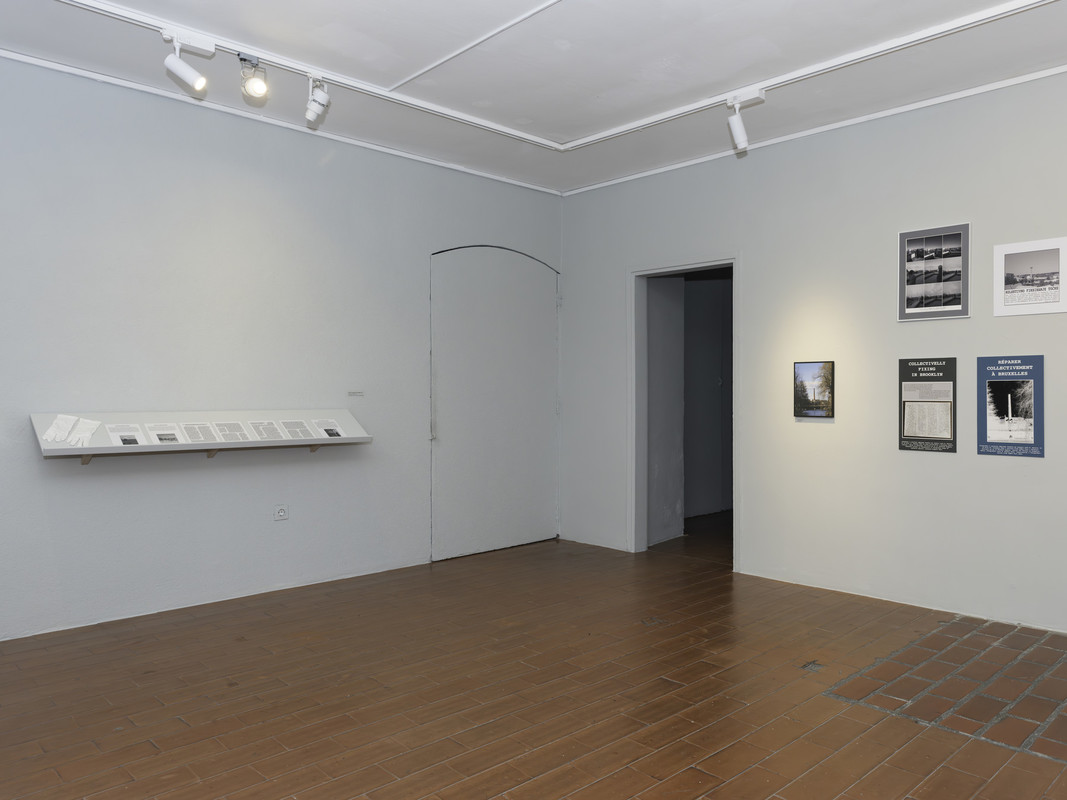
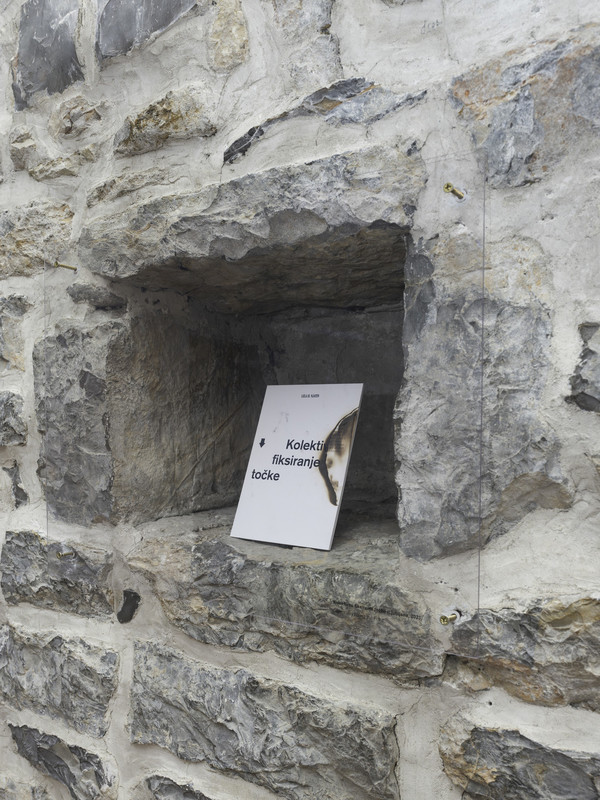
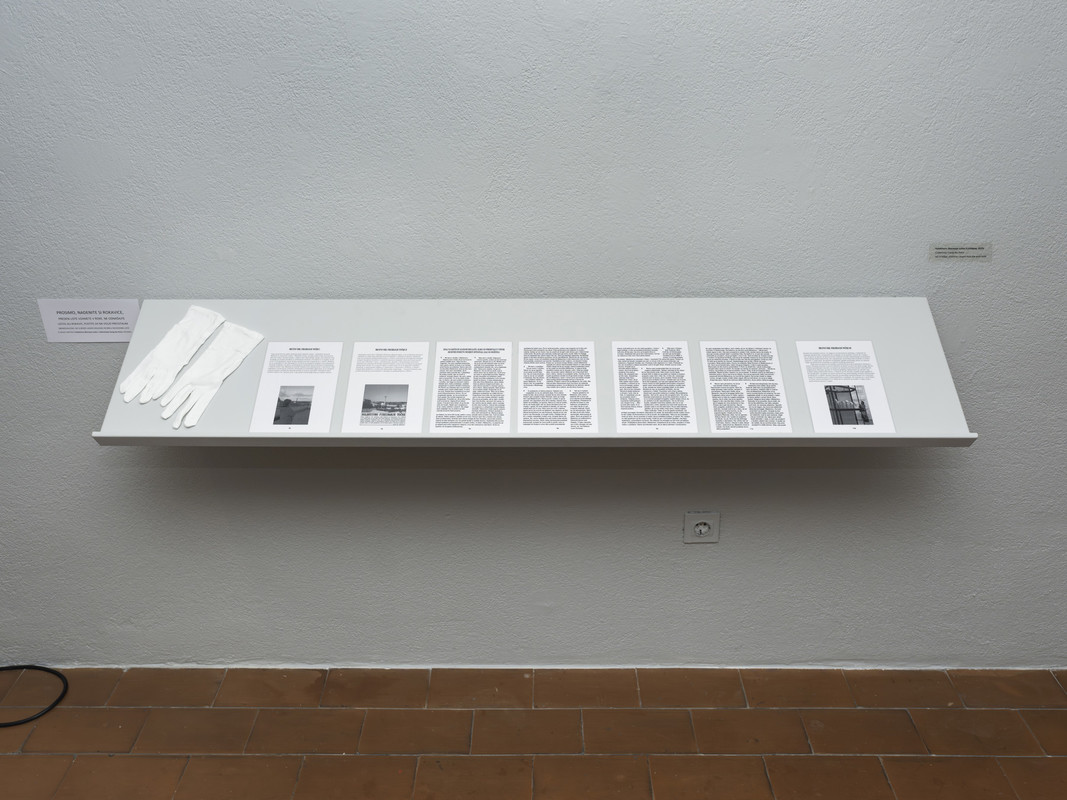
In a glazed niche to the right of the entrance to the first gallery room, visitors can see one of the 37 numbered copies of the artist’s bilingual book Collectively Fixing the Point (2023). Unique scorch marks are visible on each copy. Individual pages are displayed for visitors to read on a shelf on the opposite side of the gallery. The book consists of six chapters, most of which feature a single photograph.
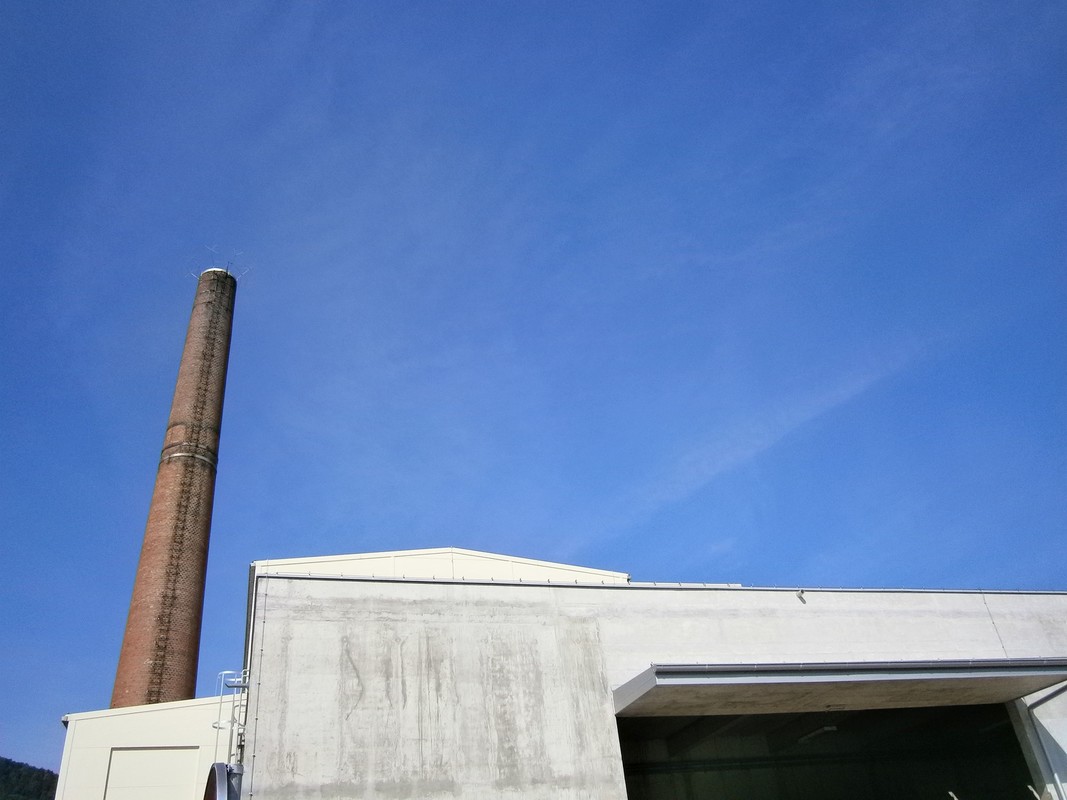
The first chapter places Lela B. Njatin’s work created over the past fifteen years in the broader context of her artistic practice. In 2010, she set up her own workspace in the apartment where she grew up. The apartment building in the centre of Kočevje known as “Samski blok”, roughly translated as the Singles’ Block of Flats (which is the main subject and setting of her book, The House of Solitude; 2020), is not only a space where she creates, but also a venue for artistic activities – one of the windows of her apartment often becomes a screen for communication with the local community, and the rooftop terrace a space for performances and artistic interventions. This year marks the beginning of a series of projects related to the town of Kočevje in which Lela B. Njatin explores “the collective imaginary” and highlights the “visual monuments” of the town’s (cultural) identity. Among these, the chimney of Melamin (the aforementioned chemical factory) – which was the highest point of Kočevje’s urban landscape for decades – to which the artist dedicated her exhibition titled Town Peak (2019, Kočevje), takes centre stage. The title is also the name of the highest peak in the area surrounding Kočevje. Both landmarks, natural and urban, are visible from the rooftop terrace of the building that houses her studio, and in the works related to them, the artist explores the relationship between natural and urban, personal and collective views.
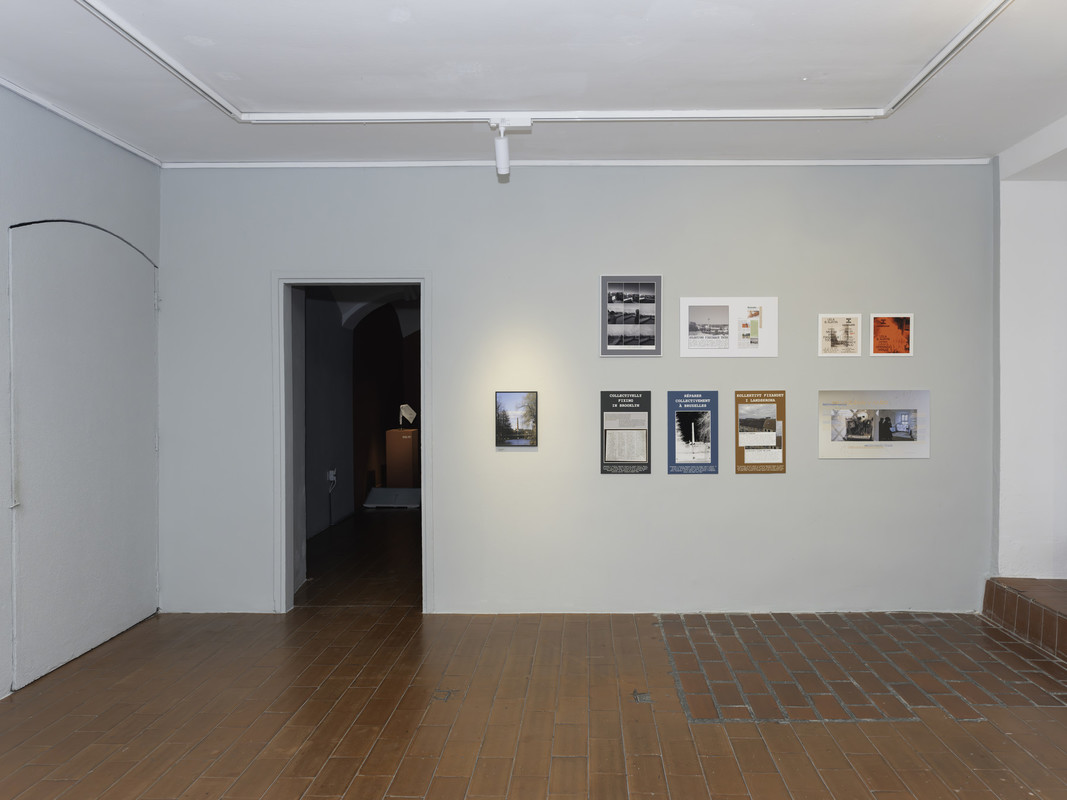
On the wall opposite the entrance, visitors can see the documentary and artistic materials from Lela B. Njatin’s past exhibitions and projects (Exhibition History). A common subject depicted on the printed materials and posters is the chimney of the Melamin factory, including in the photograph titled Centenarian (2019). The title of this photograph refers to how old the chimney was when the decision was made to demolish it. The wall connects the artist book with past exhibitions, performances and project implementations in 2024 and 2025, including in an international context (Brooklyn, Brussels, Landskrona).
In Lela B. Njatin’s book, the chapter Town Peak. Collectively Fixing the Point I presents the identically-titled project from 2014. On the roof of the building that houses her studio, the artist created an artistic situation and invited 21 local inhabitants to share their experiences of life with the Melamin factory. Among other things, this resulted in photographic portraits of the participants with the chimney in the frame. In 2016, she expanded this gesture into public space by placing an advert in Kočevska, a free local newspaper, inviting the inhabitants of Kočevje to collectively “fix” their gaze on a point above the chimney, marked with a cross. She titled the project Town Peak. Collectively Fixing the Point II, thus consciously linking it to Milenko Matanović’s work Collectively Fixing the Point from the early 1970s. The artist strives to establish Kočevje as a space for avant-garde artistic practices. Her connection to the OHO group is rooted in a personal and formative context – in the period when she was living in Kočevje as a teenager and was just started out her artistic journey.
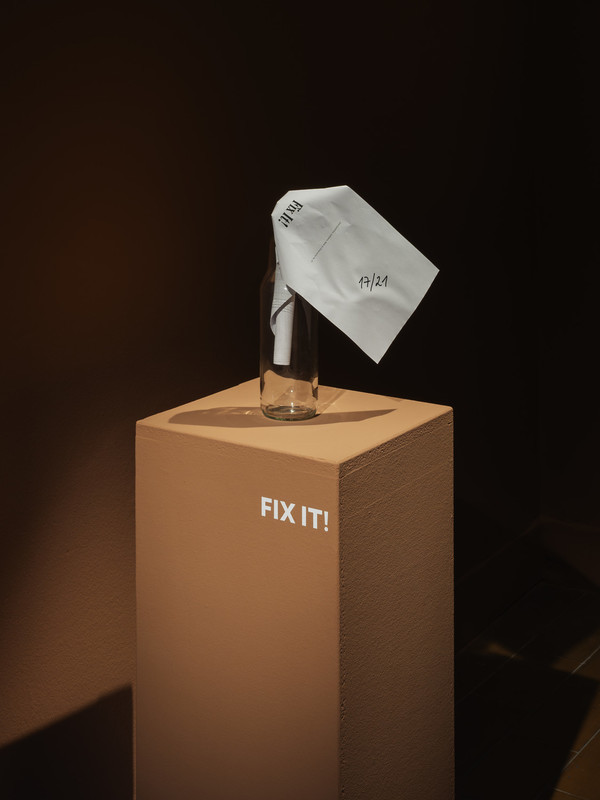
The largest part of the book is devoted to the testimonies of Kočevje’s inhabitants following the fatal industrial accident in May 2022. In addition to describing the accident itself, Lela B. Njatin highlights the resulting distrust and the emergence of civil initiatives aimed at closing down or transforming the factory’s operations. Anonymous statements by the local residents, collected in the first ten post-accident days, testify to personal experiences, fears and changes in the perception of their environment, while also revealing a temporary yet intense form of community bonds that are often established in times of crisis. These statements were first presented monumentally in Ljubljana’s GalerijaGallery as part of the exhibition Town Peak. Collectively Fixing the Point III (2023), curated and designed by Vasja Cenčič. They were displayed in dialogue with the newly created Fix It! objects.[1]
As pointed out by Lela B. Njatin, the project was started in response to a direct initiative of the local community – in response to the appeals that her fellow local inhabitants had started making immediately after the explosion. They shared their experiences with her. In individual cases, they asked her to respond to the event as part of her artistic creations. In fact, for many years, her artistic practice has included collaboration with the community and projects related to the Melamin factory.
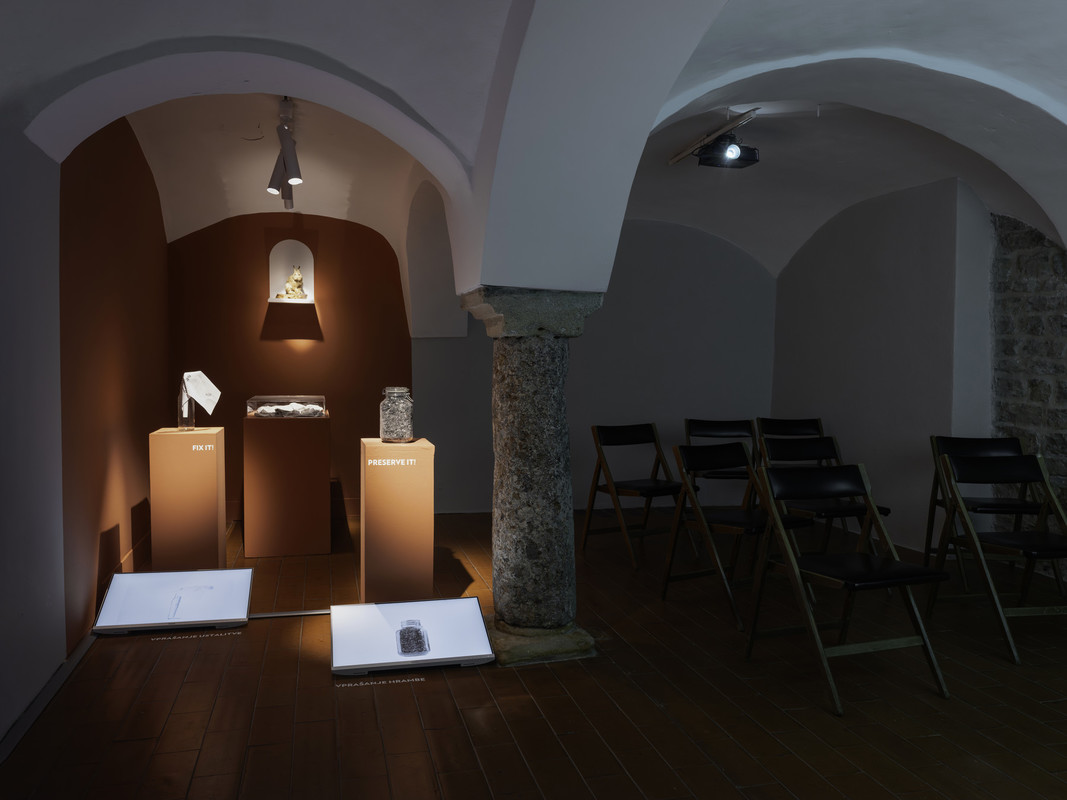
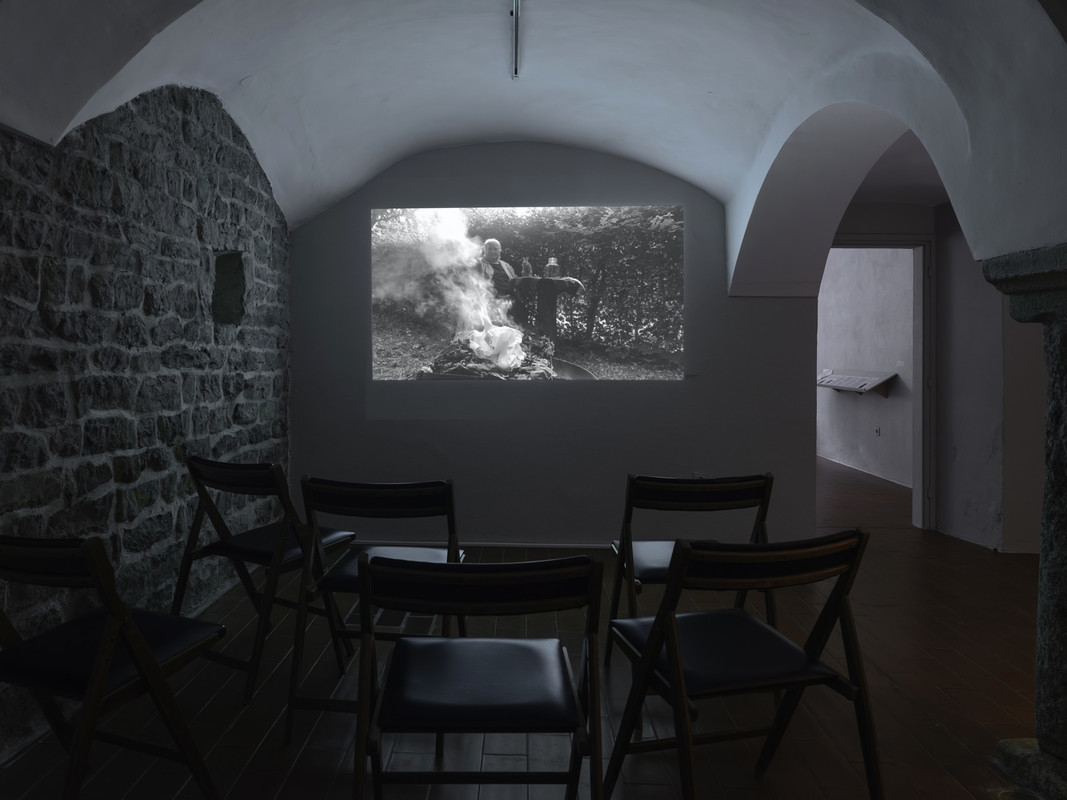
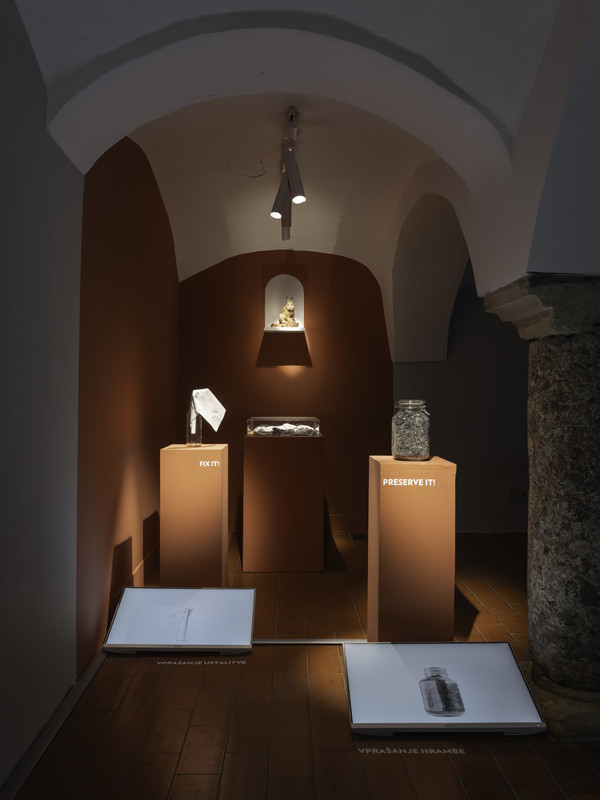
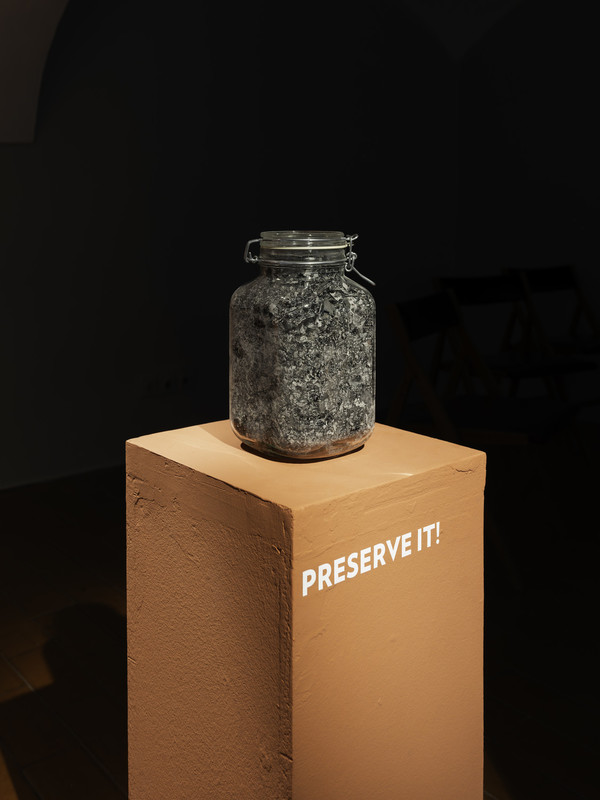
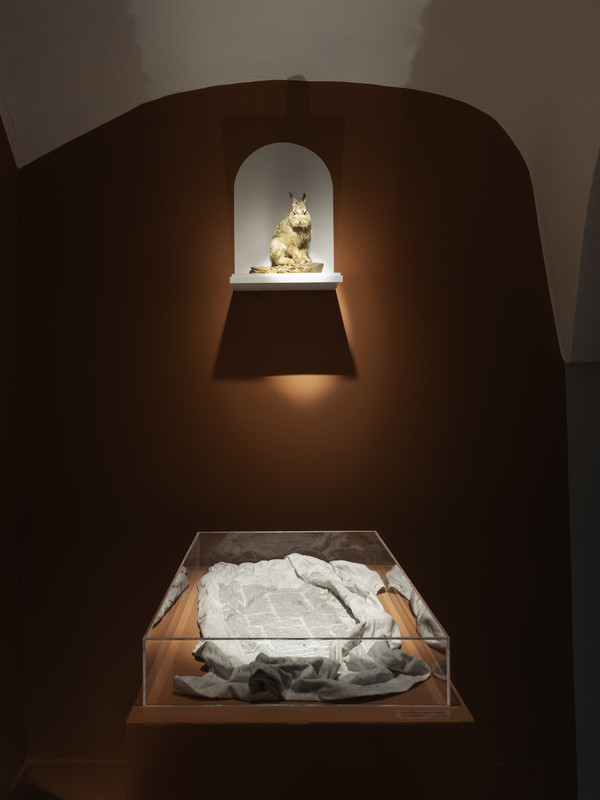
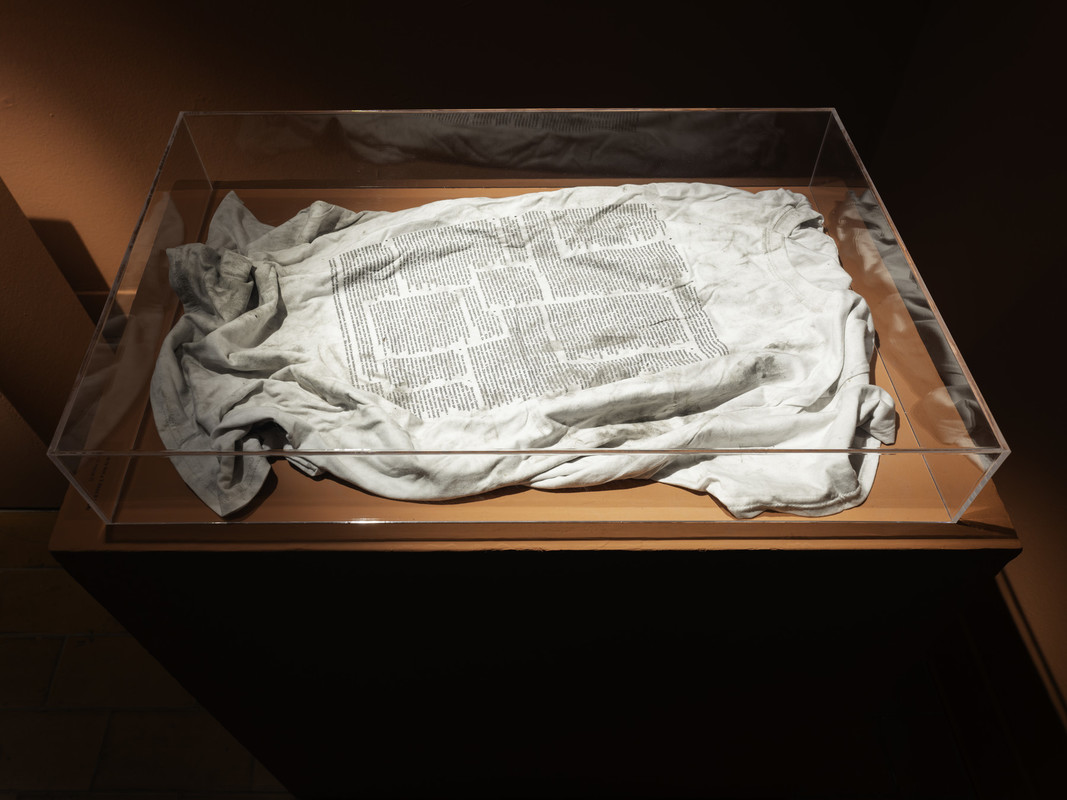
The second room of the exhibition venue presents objects and videos from Lela B. Njatin’s performance Washed in Fire (2024), as well as the aforementioned multiple Fix it! (2023). The multiple consists of a bottle containing rolled-up paper with statements and matches. On the pedestal next to it is the object Preserve It! (2024), a jar that contains hermetically stored ashes of the burned statements shared by Kočevje’s inhabitants. At the foot of the pedestals that hold the glass objects, two short videos titled The Question of Settling Down (2025) and The Question of Well Keeping (2025), which show the artefacts, are played. On view on the largest pedestal is a white T-shirt titled This Is Not a T-Shirt II (2024) with printed statements. As part of the performance, the artist had used it to collect the very last remains of ashes after burning the printed papers from the exhibition at GalerijaGallery. Above this group of works, a rabbit is placed on a shelf; this rabbit appears in the performance as a silent spectator and metaphorical figure – “a representative of the universal essence of art.” The process of burning the statements is documented in the video Washed in Fire (Remnant) (2025), the central work on view in the exhibition space, which highlights the transformation of statements from testimonies into artistic material.
In the exhibited projects, collectivity is established as one of the central thematic axes – as a process that can be revealed, shaped or encouraged by art. From bringing individuals together through sharing the experience of living with the chimney (2014) and the joint act of fixing the gaze (2016) to the response to the industrial accident in 2022, when the local inhabitants’ statements become artistic material and the voice of the community within the art world.
The collective dimension of Lela B. Njatin’s practice is not only reflected in the relationship with the local community, but also in collaborations within the art system – in the relationships between artists, curators and exhibition venues.[2] One such example is the collaboration of the GalerijaGallery’s team, who were involved in the creation of ashes as a material for further artistic creations. As part this process, art becomes a means of preserving and materialising memory.
The exhibition 73 Km from Kočevje explores the transition of individual testimonies into a shared space of memory through the artistic process. With an emphasis on processuality, repetition and transformation of materials, it raises questions about the proximity of the industrial environment and its fragility, as well as the role art plays in archiving experiences and memories. The exhibition is structured as a sequence of fragments that are connected to one another in terms of content and material, making up a whole stretched between the first and second gallery rooms.
Lela B. Njatin
Lela B. Njatin (1963) is a visual artist, writer, translator and philosopher. Her artistic practice is based on neo-avant-garde and conceptual premises, encompassing performance art, artistic actions and situations, interventions in public space, photography, video, objects, installations and process-based (participatory) projects. In the 1970s, she was part of the groups Westeast and Maj 75, focusing mainly on visual and concrete poetry.
She first showcased her work as part of the group exhibition Dasevididasenekidela (“SoThatOneCanSeeThatWorkIsBeingDone”; 1980, Art Salon, Kočevje). Later, she participated in numerous group exhibitions, such as Returning the Gaze (2022, Cukrarna, Ljubljana) and For Your Pleasure. Feminist Positions in Visual Art in and from Slovenia (2023–2024, Museum of Modern Art, Ljubljana). Her solo exhibitions included I Did Not Want to See but I Have Since Come to See
(2013, Match Gallery, Ljubljana), Subversive Body. Conceptual Works 1977–2015 (2015, Museum of Contemporary Art, Zagreb), Because We Are Not Just Images, We Are the People (2019/2020, Miklova Hiša Gallery, Ribnica; Pilon Gallery, Ajdovščina), Anatomy of Local History (2020, P74 Gallery, Ljubljana) and Town Peak. Collectively Fixing the Point III (2023, GalerijaGallery, Ljubljana). For her visual art, she has received the Deklica s Piščalko Award (2016) for
internationally comparable achievements in the Kočevje area and the Ivana Kobilca Distinction for current art production (2025).
She has authored the novels Nestrpnost (“Intolerance”; 1988) and Samski blok (“House of Solitude”; 2020) and several children’s books – Velikanovo srce (“A Giant’s Heart”;1996), Zakaj je babica jezna (“Why Is Grandma Angry”; 2011), Smer srca (“Heart’s Direction”; 2022), Zmaga! Ali kako so lisica, volk in medved pometli z nesnago (“Victory! AKA How a Fox, a Wolf and a Bear Dealt with Filth”; 2023). She writes and publishes articles in the
fields of humanities, literature and culture. She lives in Ljubljana and works in her studio in Kočevje.
[1] Made in China is an art project by GalerijaGallery (Viktor Bernik, Žiga Kariž and Jara Vogrič) and also a brand. The project produces multiples, i.e. limited edition artworks, created by most prominent Slovenian artists, as well as artists from other countries. More information: https://www.galerijagallery.com/en/made-in-china
[2] The following individuals collaborated on specific projects and the production of the exhibited works: Srečko Bajda, Viktor Bernik, Conny Blom, Vasja Cenčič, Marko Damiš, Thibaut Espiau, Ištvan Išt Huzjan, Žiga Kariž, Arven Šakti Kralj, Grégoire Motte, Sara Rman, Johannah Rodgers, Nina Slejko Blom, Jara Vogrič, Matjaž Weiss and Matic Zorman.