Oliver Pilić: Shadows Without Bodies, Images Without Authors
Ivan Grohar Gallery
1 April – 17 May 2026
Curator: Kristina Ferk
Oliver Pilić’s artistic production revolves around transformation of images, mostly cut from newspapers, magazines and other periodicals. He systematically collects and reinterprets these visual materials, using them to comment on social and geopolitical reality.
The exhibition features woodcuts, screen prints and printmaking matrices. The negatives of these matrices mirror the images of seven prints, while also revealing the lengthy, dedicated and painstaking process behind the shaping of the wooden board. In addition, this process reflects the artist’s work attitude – a counterbalance to a system driven by instant everything, the pressure of instantaneous action and hyperproduction.
Moreover, the exhibition – Pilić’s debut presentation in Škofja Loka – invites reflection on both the town itself and the gallery’s internal architectural features. Brick walls and wall niches can serve as a spatial echo of the compositional elements that make up Pilić’s artistic language: square matrix cutouts are mirrored in the wall niches and the relief matrix modelling in the hapticity of the brick surface.
The exhibition clearly establishes a connection to Škofja Loka with its opening piece, the screen print The Artist Is Not Present, which alludes to a photograph by Bojan Brecelj, created during the documentation of a performance by the IRWIN group. In this work, Pilić reinterprets both the “sower” subject and the entire series of depictions tied to the same place over time: from a photograph by Avgust Berthold and Grohar’s impressionistic painting The Sower to a performance and a photograph, and finally his own rendition. Rather than being based on a single underlying work, this work is anchored in the history of this artistic subject, including its repetition, transmission, transformation and reception, with Škofja Loka being established as a place that this subject consistently returns to. The work’s meaning is further shaped by the title The Artist is Not Present, which raises questions of authorship, depiction and appropriation, as well as broader art-historical and ideological contexts. Pilić simultaneously evokes and interrupts this history; rather than re-depicting the figures in the Škofja Loka Plain, he offers their absence that lingers only in the shadows of the obliterated characters. Since the sower is far from a neutral subject in Slovenian art, the artist’s gesture can also be interpreted both as a subtle exploration of the symbolic images underpinning collective identity and a commentary on the technologized presence and mass production of visual content. Although the title paradoxically claims that the artist is absent, the fact that the work exists accurately captures the state of modern man, whose presence is increasingly often displaced by systems, algorithms and artificial intelligence.
One of the pieces that show how deeply Pilić’s works are rooted in the existing visual tradition is Self-Portrait (Mask). As a counterpoint to the screen print The Artist Is Not Present in both meaning and form, in this woodcut the question of the author’s presence shifts to a different direction. Alluding to prints by Miha Maleš, this work uses image layering to subtly reveal the artist’s self-portrait in the adopted “mask” motif. The connection to Maleš’s prints extends beyond iconography, revealing biographical and artistic parallels between the two artists. Both of them started out in the wider Kamnik area and received painting and printmaking education in Ljubljana and Zagreb. The white mask signifies a conscious decision to move away from direct self-depictions. Pilić’s self-presentation is barely perceptible, further highlighting the ambivalence of presence. Precisely for this reason, the work raises the question of self-presentation in today’s world dominated by the mass culture of digital identities and the constant maintenance of one’s public perception. Thus, the mask – a traditional symbol of concealment – can serve as a visual metaphor for modern-day profiles, where identity is curated and tailored for the gaze of others.
The work Field of Light is Pilić’s third transformation of an original photographic source. During scanning at the start of the process, the artist manipulates the image by physically slowing it down, causing it to stretch. He then transfers the stretched image as a drawing onto the matrix, transforming it into a graphic print. This process distorts the original motif, leaving the image in a state of optical and semantic uncertainty, which is extended both temporally and physically as the print itself. In this instance, the work is structured as a dotted raster, created through the overlay of two basic printing colours: magenta and yellow. While alluding to the field/landscape in the work The Artist Is Not Present, the title of this work, Field of Light, also associates light with a realm of truth, authenticity and revelation. At the same time, the subject of sowing is almost imperceptibly translated into the visual printmaking language and scattered dots of colour.
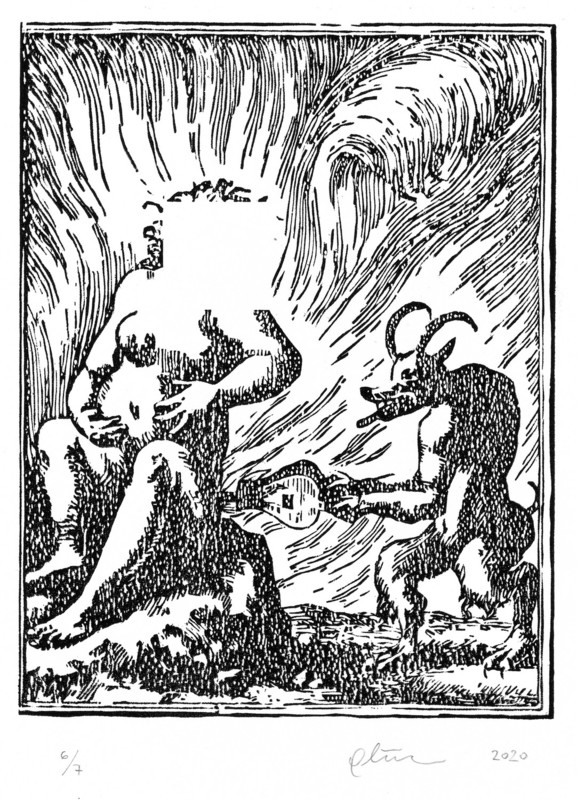
The series of prints titled Seven Sins marks a distinct departure from the images that Pilić typically cuts from newspapers and other printed materials. Like his other work, however, this series is firmly rooted in his continuous practice of reinterpreting images. For example, in 2020, Pilić created prints that are based on Andrej Trost’s copperplate engravings from Johann Weikhard von Valvasor’s seventh and final book, The Scene of Human Death in Three Parts (Theatrum mortis humanae tripartitum). Part Three of this late-17th century moral didactic work explores the torments endured by a Christian sinner in hell, drawing on a long tradition of torture depictions in medieval art. From the thirty-one copperplate engravings accompanying allegorical-moralistic verses, Pilić selected seven scenes that illustrate the cardinal sins and their corresponding punishments within the Christian tradition. However, the artist’s exploration lies outside theological teachings without delving into the Christian moralising context. He censors the sinner’s depiction by physically manipulating the matrix. Erasing the sinner with a square cutout, he alters both the original scene and its intended message. Without the sinner, the punishments of hell lose their subject and are stripped of their didactic function. In the absence of a clear carrier, the scene of punishment is moved from the realm of a historical moral allegory into one of contemporary ethical ambiguity, where responsibility is often diffused. This raises the question of how taking responsibility is perceived in the modern world and how vices and their opposing virtues are manifested today. If virtues have partly retreated from the field of ethical orientation into the private, psychological realm, shifting from conduct to discourse, principles have consequently been replaced by points of view. Yet, how much weight does discourse carry, given it is less verifiable compared to tangible actions? Perhaps this exposes the paradox of modern morality, where moral rhetoric is often instrumentalized, and character and ethical principles are being relegated to secondary importance, with success, power and influence now serving as the measure of individuals’ worth. While virtues require duration, patience and gradual cultivation, modern society demands instantaneous action and immediate responses, leaving little room for thoughtful reflection. Is there still a place for moral virtues in a social climate driven by constant efficiency and value creation, where success often validates credibility? Resistance may well be the central virtue of our time, an era where social power, capital and influence often thrive precisely in the absence of ethical principles. In this his day and age, practicing resistance and refusing to fully succumb to the demands of the system may be the path to empowerment, to understanding societal mechanisms, to persisting in focus and restraint, and to rejecting the pace of life dictated by modern society.
Oliver Pilić’s exhibition prompts reflection on the origin, circulation and mass production of images, while consciously defying “the era of instant everything”. The artist remains devoted to the slow, physically challenging artmaking process that takes time, precision and perseverance. His works, in both process of creation and message, offer a critical stance towards the world, unyielding to social and systemic pressures.
Oliver Pilić
Oliver Pilić (1978, Ljubljana), holds a BA in visual arts and specialises in contemporary printmaking with a focus on woodcuts, drawings, installations and photography. Following his studies at the Academy of Fine Arts in Zagreb and the Academy of Visual Arts (AVA) in Ljubljana, he has presented his work at numerous exhibitions both in Slovenia and abroad, receiving several coveted printmaking awards. His artistic practice focuses on the exploration of visual structures, image transformation and experimentation across various contemporary art media. His work features in numerous public and private collections.