
Sunday Labour and Larking Are a Path to Perdition
The Sunday Christ Fresco in Crngrob
The Sunday Christ art subject – historical background
Profound demographic, economic and social changes in the late Middle Ages (14th–15th centuries) triggered a profound crisis of values across Europe. Periods of famine, plague and economic crisis reduced the population by a third. As peasants in Western Europe started resisting feudal exploitation, the bourgeoisie in towns demanded a monopoly on trade and crafts (guilds), and grew increasingly strong. The Sunday Christ depictions thus emerged during a time of collective societal trauma, which manifested itself in various ways, from extreme debauchery to a profound religious devotion. As a subject of art, the Sunday Christ most likely originated within a monastic setting, before spreading to rural areas. The largest number of Sunday Christ depictions is preserved across the Alpine region, southern Great Britain, central Italy, the Czech Republic and even along the Baltic coast.
Depictions of the Sunday Christ served as a reminder to honour ecclesiastic regulations mandating rest on Sundays and feast days. The majority of these depictions are found in rural areas, commissioned by village communities or their representatives. In the late Middle Ages, initiatives to deepen religious life came not only from the clergy, but also from ordinary people. Communities contributed money for the construction of churches and rectories, while also taking care of the equipment, furnishings and artwork in religious spaces. During the Counter-Reformation, the Sunday Christ was discouraged as a subject in art, as it was deemed too ambiguous and prone to misinterpretation by believers. It was banned by the Council of Trent’s decree in 1563.
Among the ten documented Sunday Christs depictions in Slovenia, the fresco in Crngrob stands out as the most meaningful and expressive in both content and form.
The Sunday Christ Fresco in Crngrob
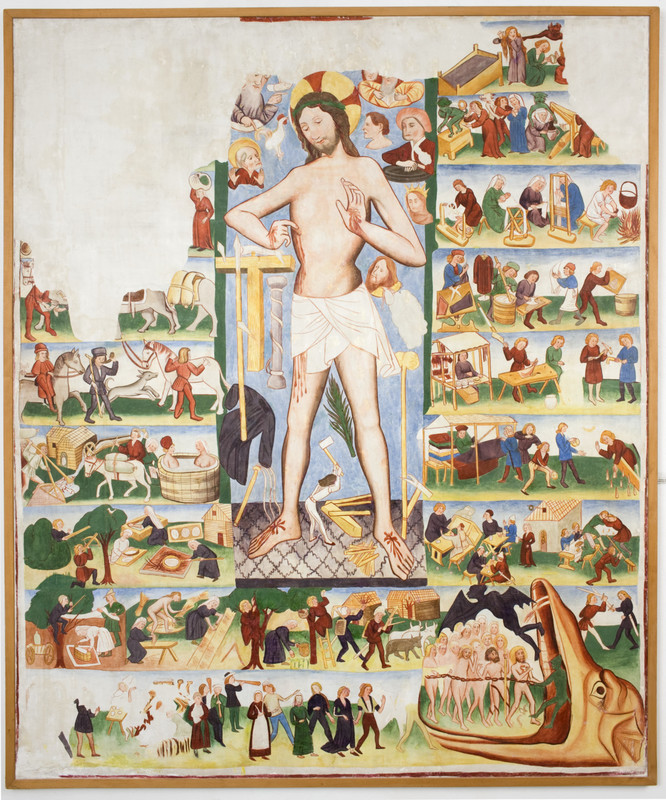
This fresco with moral and educational imagery presents Jesus Christ as a Man of Sorrows, surrounded by genre scenes of people doing various chores. Christ is surrounded by fifty scenes painted on nine horizontal strips, mainly depicting the life of the bourgeoisie and to a lesser extent the nobility and the rural population. The bottom right corner features a depiction of a yawning hell mouth, where the devil is dragging shackled sinners committed to eternal damnation.
The depicted scenes are based on various widely recognised religious and secular sources, including manuscripts, prints and calendars, allowing believers to easily identify with them. Certain scenes – specifically the flax processing and the depictions of local tradespeople, i.e. tailors, shoemakers, and furriers – were presumably painted at the request of the alleged client, as these trades formed their own guilds during that time.
Man of Sorrows
The iconographic Sunday Christ type is based on the Man of Sorrows (Imago Pietatis), which became widely established throughout European art in the Middle Ages. This is a depiction of the tortured and crucified Christ with visible traces of wounds, to which he draws the viewers’ attention with an intentional gesture. The emphasis is on his suffering and his role as a redeemer. Portrayed as the Son of God and the second person of the Trinity, Christ sacrifices his life for the salvation of humanity in obedience to God the Father. The Instruments of the Passion (Arma Christi) are typically depicted next to the suffering Christ: the cross, nails, crown of thorns, whip and spear.
In the central rectangular field of the Crngrob fresco, a full-length figure of Christ is depicted standing girded only with a white cloth. With his right hand he is reaching towards a bleeding wound on his chest, while the traces of the crucifixion are visible on his hands and feet. His head is surrounded by a red-yellow halo, attesting to his divine nature.
The traditional array of Arma Christi is expanded with busts of the figures linked to the Christ’s arrest, interrogation and condemnation
- (1) Peter the Apostle, who denied Christ three times, symbolised by the rooster depicted next to him;
- (2) High Priest Caiaphas, who tears his robe in righteous indignation;
- (3) High Priest Annas, who spits on Christ; Caiaphas and Annas are associated with the trial at which Jesus was charged with blasphemy.
- (4) the Roman governor of Judea, Pontius Pilate, depicted washing his hands as a gesture of absolving himself of responsibility;
- (5) Pilate’s wife, who warned her husband against an unjust judgment;
- (6) Judas the Apostle with a rope around his neck, hinting at a suicide after his betrayal of Jesus;
- (7) God the Father, pointing towards the Son, emphasising that Christ’s suffering is part of God’s plan of salvation.
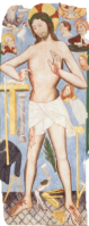
The scene of a man chopping wood directly relates to the Sunday Christ motif, illustrating how every act of Sunday labour was believed to symbolically inflict fresh wounds upon the suffering Christ.
Secular Scenes
What is the meaning behind the secular scenes on the Sunday Christ fresco in Crngrob and how do they reflect life in the Škofja Loka area?
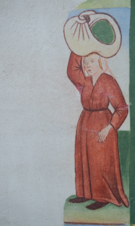
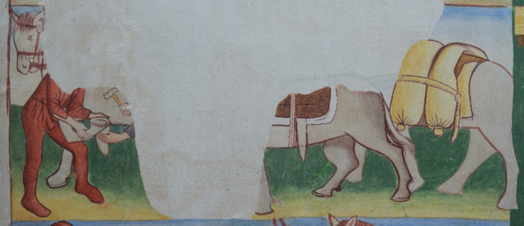
Transport scene. A woman is carrying a linen-wrapped load on top of her head. A blacksmith is shoeing a horse; two other horses are standing behind him, the last one is loaded with sacks tied to the saddle.
One of the most important medieval routes in the Slovenian territory, the so-called Škofja Loka-Tolmin Road, crossed the Škofja Loka area back in the day. It ran through the Poljane and Selca Valleys, connecting a large part of this territory (the Upper Carniola and Styria regions) with the coastal towns and Italy (Cividale del Friuli, Trieste, Koper, Piran). The road used animal- and human-powered transport, and was thus suitable only for walking, as well as carrying and transporting loads with horses. Near Gorenja vas, there was another road leading from Škofja Loka via Lučine towards Vrhnika and Pivka, where it turned towards Rijeka.
In the 15th century, the blacksmithing and nail-making trades thrived in the Škofja Loka area (Železniki, Škofja Loka). The bulk of the production included nails, as well as horseshoes, bar iron for nail making, iron pipes for guns, ploughshares, window and door fittings, and harrow teeth. Between 1437 and 1460, these products were available for sale in Rijeka, sold by 46 merchants from Škofja Loka, a few from the Selca Valley and seven from the Železniki area.
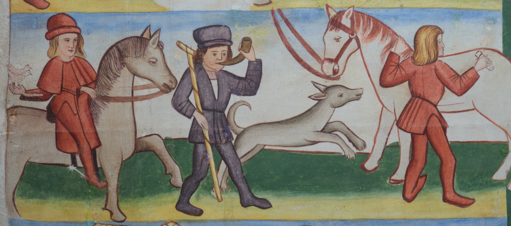
The hunting scene depicts two medieval hunting methods: hunting by means of birds of prey (falcons, sparrowhawks, hawks), which is depicted through a nobleman riding a horse, with two birds of prey sitting on his hand, and hunting by means of beaters, which is depicted with a beater that has a stick in one hand and a horn in the other; he is blowing the horn and there is a hunting dog by his side. On foot and with the help of hunting dogs and horns, the beaters loudly drove the game towards the waiting hunters, who fired at the animals. The scene ends with a man cleaning a horse.
In the Škofja Loka seigniory, the right to hunt and fish was enjoyed by the feudal lord – the Bishop of Freising, who then granted the hunting and fishing right to the estate steward and to the hunting master, whom he appointed himself. The hunting master had subordinates, i.e. hunters from the ranks of the serfs, who did the hunting job as a feudal duty, corvée. Some of them were from the village of Žabnica, and the majority from the village of Pevno near Crngrob. All the serfs from this village held this particular job and the village was therefore also known as Jägerndorf – Hunters’ Village.
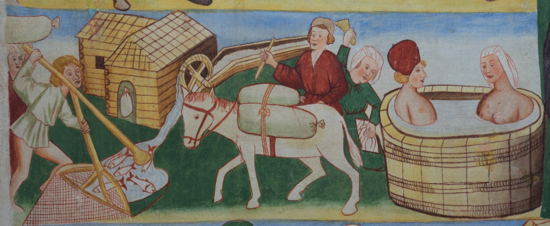
The scene shows various water-related activities. There is a wooden mill with a water wheel at the back; to its left, a woman has a sack of grain on top of her head, carrying it to the mill, and a fisherman is driving fish into his net with a club. To the right of the mill, a man on a mule is delivering grain to the mill, and behind him, there is a woman washing clothes and two naked bathers in a tub.
The oldest mills in the Škofja Loka area were owned by the feudal lord, who rented them out in return for payments in kind or money. By the mid-14th century, milling was already very widespread in the rural area. There were two types of mills: trade-operated mills and household mills.
In the Škofja Loka area, control over fishing and the right to fish was held by the seigniory’s steward. In the waters around Škofja Loka, the fishing right was additionally enjoyed by the granary attendants and the burghers; the right to do net fishing was given to the ironworkers from Železniki as well as the clergy in both valleys. Some serfs were obliged to do the fishing job and stock the castle kitchen with fresh fish.
The naked man and woman in the tub represent the affluent part of the population, who favoured wooden bathtubs for washing.
The earliest mention of public baths in Škofja Loka goes back to 1318. The baths employed a barber-surgeon.
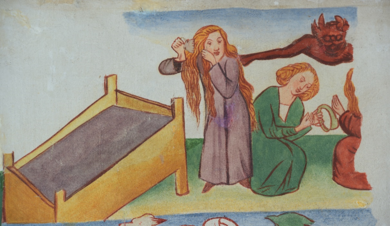
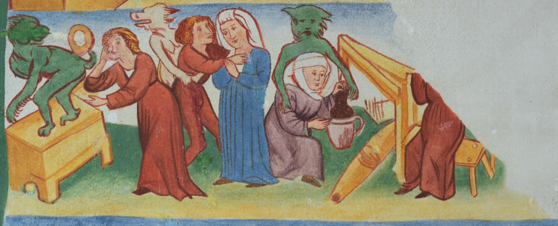
A plank bed and a chest
The Sunday Christ fresco depicts a simple plank bed and a chest, representing the first known depiction of such furniture in the territory of present-day Slovenia.
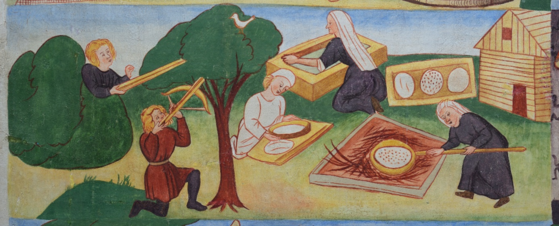
Bird hunting, bread baking
Two men are hunting a bird: one is aiming with a crossbow, while the other is preparing a bird lime twig as a trap. In the past, people hunted mostly crows and jays for sustenance, relying on horsehair snares and bird lime twigs. They lured birds by imitating bird calls.
A bread-making scene is depicted in front of a wooden log house. One of the three women is sifting flour, the second one is kneading dough in a wooden kneading through with more dough rising on a wooden plank behind her, and the third one is putting risen dough onto the hearth with a wooden peel. The dough was covered with an earthenware dish and charcoal was placed over it.
It is unclear when wood-fired ovens were first used in the Škofja Loka area for bread baking, however, the first mention of a wood-fired oven dates back to the period between 1437 and 1438 in reference to the Tower on Krancelj, which stood on a hill above the present-day Škofja Loka Castle. The following year, such an oven was set up at the Old Castle at the foot of the Lubnik hill.
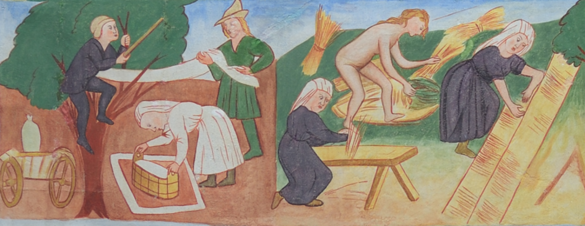
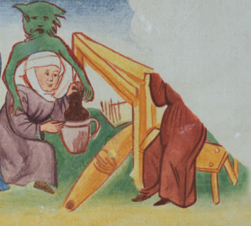
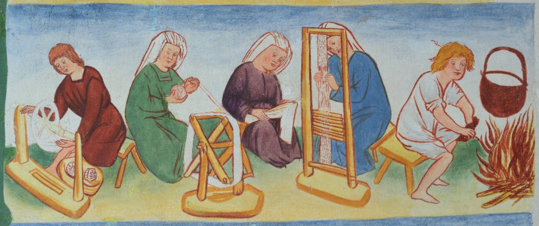
Flax-related chores and tools
On the far left, a man and a wife are bleaching linen. On sunny days, linen was spread out on a meadow, sprayed with water and turned over continuously. A naked man is plucking flax and sheafing it, while the seated woman is removing seed pods on a ripple. The woman on the right is spreading flax across the meadow, leaving it to weather in the sun and rain for two to three weeks, until the seed capsules detach from the stems.
Two tools are depicted on the damaged part of the fresco. The first tool is a flax brake, which was used to crush the outer layers of dried flax. The second tool, under the flax brake, is a hackle used for combing flax yarn.
These depictions feature flax-processing tools: a man is spinning thread on a spinning wheel, while a woman is using a reel to wind flax thread into a ball. Another woman is holding a skein. Next to her, a woman known as “the Crngrob linen weaver” is weaving threads wound on an upright stand.
In the Škofja Loka seigniory, linen weaving was an important export-oriented craft, both in the town of Škofja Loka and in the surrounding countryside. For instance, in 1437/38, the Bishop of Freising alone purchased a total of just over 273 metres of linen.
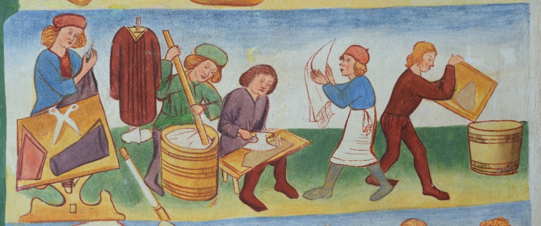
Garment-related trades – a tailor, two shoemakers, two furriers
A tailor is sewing at a large table with a finished coat hanging next to him. A shoemaker is standing next to the coat. Back then, shoemakers tanned their own leather, so he is depicted stirring a lime-soaked hide in a vat with a wooden stake to make the hair fall off. The fleshing tool lying next to the vat was used to remove the remains of flesh and fat from the flesh side of the hide. The man who is clad in a white apron, holding fur in his hands, is believed to be a furrier. The person next to him is transferring the hide from the wooden board – on which the hide was stretched – to the vat (fur tanning).
This scene shows the trades that were organised in guilds in Škofja Loka prior to 1460. Bishop John of Freising granted rights to the tailors’ guild on 21 October 1457, and to the shoemakers’ and furriers’ guilds on 26 December 1459. Even before that, shoemakers and furriers had been organised in their own ecclesiastic fraternities.
The most common holiday and feast day transgressions included gluttony, drunkenness, lust and trading. They were problematic not only because they were sinful in nature, but also because they drew attention away from Mass. Consequently, the ban also targeted Sunday and feast day fairs, as well as pubs that stayed open during Mass.
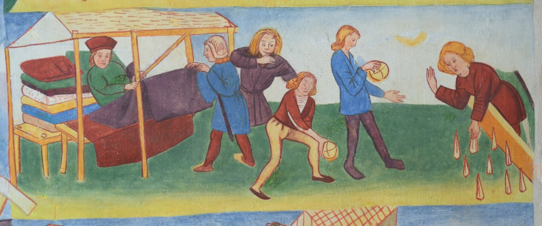
A fabric seller, nine-pin bowling
By the 15th century, linen production and trade were already flourishing in the Škofja Loka area. The main linen producers were farmers, who sold it at village and town fairs, as well as exchanged it for salt in coastal towns. In the Škofja Loka area, linen was also bought by foreign merchants, especially Friulians and Italians from Cividale del Friuli, Udine and Trieste. Part of the trade in linen was in the hands of professional town-based merchants, who exported it to Koper, Trieste and Rijeka, from where linen travelled onwards to Italy and Dalmatia. Surplus linen was sold to northern countries, among other places, for instance to Judenburg (Austria) and Freising (Germany).
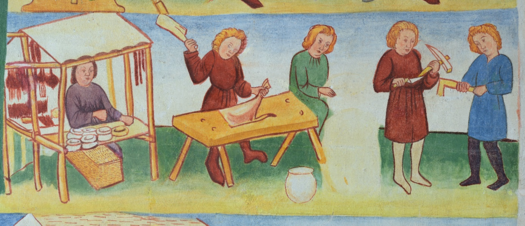
Two butchers, a stonemason and a bricklayer
A butcher is selling meat and meat products at a stall. To his right, another butcher is standing at a simple table, using a butcher’s axe to cut meat into cuts. Depicted on the right are a stonemason with a stonemason’s hammer and a bricklayer holding a square.
The presence of butcher shops in Škofja Loka is revealed in a document dating back to 1263. In the early 14th century, the town boasted seven butcher shops, all of which stood on the right bank of the Selška Sora. They were situated by the river as this allowed for the easy disposal of slaughterhouse waste directly into the water. As butchers were not organised in a guild, their work was supervised by the town council or the town judge. On St. George’s Day (23 April), they were required to pay certain dues to the feudal lord.
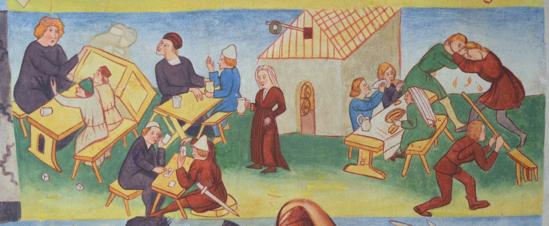
The inn scene
There is a wreath hanging above the inn’s entrance and barrels are visible inside. A waitress with a jug in her hand is standing in front of the inn. There are four tables in the inn’s garden. The patrons at the first table are gambling, the guests at the second table are watching the gamblers, the two men at the third table are playing cards, and the patrons at the fourth table are dining at a table covered with a white tablecloth and bread on top of it. There are two men brawling behind the house, and a third one is brandishing a stick.
Medieval inns were established within towns, along trade routes and in parochial centres. Records from the 1430s mention both town and countryside inns within the Škofja Loka seigniory. Inns typically consisted of at least two rooms: a living area and communal sleeping quarters with straw or lea-filled bags for travellers to sleep on. In addition, inns also featured large stables for horses. Patrons were typically offered wine, bread, cheese and sometimes meat, though inns in larger towns provided more refined amenities and services.
Court dancing
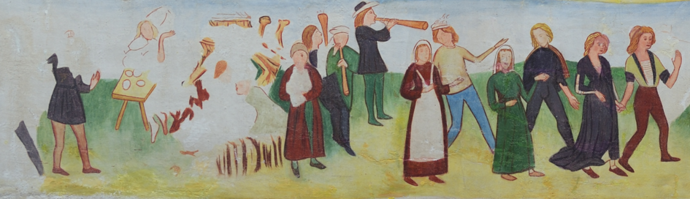
In the 14th century, a widening gap gradually emerged between the dances of the common people and the dances of the upper class, which became known as “court dances” in the 15th century. The preserved part of the fresco shows musicians and three dancing couples clad in ornate late medieval garments. The musicians and dancers are depicted right in front of the hell mouth, as music and dancing were considered rather sinful things.
A plundering or military attack
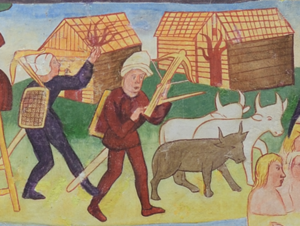
Two soldiers armed with a sabre, a crossbow and a shield are driving away cattle. Two of the three town houses, which are made of wooden logs, are on fire in the background.
A noteworthy piece of information is that in 1457 Škofja Loka was conquered and burned down by Jan Vitovec, commander of the Counts of Celje.
Violation of the third Commandment – Sunday as a Day of Rest
The medieval Church punished violations of the Sunday rest commandment with excommunication. This drastic measure was intended primarily for habitual offenders. A more common form of sanction was a fine, which was prescribed by some guilds, among others, for their members. Individuals who were unable pay the fine faced alternative forms of penance, such as public shaming, penal fasting or corporal punishment, e.g. flogging. According to medieval belief, the ultimate retribution was the denial of the eternal rest to those who failed to honour the Sunday rest.
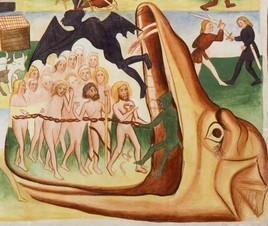
Depicted in the bottom right corner of the fresco, the hell mouth is a motif rooted in the Last Judgement iconography. The scene illustrates the punishment for sin. The devil is dragging chained naked sinners towards the hell mouth. The group is headed by a man who committed suicide. A demon with outstretched wings is hovering above the sinners’ heads.
The Fresco’s Authorship
Johannes de Laybaco, active between 1430 and 1460, was apprenticed to his father, Friedrich of Villach, a prominent regional fresco painter. Johannes worked with him on church frescoes in Carinthia, before establishing his own workshop and becoming a citizen of Ljubljana. His work adhered to the tradition of the late International Gothic’s soft style, which he adapted to suit the wants and needs of his local patrons in Carniola.
De Laybaco’s work must be viewed through the lens of medieval painting workshops. Wall frescoes were typically painted by itinerant artists from a wider area or local craftsmen, who joined up in small, often family-based workshops. Since they belonged to the same socio-cultural environment as their clients, they were well aware of the community’s expectations. They specialised in painting traditional religious subjects, employing established iconographic schemes adapted to each individual commission.
The Sunday Christ fresco in Crngrob was created in the workshop of Johannes de Laybaco, it was not, however, painted by the master himself.
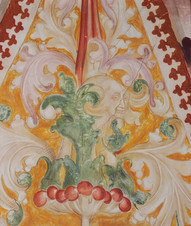
Ornamentation with a presumed self-portrait of Johannes de Laybaco, St. Peter’s Church, Kamni Vrh pri Ambrusa, 1459 (replica of the fresco: Marijan Tršar, 1964), National Gallery of Slovenia, Ljubljana.
Painting Technique
The Sunday Christ fresco was created using mixed media. The use of the fresco technique is evidenced by the preserved giornate (day’s work sections) and incisions in the plaster, indicating that the work was executed on a fresh, wet surface. The whitewash layer discovered beneath the paint layers proves that the artists used a lime painting technique, i.e. rather than applying pigments directly on fresh plaster – as is done in buon (true) frescoes – they painted on fresh lime whitewash applied to a dry surface. The pigments were mixed with milk of lime to ensure better adhesion to the surface; as a result, the colours took on a slightly whitish hue. Such frescoes were less durable than buon frescoes and the final details were likely added on a dry surface.
The colour palette in medieval wall frescoes was limited to pigments resistant to moisture, light, and basic lime. The artists most commonly used naturally occurring earth pigments, widely available as early as prehistoric times (e.g. yellow and red ochres, green earth and brown umbers). They were obtained by crushing and washing coloured rocks. Mineral pigments were more expensive and therefore less common (e.g. azurite, malachite, lapis lazuli and cinnabar). Lime also served as a basic white paint. Painting on dry plaster allowed for a wider range of colours, however, such applications proved to be the least durable.
The fresco, uncovered in 1935 under the direction of Matej Sternen and France Stele, has since been exposed to the ravages of time and is currently undergoing conservation and restoration procedures to ensure its long-term preservation in accordance with contemporary conservation and restoration principles.
Significance
The Sunday Christ fresco serves as a one-of-a-kind visual document of its era. Why was it painted directly in front of the entrance to the pilgrimage Church of the Annunciation in Crngrob?
The church was a major pilgrimage site even in the pre-1300 period. People travelled there on foot from nearby villages, market towns and towns. They would often turn to Mary, who was revered as the universal intercessor and protector of humanity during the Gothic period, with their prayers of intercession.
The fresco was painted during a period of economic prosperity, when the trade in ironwork and linen in the Škofja Loka seigniory was on the rise. Merchants from Škofja Loka were granted a trade monopoly and local tradesmen – tailors, shoemakers, furriers and, a few years later, blacksmiths – organised into formalised guilds with the approval of the feudal lord. With their newly acquired rights, merchants and tradesmen celebrated at least a hollow victory over peasant trade and crafts, however, it was never truly secured in practice.
Of the roughly 100 Sunday Christ frescoes known across Europe, the fresco in Crngrob is among those that are highly revealing in terms of content and formal expression.
Since 2024, experts have been conducting research, as well as conservation and restoration work on the fresco, with completion expected in 2026.