Tomaž Furlan: The Opposite of Consumption Is Creation
Workshop, discussion, video screening
Darağaç (Izmir, Turkey)
4 - 5 June 2026
The two-day workshop and discussion titled The Opposite of Consumption Is Creation, led by Tomaž Furlan, will address questions of labour, technology, and contemporary conditions of production within the field of art.
Darağaç is an artist collective and exhibition space based in the Umurbey neighbourhood of the Konak district in Izmir, Turkey. It was established as a self-organised community initiative bringing together artists in a former industrial area that today hosts numerous studios and workshops.
The programme will combine a presentation of the artist’s practice, discussions with participants, an open-format workshop, and a public conversation. The programme will also include a screening of Wear I–XVII (2005–2025), a video compilation produced for A Manual by Tomaž Furlan. Retrospective Exhibition 2005–2025 at the Loft Gallery of the Škofja Loka Museum.
Workshop:
– 4 June, 1 pm (introductory session)
– 5 June, 1 pm (workshop continuation)
Public closing event:
5 June, 6 pm (presentation and discussion)
The event is organised in collaboration with the Škofja Loka Museum, the Darağaç artist collective, and project collaborator Ezgi Ceren Kayırıcı.
More:
The Opposite of Spending Is Creating
The focus of the discussion is the position of creation in contemporary society and the question of what possibilities for artistic production still remain. The fact that technological progress is, to a certain extent, stagnating is difficult to perceive. Amid the flood of new technological effects, it becomes necessary to question their qualitative value. Beyond its appearance, does technology also transform its function? The constant influx of new tools that simplify the execution of tasks does not fundamentally change the tasks themselves. Technological progress primarily serves as an optimizer of work processes rather than as a genuine instrument of development.
Today, the artwork is in danger of becoming a transient piece of information whose purpose is the calibration of collective thought rather than its correction or creation. In consumerist terms, it functions as an ideal system of reproduction rather than production. As a medium, art can quickly become a tool of conservation instead of creation. The central question is whether creation establishes the foundations of a new paradigm or merely preserves the existing one.
The process of dismantling and reassembling already familiar concepts has become common; the artist is thus placed in the role of a producer of pre-existing content, materializing ideas through the capacities of production chains. This raises the question of who, in fact, dictates the image.
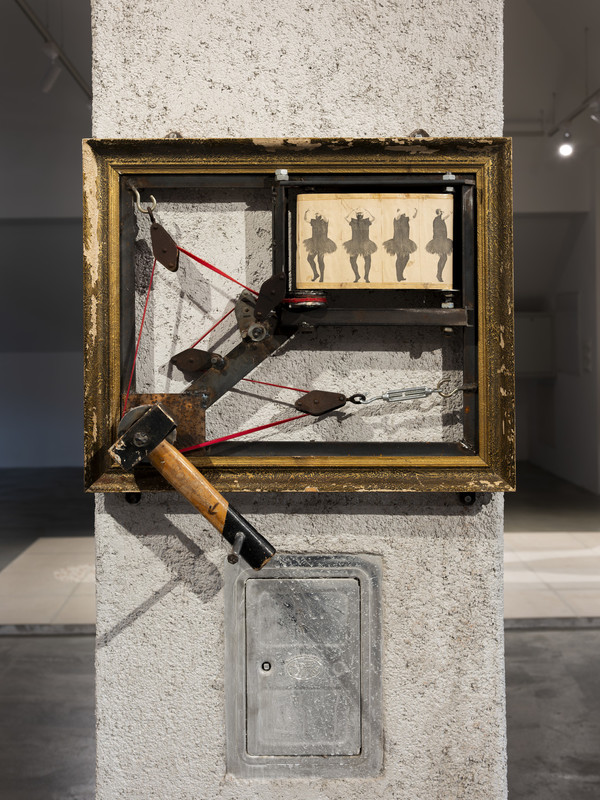
My creative practice is primarily based on a DIY technical approach to making. One could describe it as an outdated mode of production, involving the construction and maintenance of infrastructure, as well as continuous attention and sensitivity to forms, materials, and events. I consider the constant acquisition of skills — both conceptual and technical — to be essential. I understand creation as the establishment of an infrastructure for the materialization of thought.
Tomaž Furlan