
Tomo Savić Gecan: Untitled, 2026
7 October – 22 November 2026
Ivan Grohar Gallery
Curator: Saša Nabergoj
Technology and movement consultant: Ela Đimoti
Performers: Benjamin Grubar, Jernej Jocif, Nevenka Mandić, David Nez, Agata Pavlovec, Tamara Taskova, Bojan Trampuš, Zoja Žvanut
The time and location of the performance for the week ahead will be announced here every Monday.
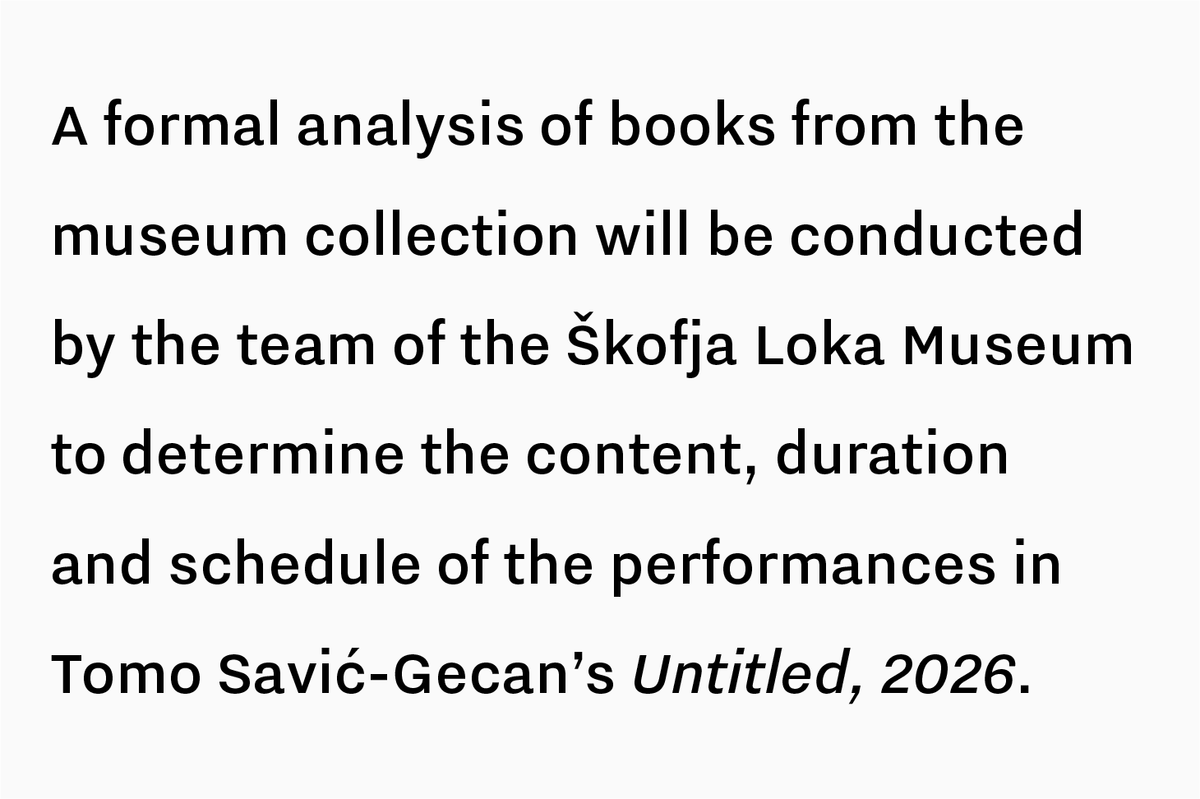
During the exhibition by Tomo Savić-Gecan, the Ivan Grohar Gallery remains empty, apart from a single sentence displayed on the main wall of the first gallery room. This empty state, which galleries typically experience only for brief periods between exhibitions, lasts for the full seven weeks of this exhibition. The sentence reads as follows: “A formal analysis of books from the museum collection will be conducted by the team of the Škofja Loka Museum to determine the content, duration and schedule of the performances in Tomo Savić-Gecan’s Untitled, 2026.”
Every week during the exhibition, a group performance takes place in one of the rooms of the Škofja Loka Museum at Škofja Loka Castle. Each performance is based on one of the old books from the museum’s collection, formally analysed by a historian and museum staff member without using a computer. The findings are then translated into instructions for the performers, specifying the space and duration of the performance, as well as individual movement elements, from how the performers enter the space and position themselves to where they direct their gaze. Within these parameters, the performers are free to make their own decisions. The formal characteristics of the book are thus directly translated into individual elements of the performance. The analysis also determines the exact time of the performance. The performers are given the timing and instructions only in the week of the performance, while the museum announces the time and exact location every Monday.
Untitled, 2026 continues Savić-Gecan’s project Untitled (Croatian Pavilion), 2022, created for the Croatian Pavilion at the 59th Venice Biennale. Each day, the main news story from a randomly selected global media outlet provided data for an AI algorithm, which determined the time, location and duration of the performance, along with individual movement elements for five female performers. As the Croatian Pavilion had no dedicated exhibition space, the work was performed each day in a different national pavilion, with the location published daily on the biennale’s website.
Developing the movement component of the work involved analysing visitors’ behaviour and, above all, their movements through museum and gallery spaces. Drawing on everyday movement has a long tradition in dance and performance art in the second half of the 20th century, when walking, simple everyday tasks and ordinary bodily movements became artistic material, and the boundary between art and everyday life became increasingly blurred.
Three years later, Untitled, 2025 was presented at Kula Gallery in Split without the use of artificial intelligence. The performer manually calculated where she should position herself in the space based on the temperature in Split, the presence of visitors, global emoji usage and the current number of aircraft in the air, and moved her desk and chair around the gallery accordingly.
For this exhibition in Škofja Loka, the field of data has been narrowed down even further. The daily stream of global news in Venice and the external data entering the gallery in Split have been reduced to a finite museum collection comprising around 2,300 items. This collection of old books, too, is the outcome of a long and ongoing process. It encompasses the Ivan and Franja Tavčar Library from Visoko Mansion, the Library of Barons Oblak-Wolkensperg from Puštal Castle near Škofja Loka, a collection of religious publications, and a collection of old monographs dating from 1800 to 1950. The two private libraries were acquired by the museum in their entirety. The collection of religious publications consists mostly of materials inherited from the Ursuline nuns, while the collection of old monographs has been assembled since the 1970s from deaccessioned holdings of closed down subsidiary primary schools, associations, and socio-political organisations in Škofja Loka and the wider area. In its present form, the collection combines various histories of ownership, collecting, classification and preservation.
For Untitled, 2026, one book is chosen each week. Its formal characteristics – the number of pages, dimensions, language, typeface and other data – are analysed, offering insight into the time and circumstances of its creation, as well as its later use, ownership and alterations. The data used by the museum to describe and classify the book are then translated into the movement of people around the museum.
For over thirty years, Tomo Savić-Gecan has been establishing unusual connections. By entering the exhibition venue of Untitled, 2001 in Utrecht, visitors caused the escalators in a Zagreb shopping centre to stop for a few moments. During the 2005 Venice Biennale, the number of people entering a gallery in Amsterdam affected the temperature of the water in a swimming pool in Tallinn. An event in one place triggers a minimal change somewhere else. The connection between the two is clearly defined, yet cannot be fully experienced. Where the change takes place, people generally do not know what caused it; where the work is presented, a sentence reveals only the bare essentials. The work is dispersed across places and people, each knowing or experiencing only a part of it.
People are always a crucial part of these systems. Their presence or actions can trigger a change elsewhere, or place them in conditions shaped by a distant event. Savić-Gecan often conceives his work as a kind of laboratory, bringing together different skills and leaving some decisions to the people who possess them. The performers are merely its most visible part. Behind the five performers in Venice, the one in Split and the eight in Škofja Loka is a much larger group of people involved in developing the system, analysing data, working with technology and movement, writing texts and instructions, and producing the work.
The people performing the work also differ in each iteration. In Venice, most of the performers were contemporary dance students; in Split, the performer needed a solid grounding in mathematics; for Škofja Loka, the artist sought a group of people that was as diverse as possible, representing different generations, professions and experiences. Here in particular, the way the group moves and organises itself in a shared space becomes especially apparent. The instructions specify part of their behaviour, while within them, relationships emerge that the system did not anticipate. From the very first rehearsals, the performers began forming certain formations, adjusting distances and responding to one another without any apparent or visible coordination. Consequently, the performance incorporates not only the instructions, but also the performers’ respective bodies, skills, habits and individual decisions, as well as the group dynamics that emerges in the course of the process.
Reduction is one of the most enduring features of Savić-Gecan’s work. His exhibitions are typically empty, the changes almost imperceptible, the art object absent, and all that remains of the work is a sentence. His artistic practice is rooted in one of the pivotal turning points in 20th-century art, when the artwork no longer had to be confined to a physical object. An idea, a process, the space and circumstances of the work’s presentation, the viewer and their actions could now all become part of the work. This shift also raised the question of what an artwork actually is and what shapes our experience of art.
Savić-Gecan radically reduces this openness. By removing what is usually recognised as an artwork, he strips the situation down to its core relationships. The people, institutions, technologies, information and decisions that shape it, and mostly remain beyond direct perception, become more visible. For a brief period, he connects these elements in such a way that they acquire concrete, yet minimal and sometimes almost absurd, consequences. The titles offer no further clue either: the works remain Untitled, defined mainly by their year of creation.
One of the few constants in Savić-Gecan’s work is the sentence that describes how the work unfolds as concisely as possible. It reveals what affects what and what change it produces. Its simplicity is the outcome of a long process: the artist may spend days refining the wording, testing different versions and removing words until only what is necessary remains. The works themselves are created in much the same way. Behind their minimal visible result lies work involving numerous people, data, agreements, technology, skills and time. The sentence says exactly what it says, yet as one gains a better understanding of the work behind it, increasingly complex relationships begin to emerge.
Savić-Gecan has deliberately forgone conventional photographic documentation of his works. As a result, they remain tied to the time in which they were created. At the 2020 retrospective at the Museum of Contemporary Art in Zagreb, his earlier works were presented in empty white exhibition spaces, for the most part only through sentences describing what they had involved. Instead of an image of the event itself, what remained was information about how it had unfolded.
What, then, constitutes a work of art in Tomo Savić-Gecan’s practice? It comes into being for a limited period, encompassing different people, objects, places and events. The viewer is not confined to a single position either. They may read the sentence, observe a consequence, find themselves in the midst of a performance, or trigger an event elsewhere through their presence alone. Sometimes they are aware that they are part of this relationship; at other times they are not. In Savić-Gecan’s practice, what conventionally remains in the background of art is integrated into the artwork itself.
Savić-Gecan takes existing elements of reality and establishes new relationships between them. His works are closely intertwined with the social, institutional and technological circumstances of the time in which they are created. In Škofja Loka, this trajectory leads from the book and the knowledge associated with it, through data and rules, to the movement of a group of people within the exhibition space.
Perhaps this is where the unusual simplicity of Savić-Gecan’s works lies. The artist choses a few elements from the complexity of the world and connects them clearly enough for us to be able to, for a moment, observe, merely sense, or perhaps even fail to perceive how one thing affects another, and how an individual responds to a rule, a space and other people. A work unfolds in a particular space and time, among particular people, for a few weeks, and then comes to a halt. Elsewhere, at another time and arising from different circumstances, the artist’s next work takes shape. The underlying principle remains recognisable, while almost everything else changes slightly.
Tomo Savić-Gecan
Tomo Savić-Gecan (1967, Zagreb) lives and works in Amsterdam. He studied at the academies of fine arts in Venice and Milan and at Ateliers Arnhem in the Netherlands. In 2022, he represented Croatia at the 59th Venice Biennale.
In recent years, his solo exhibitions have included presentations at Dotrščina Memorial Park in Zagreb, MLU – Museum of Contemporary Art in Osijek and Kula contemporary art space in Split (2025); Diocletian’s Substructures in Split with Goran Petercol and Apoteka Gallery in Vodnjan with Julije Knifer (2024); and Galerie frank elbaz in Paris (2023). In 2020, he held a retrospective at the Museum of Contemporary Art in Zagreb. His earlier solo exhibitions include presentations at Van Abbemuseum in Eindhoven and Zuidplein in Amsterdam (2016), Jeu de Paume in Paris and Bergen Kunsthall (2010), Établissement d’en face in Brussels (2005), and Kapelica Gallery in Ljubljana (1994).
Savić-Gecan has participated in numerous international group exhibitions and biennials, including Art Basel Unlimited (2023), the Sculpture Garden Biennale in Geneva (2020), the Taipei Biennial (2012), and Manifesta 3 in Ljubljana (2000), as well as exhibitions at Witte de With Center for Contemporary Art in Rotterdam (2011), De Appel in Amsterdam (2009, 2006), P.S.1 Contemporary Art Center in New York (2004), and Kunsthalle Fridericianum in Kassel (2003). In 2005, he participated in the Croatian Pavilion at the 51st Venice Biennale.
He has held artist residencies at Cité internationale des arts in Paris, Arts@CERN in Geneva, 1646 in The Hague, and PS1 in New York. He received the AICA Award at the 33rd Zagreb Salon in 1998 and the Vlastimir Kušić Prize in 2022.
Ela Đimoti
Ela Đimoti (1998, Zagreb) graduated in Contemporary Dance from the Academy of Dramatic Art in Zagreb while simultaneously studying Mathematics at the Faculty of Science. During her studies, she regularly explored connections between art and mathematics in her choreographic work, often through participatory practices, such as in her graduation project nice things inside (2021). In 2022, she participated as a performer in Tomo Savić-Gecan’s project at the Venice Biennale and has since occasionally collaborated on the technical production of his exhibitions. She is currently pursuing a PhD in Mathematics.