Agata Pavlovec: Channelling
Ivan Grohar Gallery
27 May — 12 Jul 2026
Curator: Kristina Ferk
Oxymoron of Perfect Imperfection
The exhibition Channeling by Agata Pavlovec explores fundamental existential questions and frames identity as a transition between different roles in our personal, familial and social spheres. The exhibited works establish interconnected thematic cores: a self-portrait and its almost cinematic sequence, floating circular shapes and compositions, and a bed sheet used as an atypical painting support. The artist uses them to explore themes of existence, transience, self-image,
vulnerability and the societal pressure of aesthetic ideals.
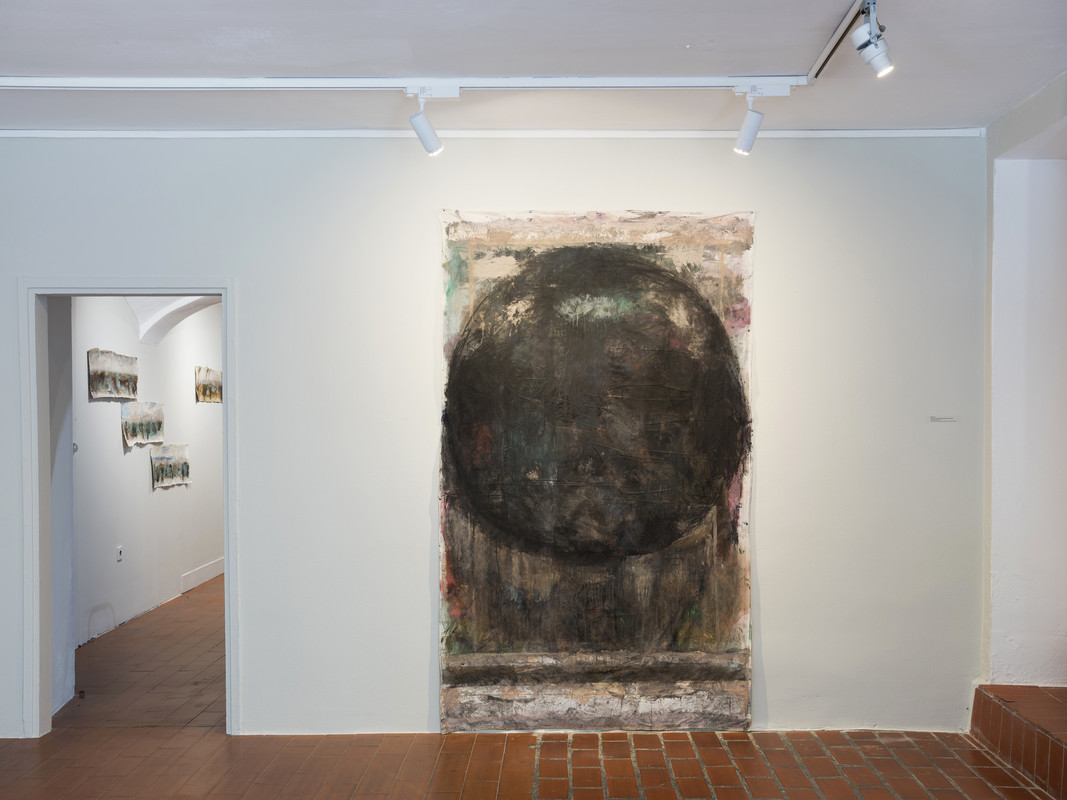
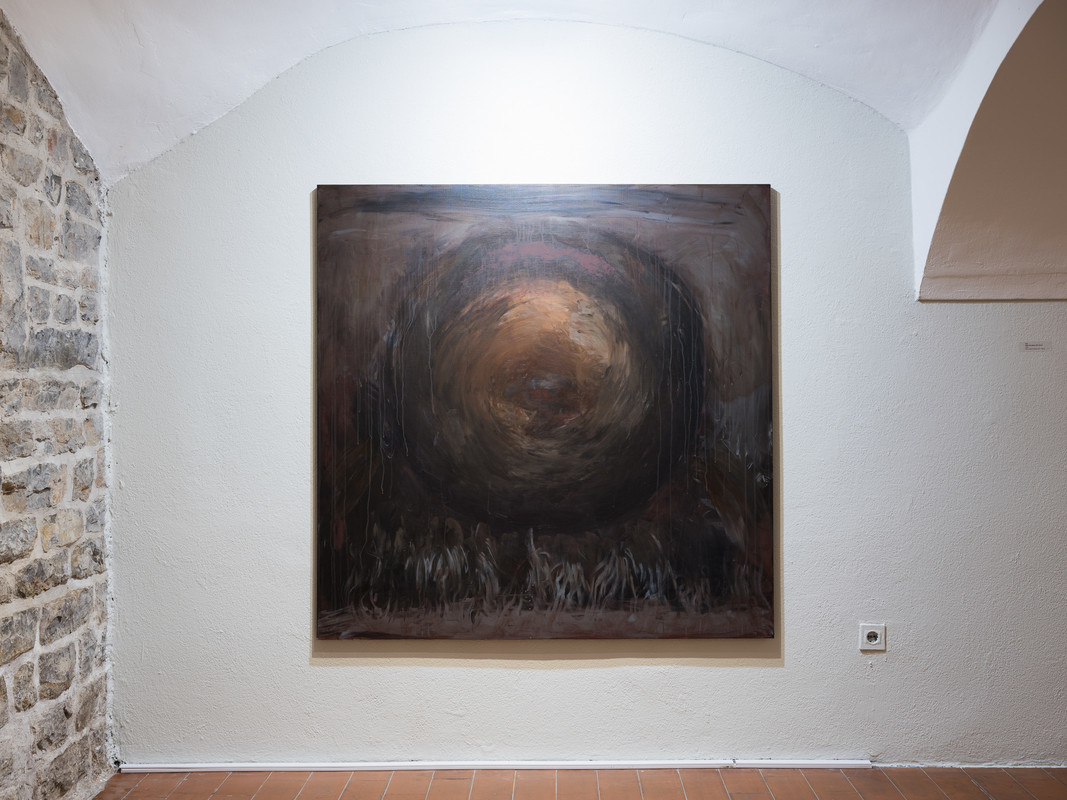
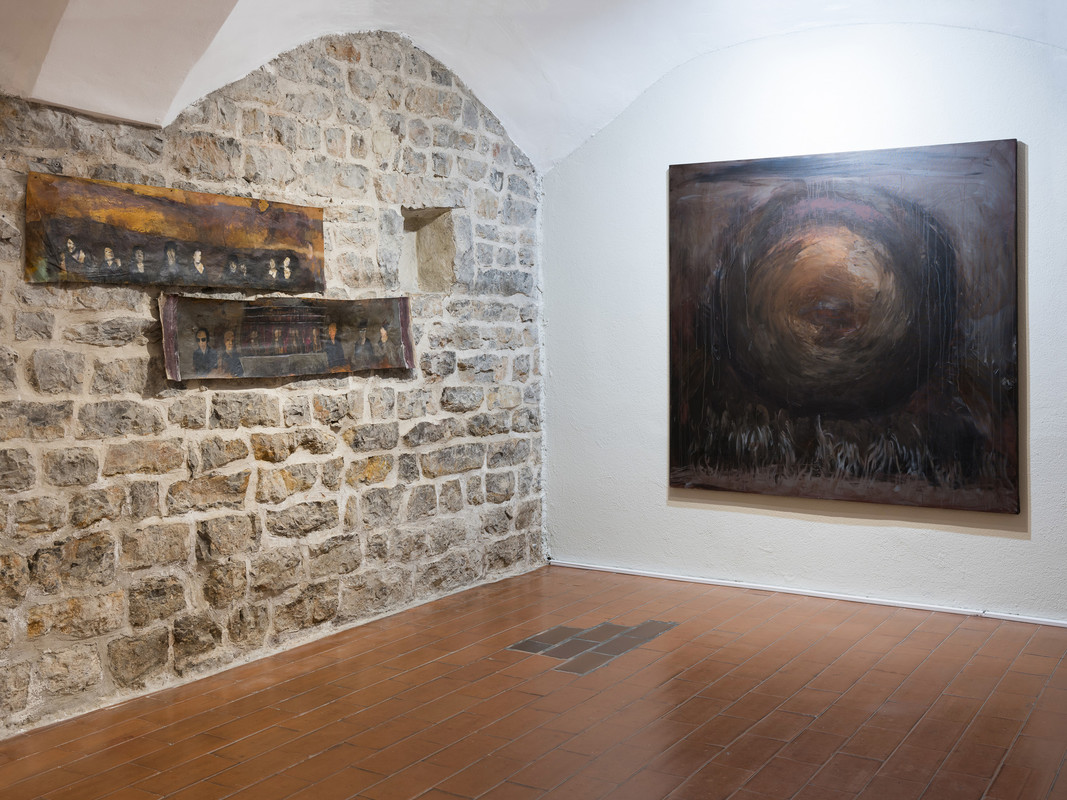
Agata Pavlovec’s painting practice oscillates between figurative art and a tendency to abstraction. These transitions between depiction styles and forms are paralleled in the exhibition’s content; no social role is final, no identity is perfectly stable, and no background or landscape in her works is meticulously defined. In these work, the artist’s signature floating circular shapes are painted in dark, earthy tones. The artist has used circular brushstrokes to thicken, darken and deepen them, producing a swirling effect that draws the viewer’s gaze toward the centre.
Long revered as a symbol of wholeness, infinity, eternity, the cosmos and cyclicity, the circle here breaks away from its purely sublime and exalted meaning. Grounding it with a dark, muted palette, the artists thickens this symbol of perfection with colour and circular brushstrokes to create an allusion to a tunnel, opening, channel or abyss that draws the eye into its interior. Its circular shape maintains a connection to the universe and the circle of life, not, however, in the sense of a comforting cycle of life and a harmonious return, but as an inevitable and inescapable loop of birth, growth, decay, disappearance and the return to matter.
This is where one of the exhibition’s core ideas takes shape. Agata Pavlovec rejects perfection as a smooth and unblemished form, redefining it as the ability of a work and its support to embrace dichotomy: to allow stains, dissonance, traces of time and passing to become part of them. The Circle thus creates an image of wholeness that encompasses both primordial chaos and order.
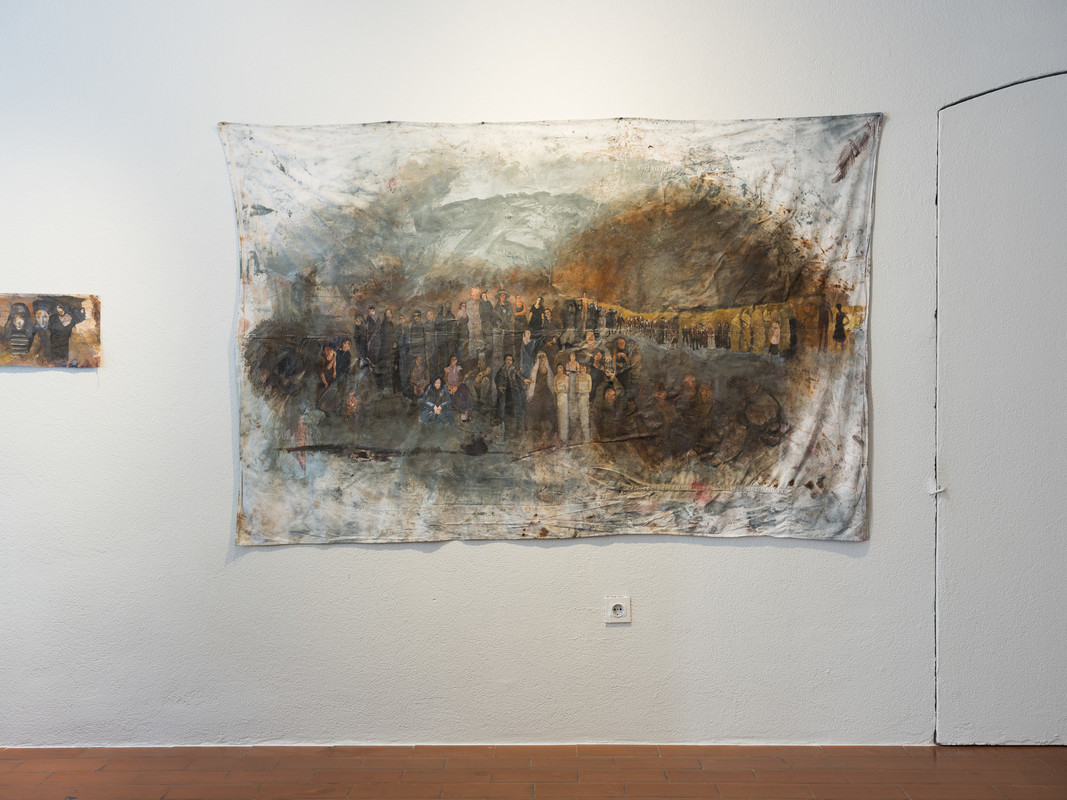
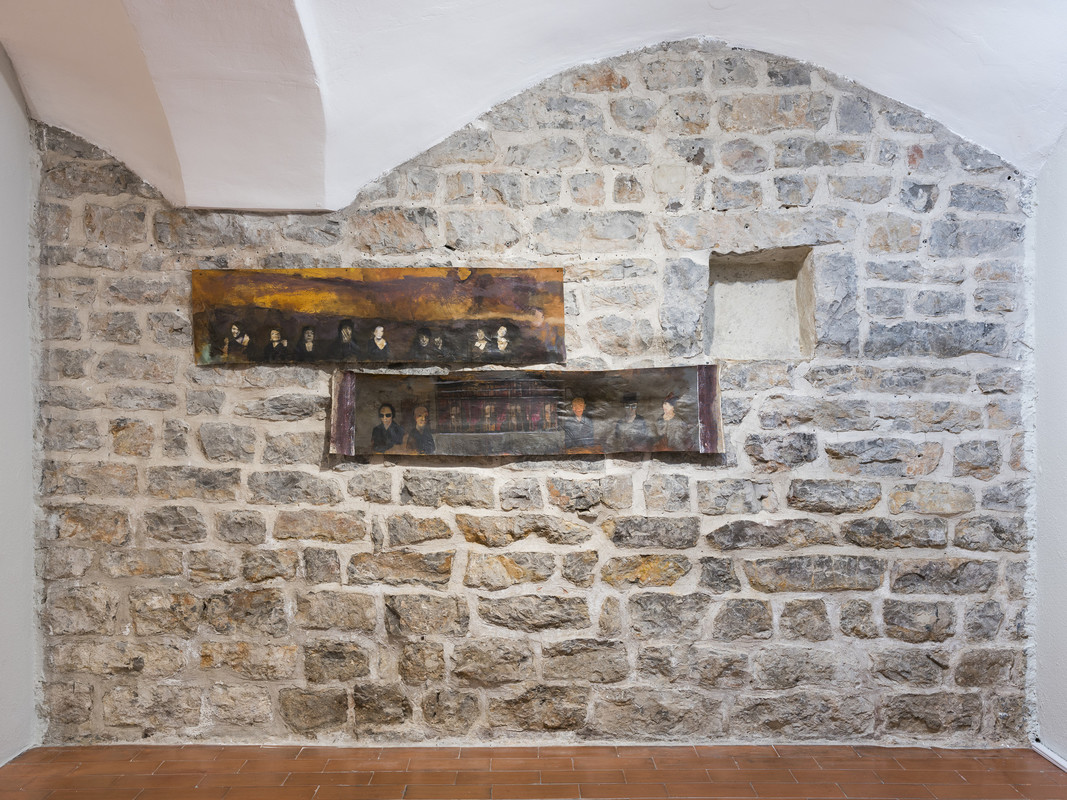
The transition motif continues in the work titled Procession, where a stream of figures conjures the allegory of the Danse Macabre. However, the absence of an explicitly macabre atmosphere transforms the scene into a quiet procession with no clear beginning or end. Some of the depicted figures display the artist’s own facial features, while others are almost faceless or typified. This re-establishes the common thread of transition: between portrait and anonymity, the individual and the crowd, and social roles and age periods conditioned by the passage of time.
Moreover, the procession of figures echoes the tradition of the Passion play processions typical of the Škofja Loka area. Agata Pavlovec uses theatrically depicted characters to reveal human life as a sequence of roles, costumes, attitudes and social scenarios. As individuals we join this procession shaped by inherited, assigned and chosen identities, which we embrace, transform or reject. The Procession serves as a reminder not only of the transience of life, but also of the fleeting nature of social roles and the fragility of the images we construct for others to see.
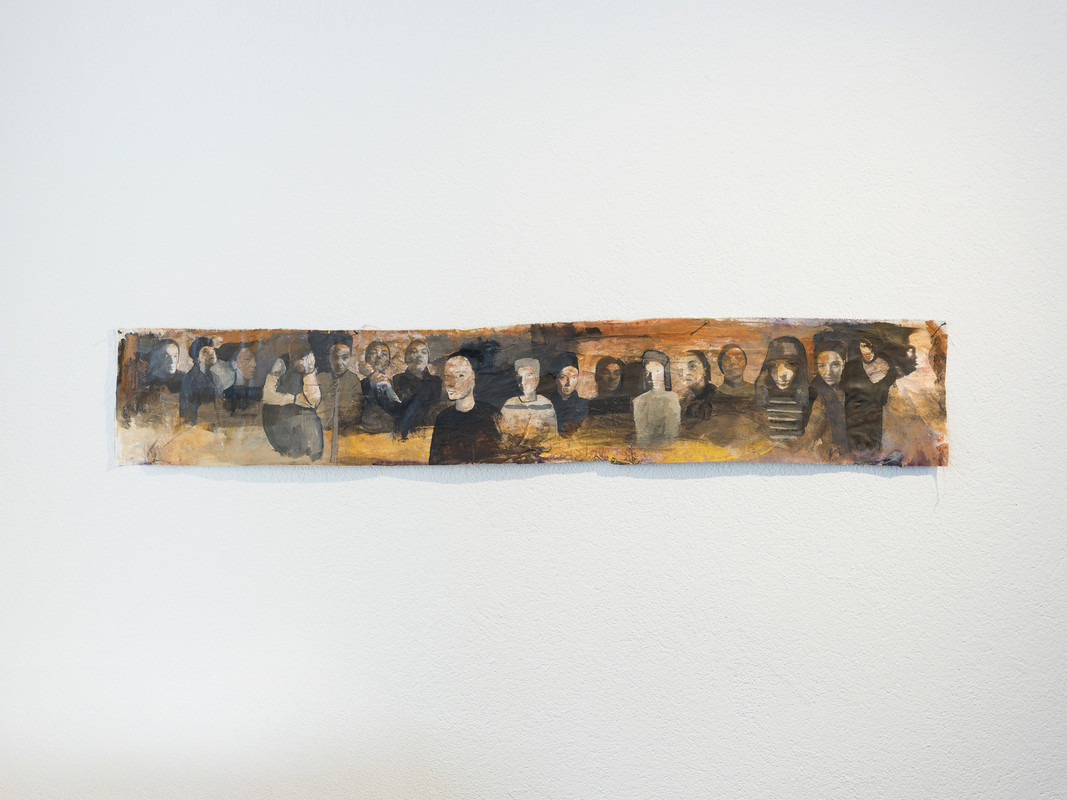
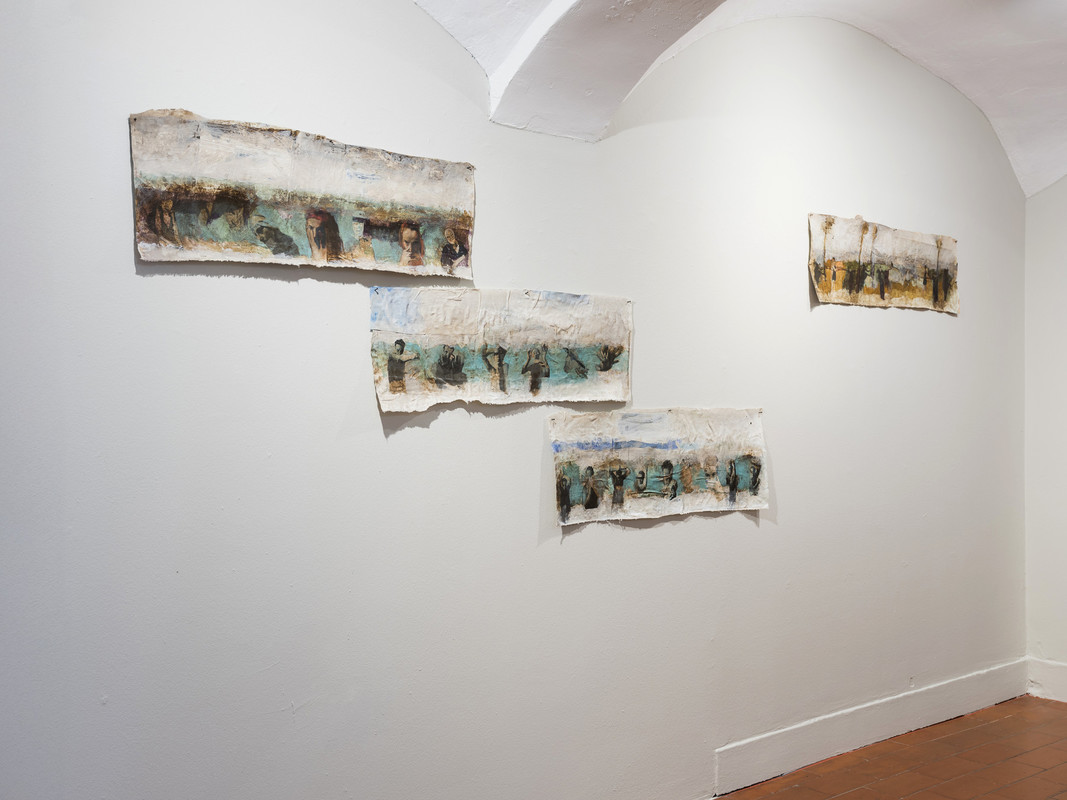
In the collage series Channeling, the procession unfolds within a single individual. Consisting mostly of bust and waist-up self-portraits, this series portrays the artist in various postures, gestures, expressions and emotional states. Her self-portraits are sequenced almost as a film strip, framing identity not as a single and fixed image, but as a movement through transitional states or as a process of staging, testing, playing out, and presenting the self across a full spectrum of human existence, from cries of despair to dignified serenity.
Through self-portraiture, the artist explores the array of available social roles, examining those that are imposed, taken for granted, as well as those she can distort, elevate, subvert or reject. Furthermore, the series offers a critical commentary on the mass proliferation of digital selfies, while also examining how women’s self-image is constructed under the pressure of social and cultural expectations, aesthetic ideals and today’s economy of visibility. Pavlovec consciously rejects the idealised, carefully controlled and curated presentation, redirecting it into a space of bodily imperfection and everyday life, further intensified by the material that makes up the support – a torn linen canvas and torn bedsheets glued together by the artist.
The support of Pavlovec’s paintings and collages plays a special role in her artistic practice, holding a particularly prominent place in her oeuvre. The bedsheet is part of the space that bears witness to intimacy, rest, sexuality, illness, caregiving, birth and, ultimately, death. It acts as a persistent companion, partly providing a boundary between the private and public life, and between protection and exposure, while retaining traces of warmth, scent, sweat, vulnerability and serving as a sign of absence. It also evokes the historical tradition of the textile dowry, in which bedding was central to women’s transition to a new social status and identity. In Agata Pavlovec’s artistic production, the bedsheet repurposed as a painting support becomes a metaphor for an archive, a register of personal changes and life milestones.
In the Channeling series, the artist’s image becomes a recurrent scene of tension between self-presentation and rebellion against it. However, the sequential rhythm of the self-portraits resurrects the allusion to the Danse Macabre, only this time it enacts the Dance of Death of self-portraits, the vanishing of representations, projections and expectations. Channelling stands for a flow of images, roles, archetypes, memories and social expectations through the artist’s body, while elements like the grotesque, humour, fragility, discomfort and vulnerability reveal her understanding of the fullness and wholeness of human existence.
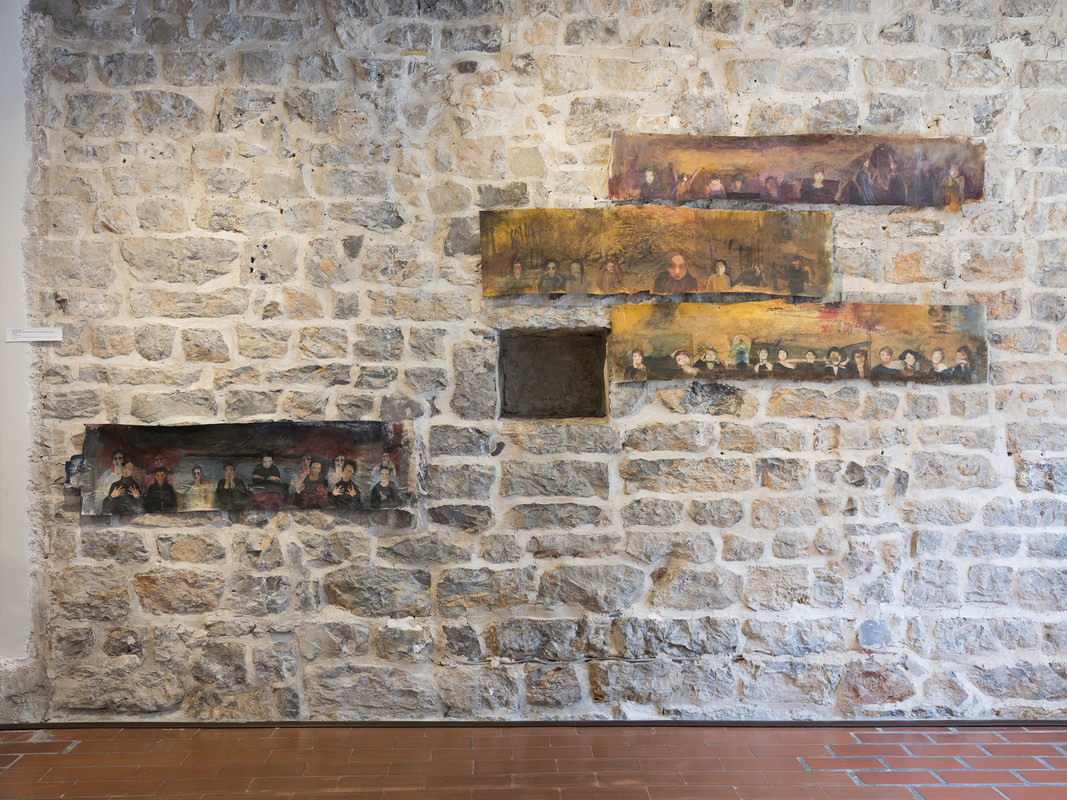
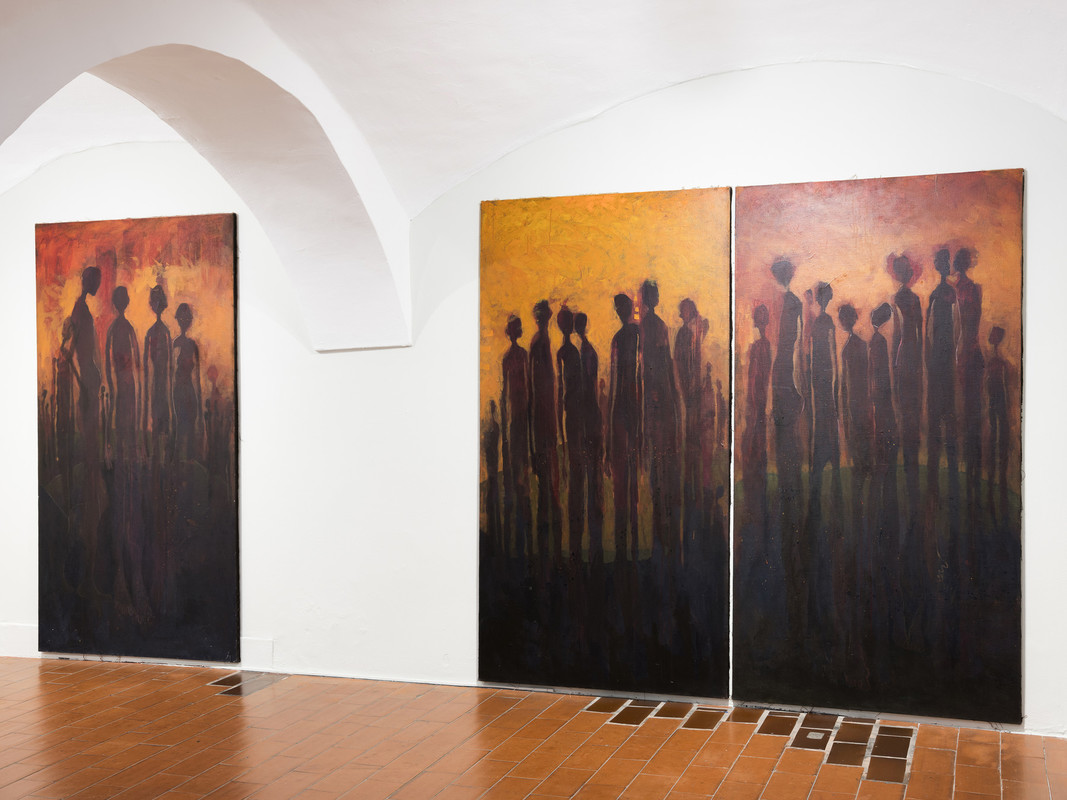
The exhibition’s narrative concludes with the Passers-by series. In contrast to the Channelling series or the Procession painting, the identities of the depicted individuals remain completely unidentifiable. Paradoxically, they evoke portraits of the absent, whose presence is reduced to mere silhouettes. They seem like some sort of shadows from the kingdom of Hades, embodying invisibility, imperceptibility, trace or memory. They expose the paradox of modern community, characterised by individuals existing in a crowd without meaningful connections, physically present, but mentally detached and emotional alienated. Passers-by continues the reflection on individuals’ presence in the world and the imprints they leave behind.
The exhibition explores self-image, the roles we adopt and, and above, the transient nature of human life. The artist pairs the memento mori concept with a sensitive, holistic understanding of beauty as something fleeting, imperfect, vulnerable and constantly evolving.
In this context, the exhibition culminates in an oxymoron of perfect imperfection. Agata Pavlovec weaves those aspects of human existence that are often overlooked or concealed — incongruities, losses, stains, traces and transitions — into a cohesive and comprehensive human experience. Her works seek to capture the full dimension of life, including its uncertainty, disorder, liminality, transience and the persistent need for transformation and transition.
Agata Pavlovec
Agata Pavlovec graduated from the Academy of Fine Arts in Ljubljana in 2002, majoring in painting under Prof Emerik Bernard and Prof Jožef Muhovič. Before that, she studied art pedagogy at the Faculty of Education in Ljubljana and received additional training in youth and adult education.
Since 2002, she has had more than thirty solo exhibitions and participated in numerous group shows, art colonies, symposia, festivals and extempore exhibitions in Slovenia and abroad. She has recently been involved in intermedia projects that integrate her art with other artistic practices, cultural heritage and space. She has illustrated several books and contributed art to poetry collections.
She works with a diverse range of institutions and societies to plan exhibitions and other events. To date, she has organised more than 300 exhibitions, including international ones. In the field of set design, she collaborates with various theatrical troupes, event organisers and concert promoters. She has over 15 years of experience in arts education, as part of which she has run art courses, schools and workshops, and delivered lectures. She has received a distinction from the Municipality of Železniki in recognition of her contributions to painting and researching the cultural heritage of the Selca Valley. She is a member of the Slovenian Association of Fine Arts Societies (ZDSLU) and the Škofja Loka Artists’ Association (ZUŠL), where she has performed managerial and editorial tasks, among others.
She is a freelance artist based in Škofja Loka.
Accompanying programme
A guided tour of the exhibition with the artist and curator: Wednesday, 24 June, at 7.00 pm