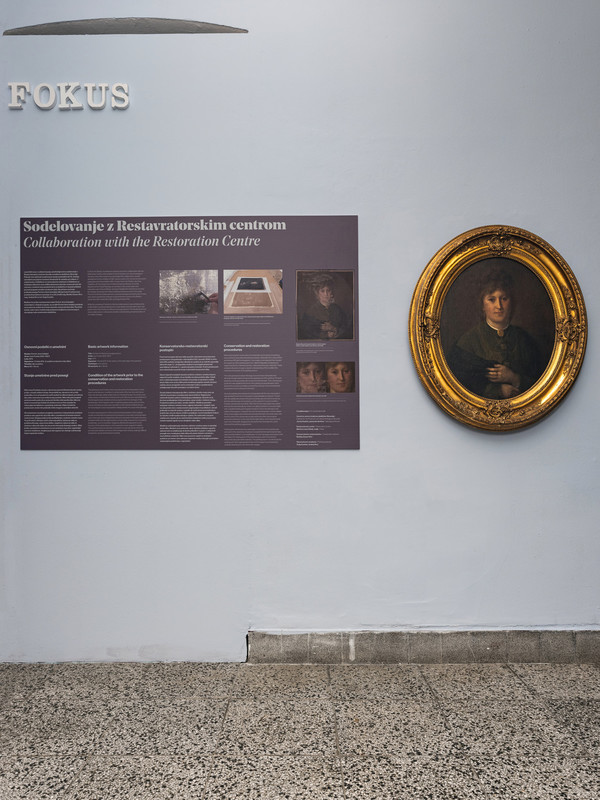
Collaboration with the Restoration Centre
In 2024, the Škofja Loka Museum started a long-term collaboration with the Restoration Centre of the Institute for the Protection of Cultural Heritage of Slovenia. One of the reasons we had initiated the collaboration was the assessment of the condition of 19th-century works of art carried out during the preparations for the exhibition 19th-Century Arts in the Škofja Loka Area. Together with the Department of Natural Sciences Research and the Department for Easel Paintings, we worked on the conservation and restoration part of the exhibition, aiming to highlight the importance of caring for heritage and present the often invisible professional work to the public. Portrait of a Woman (older person), a severely damaged portrait by Ivan Franke, was used to present the analyses and procedures carried out by Barbka Gosar Hirci, MA, Andrej Hirci, MA, and Katja Kavkler, PhD.
While the unrestored Portrait of a Woman (older person) was exhibited at the Castle Gallery, painting analyses and conservation and restoration work was performed on the Portrait of a Woman (younger person). The results show how close collaboration contributes to a better understanding and preservation of our artistic heritage.
Basic artwork information
Title: Portrait of a Woman (younger person)
Artist: Ivan Franke (1841–1927)
Year: 1874
Signature: “Franke 874” (in the centre, on the right edge of the painting)
Technique: oil on canvas
Dimensions: 66 × 54 cm
Condition of the artwork prior to the conservation and restoration procedures
The painting by Ivan Franke, which was entrusted to the Restoration Centre, was in extremely poor condition. In certain parts of the hair, face and hands, there was damage visible as light stains on the painting layer; the surface was visibly uneven, hindering the reading of the work. Microscopic examinations of the damaged areas revealed numerous spots with micro damage on the painting layer, which appear under a magnifying glass as tiny grains and fine cracks, indicating complex decomposition of the material. Despite the performed analyses, it was not possible to reliably identify the cause of the damage.
A careful visual inspection of the portrait and interpretation of the analysis results revealed that the painting had undergone conservation and restoration work in the past, most notably lining with wax resin paste. In the past, this was a standard method of strengthening the canvas, today, however, it is considered problematic, as it is irreversible, negatively affecting the appearance and structure of the painting layers, and causing the woven support to darken. The painting had previously been mounted on a new sub-frame, which did provide basic stability, but some of the wedges were missing, making it difficult to keep the canvas stretched permanently.
Conservation and restoration procedures
Before planning the conservation and restoration procedures, the painting was examined using selected painting analyses: ultraviolet (UV), raking (RAK) and infrared (IR) light photography, X-ray imaging, and analyses that revealed the sequence of the painting layers (so-called stratigraphic analysis) and helped identify the materials used (so-called spectroscopic methods). These analyses allowed us to gain a clearer understanding of the condition the material components of the painting were in.
The main goal was to reduce the large amount of wax resin paste and eliminate the light stains to improve the appearance of the painting. The work started by removing surface dirt on the front and the back. Then, a temporary protection was applied to the front of the painting via special paper, which allowed the canvas to be safely removed from the sub-frame and selected procedures to be continued on the back.
Since the painting was extensively impregnated with the wax resin paste, it was decided the amount of the paste would gradually be reduced. To start with, the additional canvas of the previous lining was removed. It turned out that the old lining was not necessary, as the support is in good condition – Franke’s canvas is thin but stable. After this, the wax resin paste was careful thinned, first mechanically by means of scalpels and then on a suction table with controlled heating and negative pressure. Due to the damage to the edges of the support, caused by the sub-frame having been moved multiple times, these edges were reinforced and extended with new textile strips, and the tiny holes in the canvas were locally reinforced. After removing the temporary protection, it was clear that the light stains, which had previously been very noticeable, disappeared during the thermal treatment, which improved the painting’s appearance.
Following this, the excess wax resin paste on the front of the painting was removed. In the meantime, it had been revealed that the heat treatment also had a beneficial effect on the stabilisation of minor damages and cracks. In the final steps, the missing parts of the painting layers were removed and retouched using reversible materials. The painting was re-mounted onto the existing sub-frame; appropriate tension of the support was achieved by carefully stretching the sub-frame with wedges.
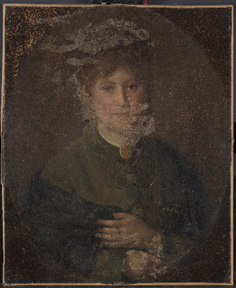
The condition of the painting prior to the conservation and restoration. Light stains and surface dirt are visible.
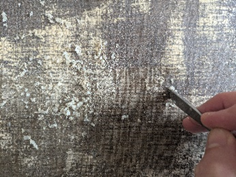
Mechanical thinning of the wax resin paste on the back of the painting.
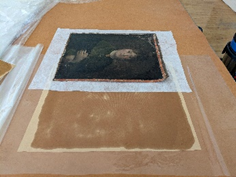
Thermal treatment on a suction table with controlled heating and negative pressure for thinning the wax resin paste.
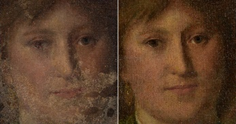
A detail showing the face before and after the completed restoration and conservation work.
In cooperation with:
Institute for the Protection of Cultural Heritage of Slovenia: Jernej Hudolin, Managing Director
Restoration Centre: Martina Lesar Kikelj, Head
Conservator-restorer: Barbka Gosar Hirci
Painting analyses: Katja Kavkler and Andrej Hirci