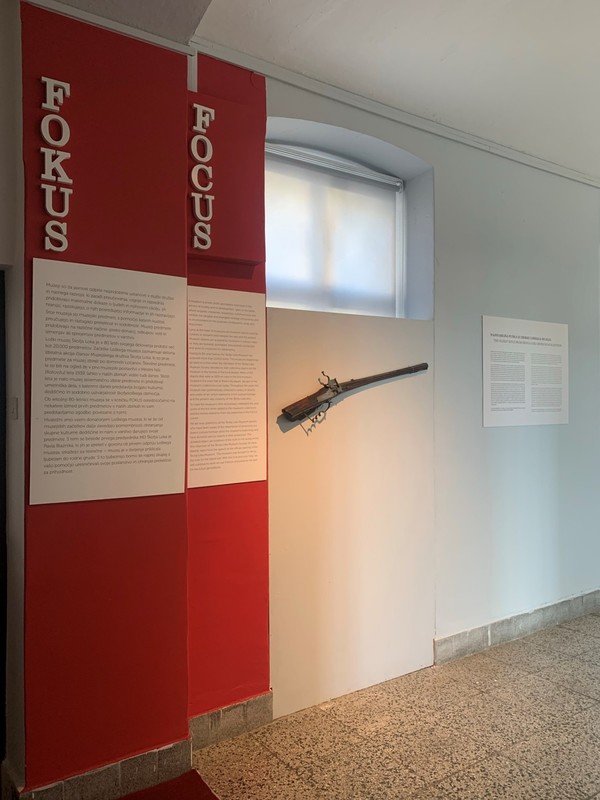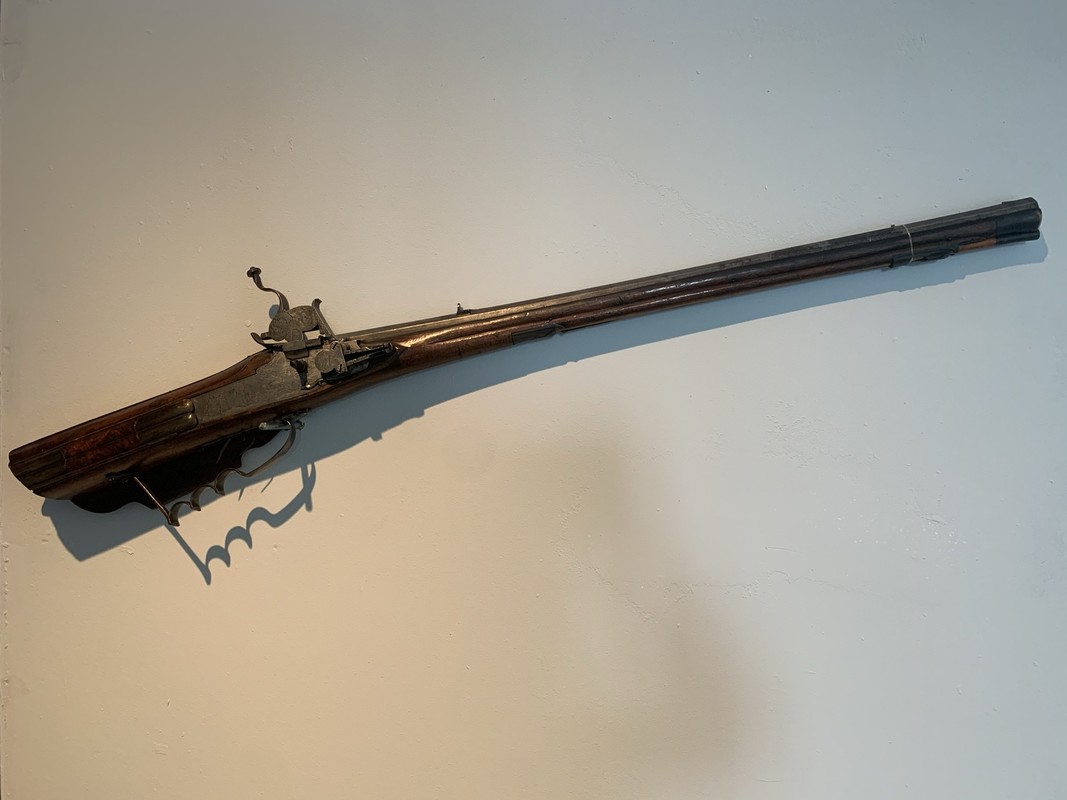
The oldest rifle from Škofja Loka museum's collection
The oldest rifle from the permanent collection of the Škofja Loka Museum dates back to the 17th century. The entire rifle is 105 cm long and its octagonal 12mm barrel is 73.7 cm long. In addition to the ornate barrel exterior and the artful, meticulously crafted wooden stock, which is decorated with various carved and horn elements, the entire firing mechanism area is engraved with a hunting scene and boasts an outstanding sense of detail. The scene shows a hunter wearing typical 17th-century attire, firing at a running red deer stag from a kneeling position. Apart from artistic perfection, the rifle boasts two one-of-a-kind constructional features.
The first feature is the ignition mechanism called the wheellock. An early sketch of the wheellock mechanism was made by the versatile artist Leonardo da Vinci circa 1500, the person credited with inventing it in 1517, however, is the watchmaker Johann Kiefuß of Nuremberg. The wheellock was an advanced and complicated ignition system, whose main drawback was the technological complexity of its manufacture, which was mainly due to the high cost. As the wheellock was very expensive, it never came into widespread use and was for the most part limited to the firearms used by the wealthy. To activate the mechanism, a special key had to be used to wind the wheel up before firing. Before the trigger was pulled, the pan cover pivoted forward and engaged the pyrite – which was screwed in the jaws of the dog – with the wheel. When the trigger was pulled, the wheel spring snapped back, forcing the wheel to spin and rub against the piece of pyrite. This generated sparks, which ignited gunpowder in the pan and the weapon was fired. This ignition system type was more reliable even in bad weather conditions.
Another special feature of this rifle is invisible to the naked eye and is hidden inside the barrel, revealing itself only when a suitable lamp is inserted into the barrel. The entire barrel interior features a pattern of grooves, the so-called rifling. In the 17th century, rifling barrels were something of a rarity as most guns at the time were smoothbores. The first rifling barrel had been made between 1500 and 1520 by August Cotter, a gunsmith from Nuremberg. Needless to say, the making of rifling using the technology available at the time was a very complex and time-consuming process, which made them very expensive. Consequently, they did not come into common use until the mid-19th century, when technological advancements made their production less costly. This particular rifle was a muzzle-loading weapon and used lead bullets, which were fired by means of black powder. This “miracle substance”, which was invented in China in the 9th century and was composed of charcoal, nitrate and sulphur, gradually spread along the Silk Road towards India, the Middle East and Europe. In Europe, gunpowder was used from the 13th century onwards, which marked the beginning of a new era in firearms.
It is not known who exactly the rifle belonged to, it is, however, believed that it was part of the aristocratic collection of firearms from one of the Škofja Loka castles: the Ajman Castle, the Stara Loka Castle or the Puštal Castle.