
Glass Paintings
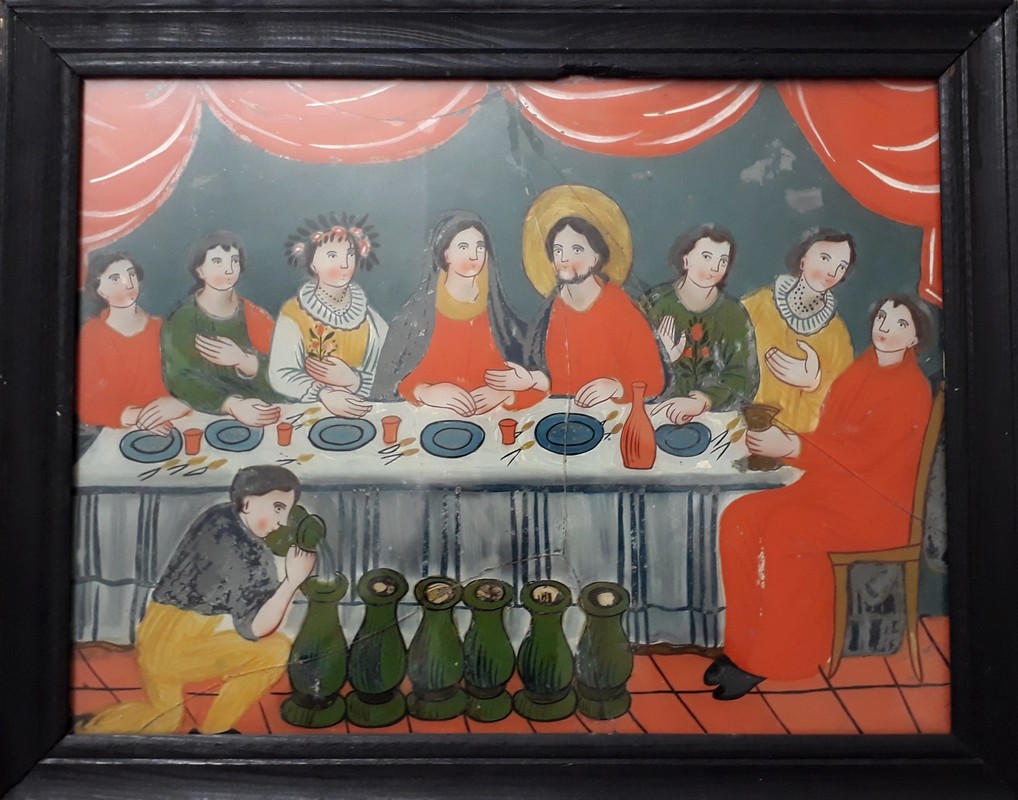
Glass paintings are an important part of European and Slovenian folk art. The Škofja Loka Museum is in possession of 69 glass paintings, the first of which was acquired for the museum by the Museum Society in 1938 from a municipal almshouse. The glass painting, which depicts a wedding in Cana of Galilee, was painted by the Master of Crude Drawings in the mid-19th century. Today, it is listed as the first museum item under Inv. No. E 1 in the Inventory Book of the Škofja Loka Museum's Department of Ethnology.
Glass paintings are painted using a special technique. The back of the glass is the painting base, while the front protects the paint layers. This technique allows copying directly from dashed-line templates placed underneath the glass. The most widely used glass painting technique was the mixed media technique. The contours were painted using watercolour paint with gum arabic used as a binder. The next layers were usually created in tempera and the final layer using oil paints. The painter first painted details and a basic drawing on the back of the glass base, before moving on to larger coloured surfaces. This painting technique allowed for no corrections. Most paintings on glass were small-sized paintings painted on a thin sheet of glass made of pressed glass or, at a later time, rolled glass. They mostly depicted religious scenes and motifs, with particular emphasis on figures and ornaments painted in a way that provides colour contrast between the figural depiction and the background. The mirror image is visible through the glass. The paintings usually had black, shallow-profile frames.
The glass painting technique dates back to the 2nd century BC. It originated in the Western Roman Empire, from where Roman soldiers brought it East to Byzantium. With the fall of the Roman Empire in the 3rd and 4th centuries, in its western part painting on glass gradually became less common, however, circa 1100, during the Crusades, it spread from the Orient to Italy. In the Middle Ages, glass paintings were made in monasteries and Italian monks brought them from Italy to other parts of Europe – France, Switzerland, Bavaria and the present-day Czech Republic. As these paintings featured a lot of gilding, only the church and the rulers were able to afford them. In the 15th and 16th centuries, however, gilding was increasingly less common, as a result of which the paintings became cheaper and more accessible to the bourgeoisie too. The reduction in the cost of glass in the 17th and 18th centuries resulted in the paintings on glass (including etched glass and paintings on mirrors) becoming accessible to an even wider range of customers.
Folk glass painting originated in Jelenia Góra, Silesia (the present-day Poland), and in Bor in the northern part of present-day Czech Republic in the mid-18th century. Due to an unfavourable economic situation, in the 1770s, glassmakers moved from the northern parts to the border area between Austria and the present-day Czech Republic. They continued to paint on glass as this provided them with an additional source of income. Over time, painting on glass grew into a cottage industry where a master and his assistants and apprentices worked alongside family members. Each of them was responsible for a certain part of the process. They reportedly painted up to fifty glass paintings a day.
Glass painting products came to Slovenia mainly from Pohoří in the present-day Czech Republic and Sandl in northern Austria. The large volume of glass paintings imported into the Slovenian territory is partly evident from the fact that, between 1852 and 1857, the Sandl-based painting workshop owned by Vinzenz Köch, who was probably also selling glass paintings at other painting workshops in the area, produced 206,775 glass paintings, of which 13%, i.e. 27,014, were sold to Carniola.
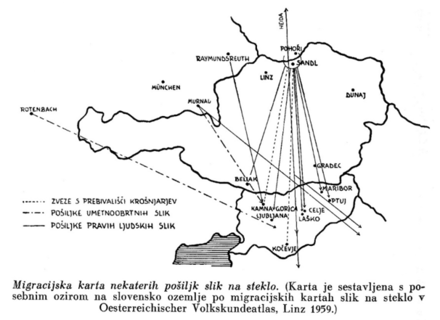
Source of the map: a paper by Makarovič, G., Slikanje ljudskih slik na steklo na Slovenskem, in: Slovenski etnograf, Vol. 15, 1962, p. 116.
In addition to foreign glass painting production, glass paintings were produced in Slovenia too. Based on the painting typology, art historian Dr Gorazd Makarovič attributed the glass paintings with Slovenian lettering to two folk painters and one painting workshop: the Master of Crude Drawings, the Master of Small Figures and the Selca Workshop from the village of Selca in the Selca Valley. The Selca Workshop is represented by two members of the Pavlič family: father Andrej Pavlič and his daughter Marija Pavlič (1821–1891), locally known as Podnartovčeva or Blaževčeva Mici, who learnt the glass painting skills from her father. Besides glass paintings, the two painters and the Selca Workshop artists also painted beehive panels and the like. Their glass paintings are kept by the Slovene Ethnographic Museum, the Gorenjska Museum and the Škofja Loka Museum.
Glass paintings mostly adorned the walls of farmhouses. They hung in the main room to the left and right of the crucifix in the so-called ‘bohkov kot’ (God's Corner) above a large table. Glass paintings satisfied the religious and aesthetic ideas of farmhouse inhabitants, while also revealing quite a lot about how well-off they were. In the late 19th and early 20th centuries, they were gradually replaced with lithographs with religious content.
References:
- Makarovič, G., Slikanje ljudskih slik na steklo na Slovenskem, in: Slovenski etnograf , Vol. 15, 1962, pp. 107–118.
- Makarovič, G., Slovenska ljudska umetnost, Slike na steklo, Ljubljana, 1981, pp. 254–258.
- Simonič Roškar, M., Zbirka slik na steklo na Ptujskem gradu, Ptuj: Pokrajinski muzej Ptuj – Ormož, 2019.