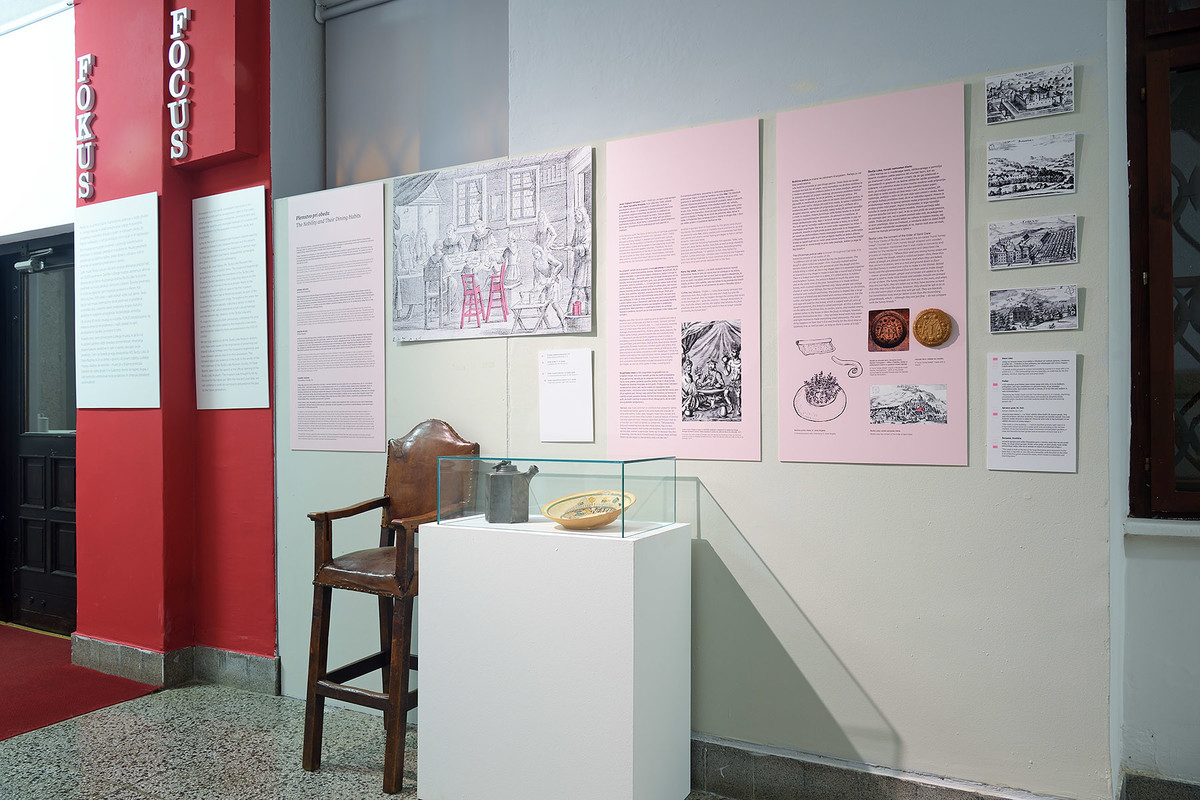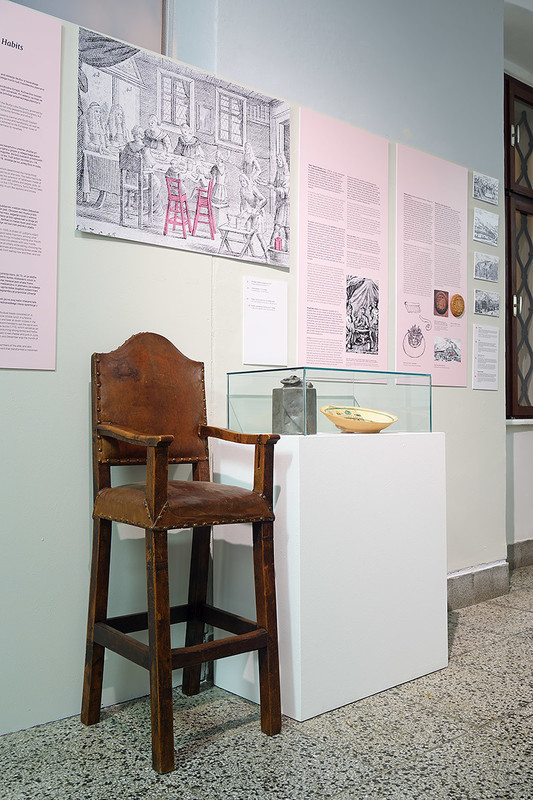
The Nobility and Their Dining Habits
The town of Škofja Loka was the administrative, economic, commercial and cultural centre of the Škofja Loka Seigniory governed by the bishops of Freising in Bavaria. In the mid-18th century, the seigniory's population consisted not only peasants and burghers, but also a small number of noble families (the Erberg, Oblak-Wolkensperg, Fürnpfeil, Dinzl, Lampfritzhaimb families and others).
Although few in number, Carniolan nobility – and thus also the Škofja Loka nobility – was exposed to Central and South-Eastern European influences. The nobility learned about culinary innovations and habits through cookery books and handbooks, as well as their studies at foreign universities. When it came to the dining etiquette, the Carniolan nobility adhered to the European rules of etiquette. This, however, also depended on the individual nobles' material position and their openness to novelties.
Dining Room Equipment
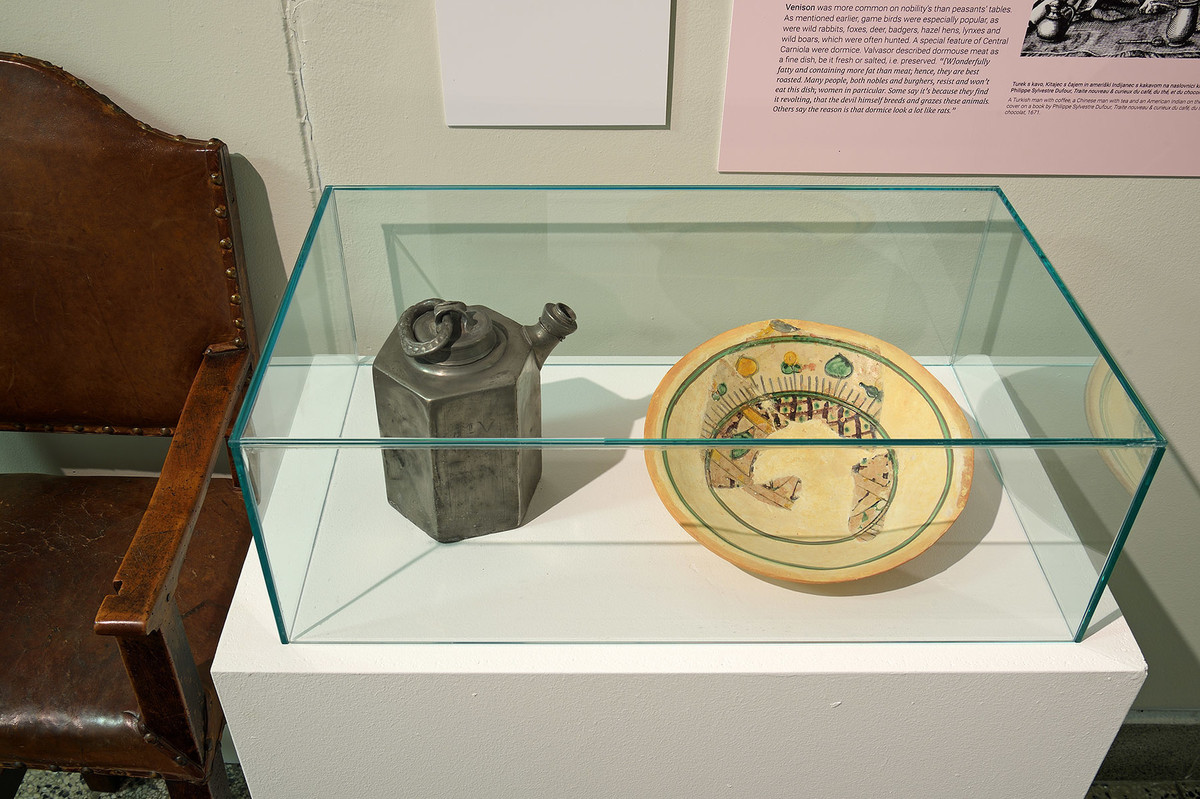
The most representative part of an aristocratic home was the dining room with a dining table, which determined the hierarchical ranking of the people gathered at the table. The closer a guest sat to the host, the more important he or she was. The table had to be covered with a tablecloth made of the same material as the napkins. Another important part was the selection of tableware made of brass, copper, tin or majolica. On festive occasions, the table was set with porcelain tableware, silver salt cellars and pepper pots, oil and vinegar bottles. Cutlery was another standard piece of tableware in the 18th century. While in the 17th century, forks had not been commonly used by nobles, from the 18th century onwards, they were an obligatory part of cutlery, much like spoons and knives.
Dining Etiquette
Apart from the use of cutlery, the guests' breeding was further reflected in their table manners. In 1659, a citizen of Ljubljana Adam Sebastian von Siezenheim published a book titled Speculum generosae, in which he described good table manners, among other things. An obligatory part of the dining ritual was hand washing and saying grace. Non-acceptable things included wiping your mouth with your hands, elbows on the table, reaching into the salt cellar with your fingers and tearing bread into pieces with your hands, finger licking, scratching your head and picking your teeth. It was considered bad manners to look at others while eating, choosing the finest pieces of meat for yourself, turning up one's nose at the food served, feeding or touching animals and throwing bones under the table. Siezenheim pointed out that you should not gobble down food, that you should take a break from eating now and then, and not drink more than three sips of a drink.
The Nobility's Everyday Life
In addition to the food eaten, another important thing was when the food was eaten and what individual meals consisted of. In the German lands, the day started at eight in the morning with the morning coffee, followed by a one o'clock lunch in a festive atmosphere, the afternoon coffee at four o-clock and dinner with tea, cold ham, sausages, cheese and beer at seven o'clock in the evening. The Carniolan nobility most likely kept to a similar daily schedule. Of course, it was not recommended to eat the same sort of food all month long. Wolfgang Helmhard von Hohnberg authored the work titled Georgica Curiosa Aucta (1715), which served as an estate-management handbook for the bourgeoisie and the nobility. According to his handbook, consuming strong drinks and herbs was recommended in January, salty foods and fish were best avoided in April, it was not appropriate to eat cheese and pork in June, eating plenty of herbs and salads was advisable in July, venison was recommended in September, and December was the month of dry-cured meats and roasts.
Through their manners, especially table manners, the nobility expressed the fact that they were members of the elite, and also interpreted and modified novelties in their own way. Eating food became a status-defined social event that transformed a nobleman from a medieval knight into a modern and well-mannered gentleman.
In his famous work The Glory of the Duchy of Carniola, published in 1689, Johann Weikhard Freiherr von Valvasor (1641–1693) showed a strong interest in peasant and aristocratic culture in this area. On the question of the life of Carniolan nobles, his remark about nobles and burghers in Carniola living much like elsewhere in the world speaks volumes. Therefore, his work includes few descriptions of the life of Carniolan nobles and the same goes for their food culture. Nevertheless, individual descriptions include information about certain foods that were consumed by the Carniolan nobles and burghers too.
Poultry was often found on roasting-spits at castles and was a common part of everyday and festive meals. Valvasor pointed out that the Duchy of Carniola was, “/… / rich in poultry, boasting more of it than most other parts of Europe /.../ Carniola has no shortage of domesticated birds; chickens, geese, ducks, pigeons, the Indian Game, turkeys, peacocks and the like are commonly bred. /… / Mountains are also far from ungenerous when it comes to providing us with all kinds of edible game birds, such as pheasants, rock partridges, grey partridges, black grouse, hazel grouse, Western capercaillie, Eurasian woodcocks, common quails and others. Wild geese of many species, as well as various species of wild ducks, also often end up on our tables, enticed by a well-loaded gun.” While the nobles loved eating fine, sophisticated dishes, peasants preferred plain and simply prepared foods. Food eaten by the nobility and considered sophisticated included pheasants and grey partridges, as well as other types of meat, including pork.
Venison was more common on nobility's than peasants' tables. As mentioned earlier, game birds were especially popular, as were wild rabbits, foxes, deer, badgers, hazel hens, lynxes and wild boars, which were often hunted. A special feature of Central Carniola were dormice. Valvasor described dormouse meat as a fine dish, be it fresh or salted, i.e. preserved. “/… / wonderfully fatty and containing more fat than meat; hence, they are best roasted. Many people, both nobles and burghers, resist and won't eat this dish; women in particular. Some say it's because they find it revolting, that the devil himself breeds and grazes these animals. Others say the reason is that dormice look a lot like rats.”/…/
Another important kind of food eaten by the gentry and church dignitaries, the inhabitants of markets towns and towns, as well as peasants were fish. Many castles and monasteries had their own ponds and others owned fishing privileges to fish in certain streams, rivers and lakes.
Valvasor listed the following freshwater fish species: “/…/ such as pike, carp, tench, eel, chub, barbel, burbot, roast fish, as well as large sheatfish, nase and char. And in particular large huchens, beautiful grayling, fine trout and bullheads.” In addition to fish, they fished for crayfish, turtles and frogs. Valvasor also mentioned the Poljanska Sora river being inhabited by trout, common chub and other fish, and many trout and similar delicate fish in the Sora.
Coffee, tea, tobacco. “Coffee /.../ turns those manly Germans into effeminate men; thus, it affects not only one's body but also the mind: this, however, does not happen through the cooling that occurs in this beverage, but – quite the contrary – through desiccation; in fact, much like tobacco and tea, the sulphur that inhabits this fruit gradually dries out the male seed, which is thus no longer suitable for sowing the human field.”
The Christmas potica cake is known throughout Carniola. It bears saying that the potica is baked by people of all walks of life.
A different sort of cake is baked during the festive season. The dough is often rolled out paper-thin. Coarsely crushed walnut kernels mixed with honey are spread all over the dough and this whole thing is rolled up into a log shape; then it is squeezed together or placed in a ring shape to make it look like a round loaf of bread. Then it is baked and when it is done, it’s called potica.
In nobles' and burghers' homes, the potica is baked in much the same way and at the same time of the year. Sometimes it is made without honey, with crushed walnut kernels only. Many people use cottage cheese or some other fillings, but not at Christmastime; at Christmas, everyone uses walnuts and honey. The potica is shaped like a large round loaf of bread and decorated with various ornaments. For the nobles and burgers with a more sophisticated palate, a lot of fat and eggs are used for this bread, which is topped with all sorts of dough ornaments; this bread is called poprtnjak. All this is placed on the table on Christmas Eve. In castles, towns, and market towns, a priest comes to the house to bless the food; in villages, however, peasants themselves do this – they sprinkle bread with holy water and light incense to make everything smell pleasantly. The same thing happens on New Year's Eve and finally for the third time on Epiphany Eve, as well as later, as long as there is some of it left./… /.
Škofja Loka, the convent of the Order of Saint Clare:
The Poor Clares of Škofja Loka baked the so-called “nuns’ honey bread” (“nunski lect”). from honey dough shaped with wooden moulds. Valvasor mentioned that it was made in convents and castles for the residents' own enjoyment and described the process of making it:
Wheat flour and very strong honey water are used to make the dough, which is rolled out paper-thin; these thin sheets of dough are placed in the oven, and when they are baked, they are torn to pieces, sent to a mill and ground down to flour. Clarified honey is cooked over a fire to make it a bit thicker. Boiled honey and the aforementioned flour are then used to make dough – coarse-ground pepper, ginger and coriander are added to it; the dough is used to make little breads and wooden moulds are pressed on top of them. The honey breads are then put in the oven, and when they are just right, they are taken out as they have become so hard that they may crack like glass. However, they should be left to lie in a dry and warm place or else they will get soft. They are blackish, but nevertheless tasty and far better to eat than the Nuremberg gingerbreads, which – although they are just fine – do not compare with the honey breads.