The Peča
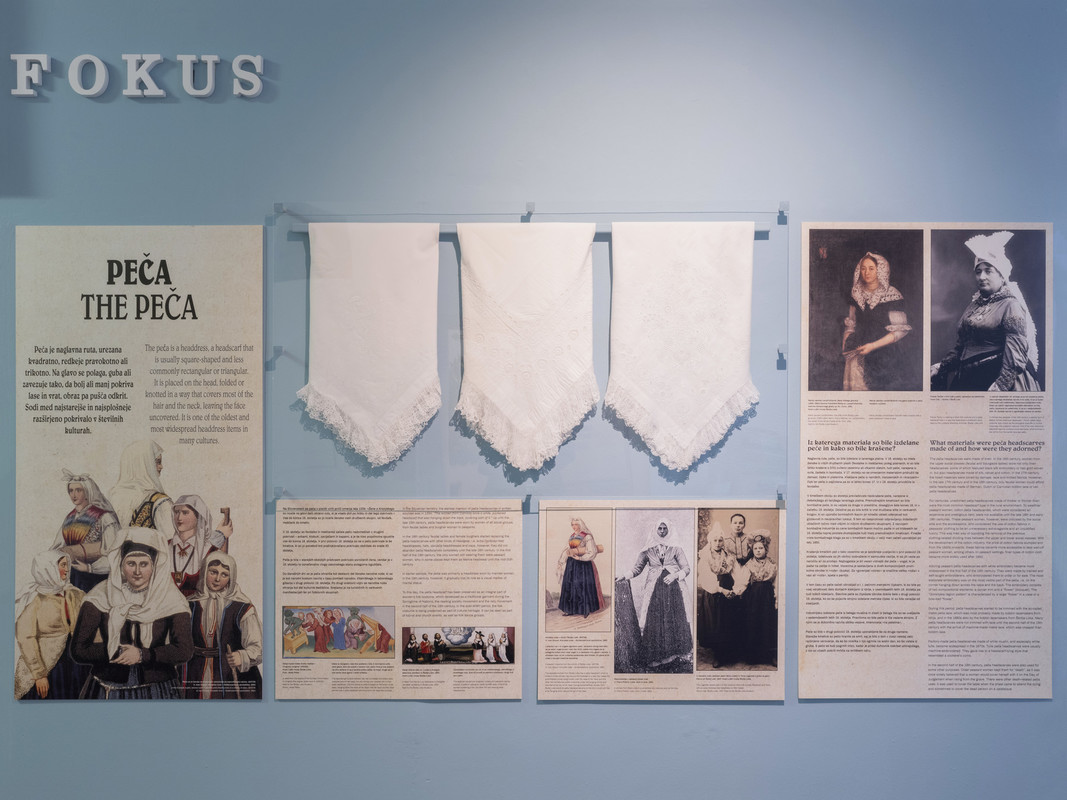
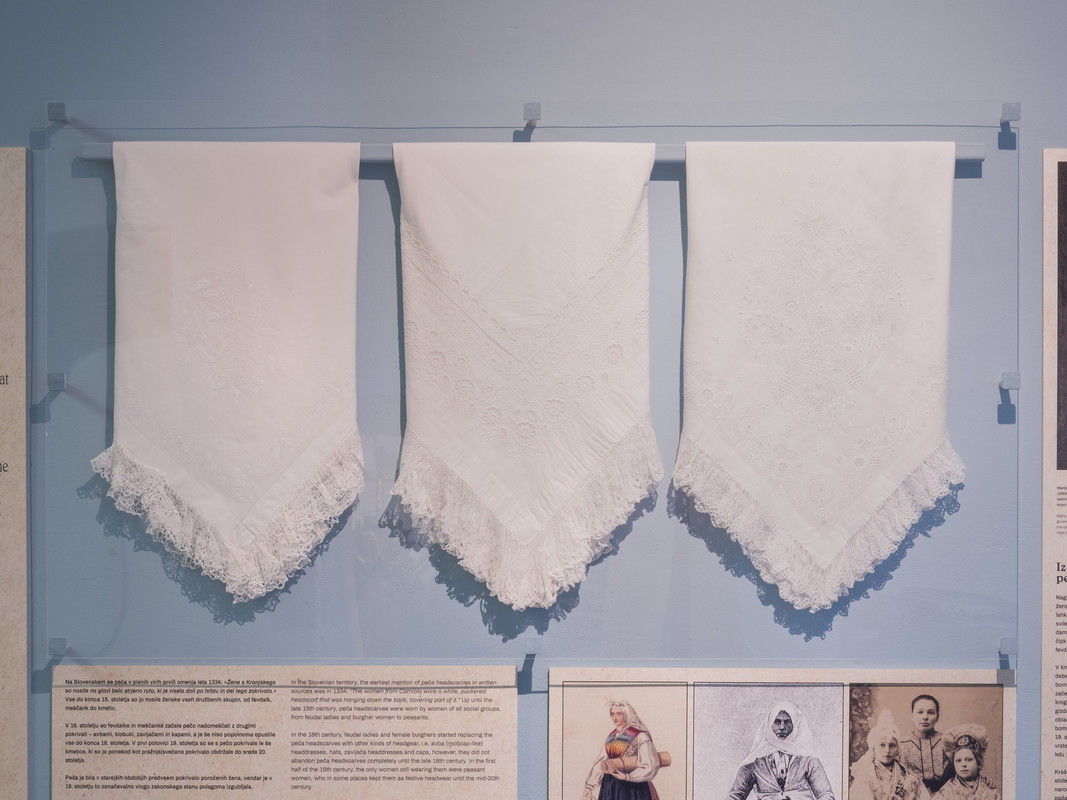
The peča is a headdress, a headscarf that is usually square-shaped and less commonly rectangular or triangular. It is placed on the head, folded or knotted in a way that covers most of the hair and the neck, leaving the face uncovered. It is one of the oldest and most widespread headdress items in many cultures.



In the Carniola region, women used to tie their peča headscarves in a variety of ways, 1837/38. In: Ivan Stopar: Kranjske noše – Goldensteinove upodobitve, 1993.
In the Slovenian territory, the earliest mention of peča headscarves in written sources was in 1334: “The women from Carniola wore a white, puckered headscarf that was hanging down the back, covering part of it.” Up until the late 15th century, peča headscarves were worn by women of all social groups, from feudal ladies and burgher women to peasants.
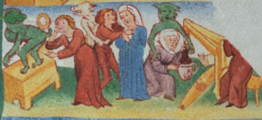
A detail from the replica of the Sunday Christ fresco in Crngrob (the original dates back to 1455/60). Kept by the Škofja Loka Museum. Photo: Janez Pelko
The depicted girl is bare-headed, her hair is braided and presumably wrapped around her head; the two women are covered with a linen peča headscarf. The first woman’s peča is folded on the crown of her head, hanging down the back of her head onto her back and the other woman has a peča headscarf wound around her head like a turban.
In the 16th century, feudal ladies and female burghers started replacing the peča headscarves with other kinds of headgear, i.e. avba (mobcap-like) headdresses, hats, zavijača headdresses and caps, however, they did not abandon peča headscarves completely until the late 18th century. In the first half of the 19th century, the only women still wearing them were peasant women, who in some places kept them as festive headwear until the mid-20th century.
In earlier periods, the peča was primarily a headdress worn by married women, in the 19th century, however, it gradually lost its role as a visual marker of marital status.
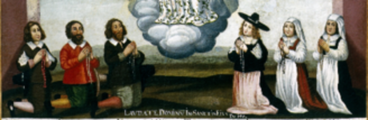
A detail from the St Lucy altarpiece in Dražgoše, Jamšeks’ workshop in Škofja Loka, 1655. Kept by the Škofja Loka Museum.
The depicted people are burghers, nobles and peasants saying prayers of petition, asking for vision for their eyes. One of the women is wearing a hat, the other two are wearing peča headscarves.
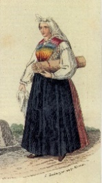
A peasant costume from the vicinity of Škofja Loka, 1837/38. In: Ivan Stopar: Kranjske noše – Goldensteinove upodobitve, 1993.
The depicted woman from Škofja Loka has a peča headscarf, which is folded in three corners, tied around the forehead in a way that makes the embroidered corner hang loosely over the nape of her neck, and the other two corners are pulled crosswise under the hanging corner and bow-tied at the top of her head. During the wintertime, women from Škofja Loka would tie peča headscarves around the chin; a knot with the ends hanging down was at the top of the head.
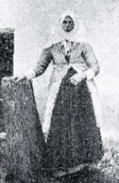
A woman from Stara Loka in a wintertime folk costume worn at the time. In: Franc Pokorn: Loka. Dom in svet, 1894.
To this day, the peča headscarf has been preserved as an integral part of women’s folk costume, which developed as a traditional garment during the Springtime of Nations, the reading society movement and the rally movement in the second half of the 19th century. In the post-WWII period, the folk costume is being preserved as part of cultural heritage. It can be seen as part of tourist and church events, as well as folk dance groups.
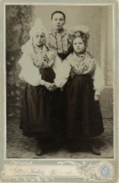
The Logonder sisters clad in a folk costume: Mina with a peča headscarf and Tona with an avba (mobcap-like) headdress on their heads. Pevno near Škofja Loka, 1907. Kept by the Škofja Loka Museum.
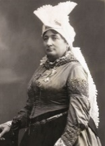
Franja Tavčar is wearing a black folk costume and a peča headscarf tied in a way that resembles a cockerel’s comb. Kept by the Ljubljana Historical Archives, Škofja Loka Unit.
In the last few decades of the 19th century, a special form of festive, formal attire was developed – the so-called black costume, also known as the bourgeois costume or, in rare instances, the Ljubljana costume. One of its most distinctive elements was the cockerel comb-tied peča, which evolved in the 1870s from the earlier bow-tied peča.
What materials were peča headscarves made of and how were they adorned?
The peča headscarves were made of linen. In the 16th century, women from the upper social classes (feudal and bourgeois ladies) wore not only linen headscarves, some of which featured black silk embroidery or had gold woven in, but also headscarves made of silk, velvet and cotton. In the 17th century, the listed materials were joined by damask, lace and knitted fabrics. However, in the late 17th century and in the 18th century, only feudal women could afford peča headscarves made of German, Dutch or Carniolan bobbin lace or veil peča headscarves.
For centuries, unadorned peča headscarves made of thicker or thinner linen were the most common headscarf type in the rural environment. To wealthier peasant women, cotton peča headscarves, which were considered an expensive and prestigious item, were not available until the late 18th and early 19th centuries. These peasant women, however, were criticised by the social elite and the ecclesiastics, who considered the use of cotton fabrics in peasants’ clothing to be an unnecessary extravagance and an unjustified luxury. This was their way of opposing the removal of the previous clothing-related dividing lines between the upper and lower social classes. With the development of the cotton industry, the price of cotton fabrics slumped and from the 1830s onwards, these fabrics became more accessible to less well-off peasant women, among others. In peasant settings, finer types of cotton cloth became more widely used after 1850.
Adoring peasant peča headscarves with white embroidery became more widespread in the first half of the 19th century. They were made by trained and self-taught embroiderers, who embroidered them to order or for sale. The most elaborate embroidery was on the most visible part of the peča, i.e. on the corner hanging down across the nape and the back. The embroidery consists of two compositional elements: a corner trim and a “flower” (bouquet). The “Gorenjska region pattern” is characterised by a large “flower” in a vase or a bow-tied “flower”:
During this period, peča headscarves started to be trimmed with the so-called metre peča lace, which was most probably made by bobbin lacemakers from Idrija, and in the 1880s also by the bobbin lacemakers from Škofja Loka. Many peča headscarves were not trimmed with lace until the second half of the 19th century with the arrival of machine-made metre lace, which was cheaper than bobbin lace.
Factory-made peča headscarves made of white muslin, and especially white tulle, became widespread in the 1870s. Tulle peča headscarves were usually machine-embroidered. They gave rise to a headscarf-tying style that resembled a cockerel’s comb.
In the second half of the 19th century, peča headscarves were also used for some other purposes. Older peasant women kept them for “death”, as it was once widely believed that a woman would cover herself with it on the Day of Judgement when rising from the grave. There were other death-related peča uses: it was used to cover the table when the priest came to attend the dying and sometimes to cover the dead person on a catafalque.