
Painted Beehive Panels from the Selca Workshop in Selca
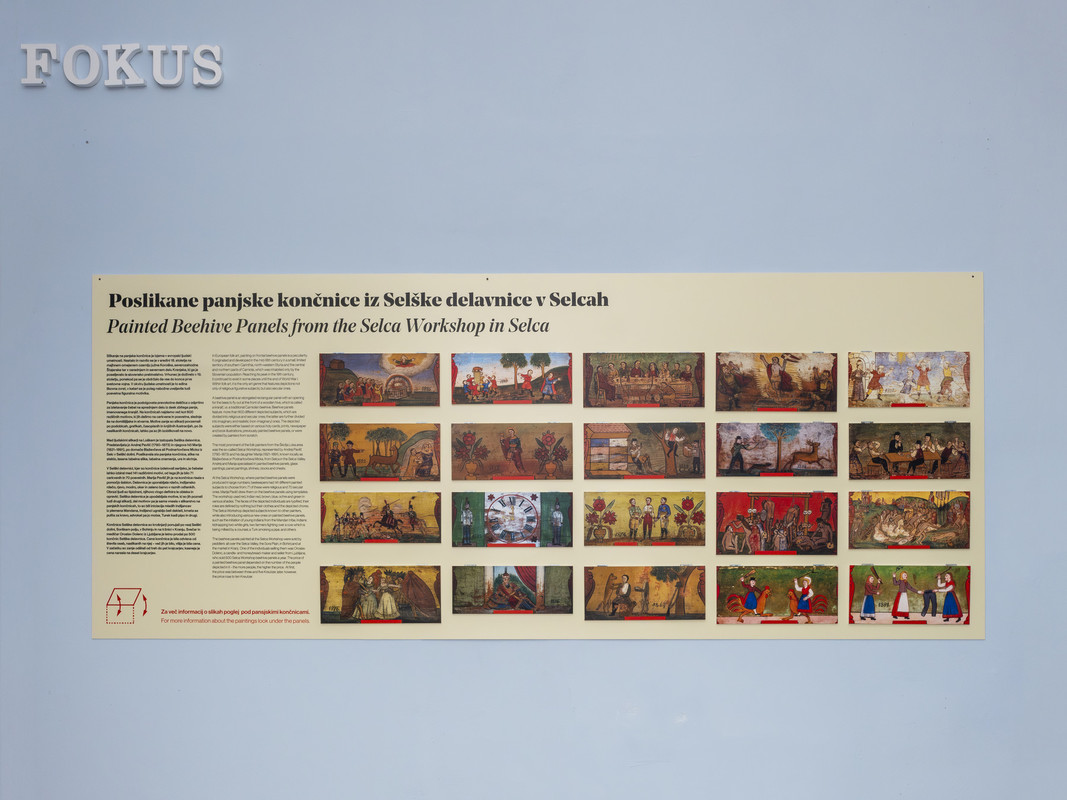
In European folk art, painting on frontal beehive panels is a peculiarity. It originated and developed in the mid-18th century in a small, limited territory of southern Carinthia, north-western Styria and the central and northern parts of Carniola, which was inhabited only by the Slovenian population. Reaching its peak in the 19th century, it continued to exist in some places until the end of World War I. Within folk art, it is the only art genre that features depictions not only of religious figurative subjects, but also secular ones.
A beehive panel is an elongated rectangular panel with an opening for the bees to fly out at the front of a wooden hive, which is called a kranjič, i.e. a traditional Carniolan beehive. Beehive panels feature more than 600 different depicted subjects, which are divided into religious and secular ones; the latter are further divided into imaginary and realistic (non-imaginary) ones. The depicted subjects were either based on various holy cards, prints, newspaper and book illustrations, previously painted beehive panels, or were created by painters from scratch.
The most prominent of the folk painters from the Škofja Loka area was the so-called Selca Workshop, represented by Andrej Pavlič (1790–1873) and his daughter Marija (1821–1891), known locally as Blaževčeva or Podnartovčeva Micka, from Selca in the Selca Valley. Andrej and Marija specialised in painted beehive panels, glass paintings, panel paintings, shrines, clocks and chests.
At the Selca Workshop, where painted beehive panels were produced in large numbers, beekeepers had 141 different painted subjects to choose from; 71 of these were religious and 70 secular ones. Marija Pavlič drew them on the beehive panels using templates. The workshop used red, Indian red, brown, blue, ochre and green in various shades. The faces of the depicted individuals are typified, their roles are defined by nothing but their clothes and the depicted chores. The Selca Workshop depicted subjects known to other painters, while also introducing various new ones on painted beehive panels, such as the initiation of young Indians from the Mandan tribe, Indians kidnapping two white girls, two farmers fighting over a cow which is being milked by a counsel, a Turk smoking a pipe, and others.
The beehive panels painted at the Selca Workshop were sold by peddlers all over the Selca Valley, the Sora Plain, in Bohinj and at the market in Kranj. One of the individuals selling them was Oroslav Dolenc, a candle- and honeybread-maker and seller from Ljubljana, who sold 500 Selca Workshop beehive panels a year. The price of a painted beehive panel depended on the number of the people depicted in it – the more people, the higher the price. At first, the price was between three and five Kreutzer, later, however, the price rose to ten Kreutzer.
***
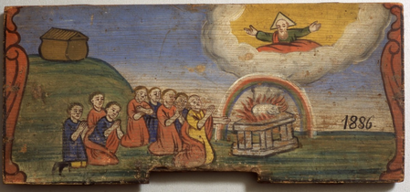
Noah’s Sacrificial Offering, a scene from the Old Testament, Selca Workshop, 1886, photo by Miran Kambič. Kept by the Museum of Apiculture Radovljica.
Only the humans and animals on Noah’s Ark survived the global deluge. When the ark landed on Mount Ararat and the earth dried up again, Noah built an altar and made a sacrificial offering to the Lord.
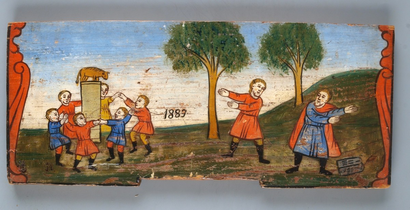
The Israelites Are Worshipping the Golden Calf, Moses Breaks the Two Tablets of Stone, a scene from the Old Testament, Selca Workshop, 1889, photo by Marko Habič. Kept by the Slovene Ethnographic Museum.
Moses led the Israelites out of Egyptian bondage. On the way, he climbed Mount Sinai, where he stayed for forty days. God gave him two Tablets of Stone inscribed with the Ten Commandments. During this time, the Israelites used gold jewellery to forge a golden calf, which they then worshipped. When Moses returned from the mountain, he got enraged, shattered the two Tablets of Stone and destroyed the golden calf. God spoke to Moses again and told him to lead his people to the promised land.
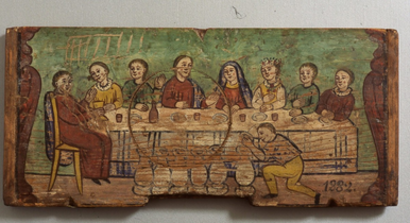
The Wedding at Cana in Galilee, a scene from the New Testament, Selca Workshop, 1882, photo by Miran Kambič. Kept by the Museum of Apiculture Radovljica.
Mary, Jesus and his disciples were invited to a wedding at Cana in Galilee. When the wine started to run low, Mary told Jesus, who turned the water in six jars into wine. This was Jesus’s first miracle.
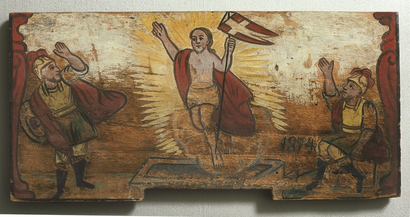
Resurrection of Jesus, a scene from the New Testament, Selca Workshop, 1874, photo by Miran Kambič. Kept by the Museum of Apiculture Radovljica.
The iconographic depiction of Jesus hovering in mid-air above the sarcophagus next to the guards dates back to the Gothic period. In Gothic depictions, the guards are usually asleep; the guards being awake, such as in beehive-panel depictions, is much less common.
This iconographic depiction represents the resurrection of Jesus three days after his death, giving Christians hope of eternal life. To commemorate this event, Christians celebrate Easter, which is considered the most important Christian feast.
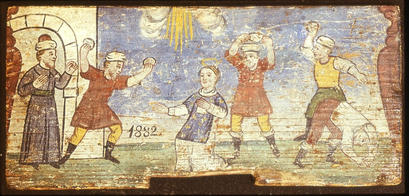
The Stoning of Saint Stephen, a scene from the New Testament, Selca Workshop, 1882, photo by Miran Kambič. Kept by the Museum of Apiculture Radovljica.
Saint Stephen, whose feast day is celebrated on 26 December, is considered the first Christian martyr. His teachings angered the Jewish high priests and consequently he was executed by stoning at the Damascus Gate in Jerusalem. Before he breathed his last, he cried out in a loud voice: “Lord, do not hold this sin against them.” On St Stephen’s Day, water and salt are blessed in churches, and so are horses in some places. In Slovenia, since 1990, a Slovenian national holiday – Independence and Unity Day – has also been celebrated on this day.
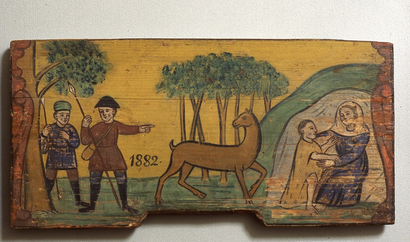
Saint Genevieve, a saint-related scene, Selca Workshop, 1882, photo by Miran Kambič. Kept by the Museum of Apiculture Radovljica.
Genevieve of Brabant was the wife of Count Siegfried of Treves, who had to go to war. He entrusted his pregnant wife to the care of a knight, who tried to seduce her, but in vain. The offended and vengeful knight informed the count that his wife had been unfaithful to him, and the count ordered her to be murdered. A servant took pity on Genevieve and left her and her child in the woods, in a cave where a roe brought them food. Seven years later, Count Siegfried returned from the war. At home, he found a letter in which his wife had declared her innocence. One day, when he went hunting in the woods, he chased a roe, which led him to the cave where his wife Genevieve was living with his son. The count realised his mistake and returned to the castle with his wife and child. His wife soon fell ill and died, and the count had a pilgrimage church built in her memory.
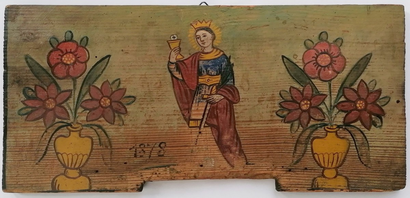
Saint Barbara, a saint-related scene, Selca Workshop, 1878, photo by Tomaž Lunder.
Saint Barbara (feast day on 4 December) was born in Nicomedia (273–306) in Asia Minor. Her father kept her locked up in a tower because she was very beautiful. Here, through a Christian, she learned about the Christian faith. When her father learned that she had become a Christian, he dragged her before the prefect of the province in a fit of rage. After she was tortured, her father himself beheaded her. Saint Barbara is the patron saint of miners, masons, soldiers, foundry workers, and the saint people pray to with their prayers of intercession if they wish for their last hour to be calm and happy. Her most typical attributes are a chalice with a host, a sword, a palm, a three-windowed tower and a crown of martyrdom.
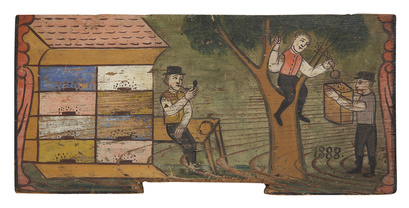
Beekeepers Hiving a Swarm, a beekeeping scene, Selca Workshop, 1888, photo by Aleksander Jesenovec.
A man with a pipe in his mouth is sitting by a beehive – the smoke coming out of the pipe is driving away the bees, calming them down. The other two men are hiving a swarm of bees that has landed on the tree. The man in the tree is using a wooden scoop to get the colony into a wooden box.
Swarming is the natural reproduction of bee colonies. During swarming, the colony divides into two parts. One part stays in the hive, while the other one leaves it. Beekeepers work to catch the swarm and place it in a new hive.
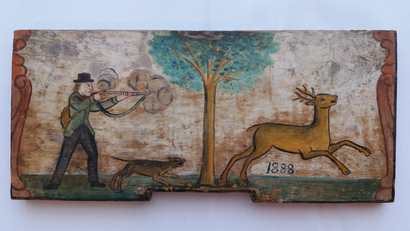
A Hunter with a Dog Is Shooting at a Roe Deer, a hunting scene, Selca Workshop, 1888, photo by Miran Kambič. Kept by the Museum of Apiculture Radovljica.
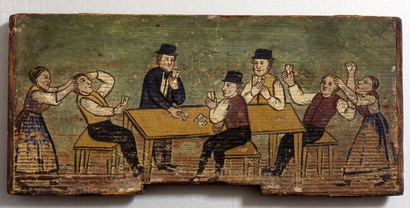
A Pub Scene, a village life depiction, Selca Workshop, photo by Miran Kambič. Kept by the Museum of Apiculture Radovljica.
Two wives come to a pub looking for their respective husbands, who are playing cards. They drag the husbands away from the table by their hair.
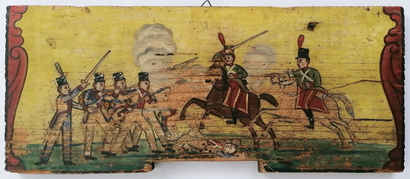
A Battle Between Horsemen and Foot Soldiers, Selca Workshop, 19th century, photo by Aleksander Jesenovec.
On the left, there are five foot-soldiers with sabres, one of whom is lying on the ground wounded. Depicted on the right are two horsemen.
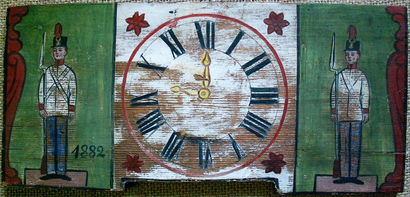
A Clock, Two Soldiers, a military scene, Selca Workshop, 1882, photo by Aleksander Jesenovec.
The painted beehive panel is divided into three fields. In the middle one, there is a clock with Roman numerals, the hands indicating that the time is 9 o’clock. In the left and right fields are depictions of two soldiers standing guard, with a bayonet at their right side.
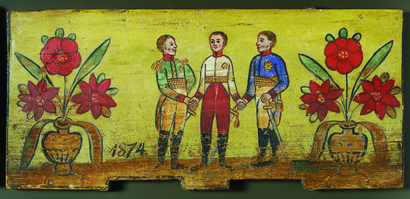
The Congress of the Holy Alliance in Ljubljana in 1821, attended by Tsar Alexander I of Russia, Emperor Francis I of Austria, King Frederick William III of Prussia, a historical scene, Selca Workshop, 1874, photo by Miran Kambič. Kept by the Museum of Apiculture Radovljica.
The congress, which took place in Ljubljana, was one of the biggest 19th-century events on Slovenian soil. In addition to Tsar Alexander I of Russia, Emperor Francis I of Austria and King Frederick William III of Prussia, it was attended by many European diplomats, high-ranking officers and other dignitaries. The congress, by political agreement, used military intervention to supress the revolution in the Apennine Peninsula, not, however, also in Greece. The event lodged itself in the public consciousness – hence the aforementioned rulers were depicted on a beehive panel.
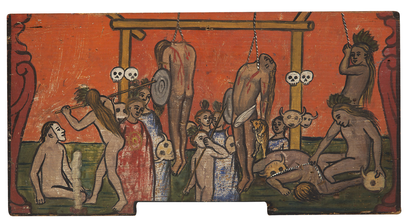
The Initiation of Young Indians from the Mandan Tribe, Part 1, an exotic scene, Selca Workshop, between 1870 and 1890, photo by Tomaž Lunder.
The initiation, called the Sun Dance of the young Mandan Indians, was described by Friderik Baraga in his book The History, Character, Manners and Customs of the North American Indians. After enduring four days of fasting, the young Indian men had their skin cut with a knife and wooden skewers inserted through the skin. Ropes were then attached to the skewers and used to pull the men up onto a sacred stake. In addition, they were often weighted down with buffalo skulls. When the skin around the skewers broke, they usually fell to the ground unconscious.
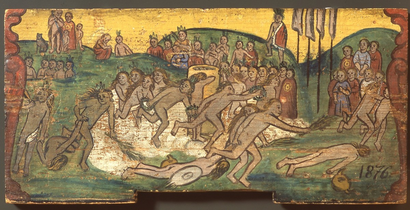
The Initiation of Young Indians from the Mandan Tribe, Part 2, an exotic scene, Selca Workshop, 1876, photo by Miran Kambič. Kept by the Museum of Apiculture Radovljica.
When the young men fell off the rope, they had another challenge to face – sacrificing at least one finger to the Great Spirit. The initiation ceremony ended with the young men being dragged on the ground around the cylinder-shaped totem pole until they lost consciousness a second time, and stayed lying on the ground. At dawn, the exhausted participants enjoyed a steam bath.
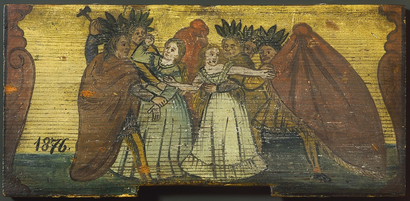
The Indians Kidnap Two White Girls, an exotic scene, Selca Workshop, 1876, photo by Miran Kambič. Kept by the Museum of Apiculture Radovljica.
In his book The History, Character, Manners and Customs of the North American Indians, Friderik Baraga mentions an incident when Indians attacked a group of settlers who had gone to work in the fields. They killed six men and three women, while also taking two girls and twenty cattle with them.
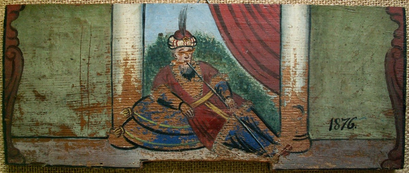
A Turk with a Pipe, an exotic scene, Selca Workshop, 1876, photo by Aleksander Jesenovec.
The Turk is lying on top of cushions, smoking a long pipe. This scene may be a depiction of the Slovenian idiom “kadi kot Turek”, which literally translates as “he smokes like a Turk”, used to describe someone who smokes a lot or excessively.
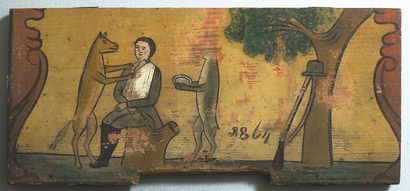
Two Foxes Shaving a Hunter, a scene showing animals acting human, Selca Workshop, 1864, photo by Miran Kambič. Kept by the Museum of Apiculture Radovljica.
The scene that shows foxes shaving a hunter is one of the scenes of the so-called topsy-turvy world, where animals’ and humans’ roles are reversed. Such scenes were spread all over Europe. In part, they date back to the antiquity, from the 16th century onwards, however, they were also a common feature on prints. The scene of the foxes shaving a hunter may be a depiction of the Slovenian idiom “norca briti iz nekoga”, which literally translates as “to shave a fool of someone”, meaning “to make a fool of someone”.
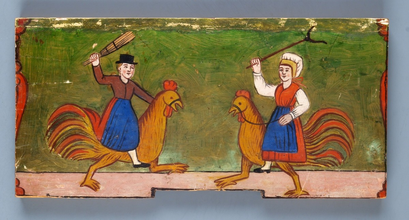
Two Women Riding Roosters, a scene depicting women being ridiculed, Selca Workshop, 19th century, photo by Marko Habič. Kept by the Slovene Ethnographic Museum.
The first woman is wearing a hat and holding a broom in her hand, while the second one, who is holding fire-tongs, has her head covered with an avba headdress. This scene is most probably based on a template, as the humorous duel of the riders on roosters had been depicted before – in an English woodcut dating from 1503/04.
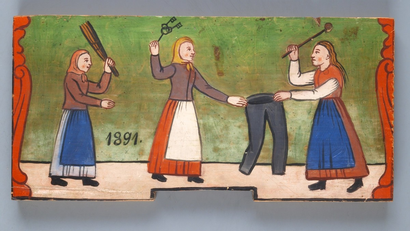
Fighting over Men’s Trousers, a scene depicting women being ridiculed, Selca Workshop, 19th century, photo by Marko Habič. Kept by the Slovene Ethnographic Museum.
The scene depicting women fighting over men’s trousers is most probably based on the folk song titled A Sick Girl Heals Herself with Trousers, which was known in Škofja Loka among other places. It is written down in Volume 4 of Karel Šterkelj’s collection Slovenian Folk Songs (p. 509, No. 8235).