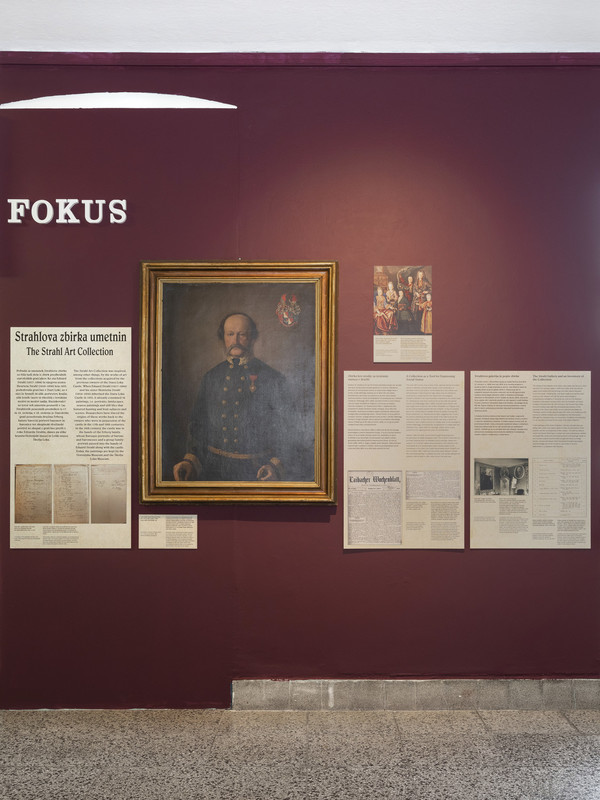
The Strahl Art Collection
The Strahl Art Collection was inspired, among other things, by the works of art from the collections acquired by the previous owners of the Stara Loka Castle. When Eduard Strahl (1817–1884) and his sister Henrietta Strahl (1816–1856) inherited the Stara Loka Castle in 1833, it already contained 56 paintings, i.e. portraits, landscapes, season paintings and still lifes that featured hunting and fruit subjects and scenes. Researchers have traced the origins of these works back to the owners who were in possession of the castle in the 17th and 18th centuries; in the 18th century, the castle was in the hands of the Erberg family, whose Baroque portraits of barons and baronesses and a group family portrait passed into the hands of Eduard Strahl along with the castle. Today, the paintings are kept by the Gorenjska Museum and the Škofja Loka Museum.
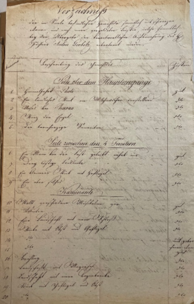
An inventory of the paintings at the Stara Loka Castle, 1833. Kept by the Archives of the Republic of Slovenia.
The inventory, which lists a total of 56 paintings, was commissioned by Eduard’s uncle, Franc Ksaver Demšar. It was made in the presence of the district physician Anton Gerbec, who had temporary use of the Stara Loka several times in the first half of the 19th century and was also in charge of the property inside the castle.
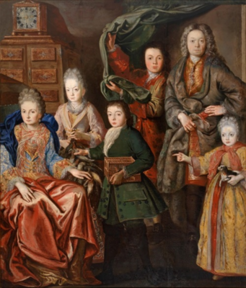
Unknown painter. A group portrait of Baron Erberg’s family, 200 × 170 cm, oil on canvas, early 18th century. Kept by the Škofja Loka Museum.
The painting depicting a group portrait of the family of Baron Johann Adam Erberg, who bought the Stara Loka estate in 1706, is a rare example of a group family portrait dating back to the early modern period in Slovenia. The monumental work is on view as part of the permanent exhibition on the museum’s ground floor.
A Collection as a Tool for Expressing Social Status
The mid-19th century was a time of the national identity formation, which is reflected, among other things, in the exploration of domestic history and culture. At the same time, the nobility was still interested in flaunting their high status and art collections could prove a useful tool for this. Apart from the zeitgeist, Eduard’s interest in art may have been fostered by his uncle’s zeal for collecting art, and even more so by his ties with the painter Cecilia von Plettenegg (1821–1855), married name Strahl, who was taught how to paint by her mother Elisabeth von Pilgram and by the Vienna-based painter Heinrich Hollpein. In the concluding part of her article titled Po sledeh Strahlove zbirke (Tracing the Strahl Collection), Dr Renata Komić Marn suggests that “in part, his zeal for collecting art was the result of his need to prove his hard-won status”. In fact, Eduard Strahl, who was a lawyer by profession, was unable to prove his nobility prior to his marriage to Cecilia Pettenegg. Consequently, he applied for a nobility title and obtained it four years after his marriage (1848), when it was granted by the reigning Prince Alois of Leichtenstein.
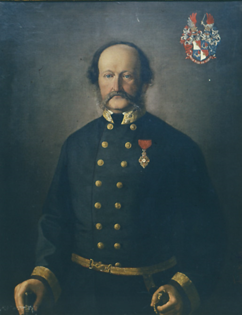
Ivan Franke, A Portrait of Eduard Strahl, 97 × 75 cm, oil on canvas, 1868. Kept by the Škofja Lka Museum.
Among the nobility, portraits like the portrait painted by Ivan Franke had a representative function. Even now such portraits convey the sitter’s education or status through the depicted objects and clothing. By means of the portraits displayed in their mansions and castles, members of the nobility showed their origins and tradition of belonging to a high social class. Eduard Strahl commissioned this portrait, when he was awarded the high decoration of the Order of Franz Joseph.
Between 1864 and 1868, Eduard Strahl bought 26 paintings from the well-known art dealer Alessandro Volpi. This is Strahl’s first known art purchase, following which he collected various paintings, objects and antiques. On his behalf, objects were searched for and collected in the homesteads all over the Gorenjska (Upper Carniola) region by the housekeeper of the Stara Loka Castle Nepomucena Strupi, Eduard’s son Carl von Strahl (1850–1929) and Carl’s friend Janko Škerjanc. Edvard also purchased paintings in Ljubljana and Graz, and he kept adding to the collection until his death in 1884, when his son Carl took over.
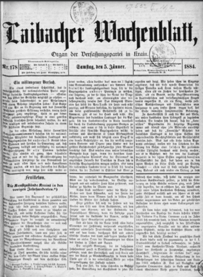
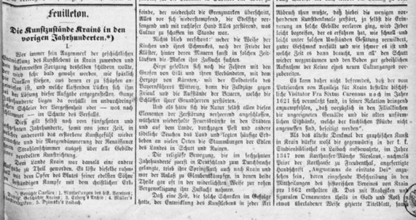
Kunstzüstande Krains in den vorigen Jahrhunderten (Situation in the Field of Art in Carniola in Past Centuries), Laibacher Wochenblatt, Issue 178 (5 Jan 1984), Ljubljana, 1984.
Eduard Strahl was not only devoted to assembling his own art collection, but also commented on and researched the history of Slovenian art and the events in the cultural sphere. During the year of his death, the Laibacher Wochenblatt newspaper featured his essay Kunstzüstande Krains in den vorigen Jahrhunderten (Situation in the Field of Art in Carniola in Past Centuries), which was later considered one of “the first attempts to present an overview of our artistic past”. It was published in nine instalments in the Feuilleton column, which featured essays on art, fiction, social life, etc.
The Strahl Gallery and an Inventory of the Collection
The display of the collection at the Stara Loka Castle was set up by Carl’s wife Mimi von Lehmann (died in 1929) circa 1909, when she had the castle rooms redone and the paintings and other objects displayed around the castle. Following this, Carl Strahl made sure that the public could tour the collection and that the works were included in comprehensive exhibitions of Slovenian art, such as The Historical Exhibition of Slovenian Painting (1922) and The Exhibition of Portrait Painting in Slovenia from the 16th Century to the Present Day (1925). Almost a hundred years after the aforementioned inventory of the paintings at the Stara Loka Castle, he also authored and edited the Catalogue, which includes approximately 600 works, thus testifying to the intense art collection-related work undertaken by the Strahl family. Although the Catalogue does not include lists of artefacts and antiquities, it is an important document for the study of the Strahl Collection.
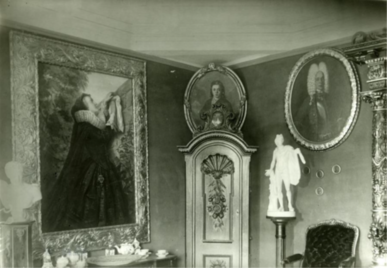
Veliki salon v drugem nadstropju Starološkega gradu z Globočnikovo sliko Marije Stuart na levi, 1929, Stara Loka (© INDOK center MK; foto: France Stele)
The collection at the Stara Loka Castle was photographed by the conservator and art historian France Stele. Stele first visited the Strahl Gallery – as it used to be known – in 1923 as part of a study trip made by the Art History Society and on this occasion he made arrangements to photograph some “of the more important objects”. The last time he visited Carl Strahl in Stara Loka was in the summer of 1929 in order to mark the works that are important for the national collections, and on this occasion he photographed the display.
In the Catalogue of the Strahl Collection, Carl also included short yet telling notes, which now make it easier to follow the provenance of the artworks and the circumstances of their creation. The brief annotations reveal that Eduard Strahl kept in contact with local contemporary painters. He bought their works and commissioned them to do paintings based on the proposed subjects and the artists brought him works by foreign painters. He was well aware of the importance of preserving tangible cultural heritage and he did his best to save works of art from deterioration in cooperation with restorers.
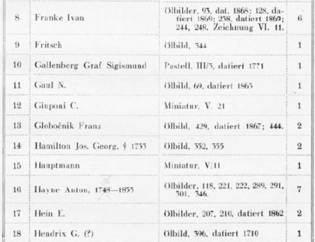
List of contemporary artists in the Strahl Collection, based on the Strahl Collection Catalogue (Janko Polec, Zbornik za umetnostno zgodovino, 1931, pp. 203–206).
In addition to the works of art dating back to older periods, Eduard Strahl also added works by contemporary Slovenian painters to his collection. Judging by the list of the artists, which Carl Strahl included in the Catalogue, the Strahl Collection contained the artworks created by twelve Carniolan contemporary artists; he acquired most of their 77 works directly from them.