A bronze age settlement in Trata near Škofja Loka – the first results of archaeological research
Protective archaeological excavations have been underway in Trata near Škofja Loka since 2018, specifically in the area of Velike dobrave and Kozinov boršt above the village of Godešič (Godešič – Archaeological Site EŠD 12123). Research has revealed that the archaeological site – protected on account of two Iron Age barrows located in Kozinov boršt – contains a large prehistoric settlement from the Late Middle Bronze Age (15th to 12th centuries BC). The lowland settlement lies on the plain of Sorško polje to the east of the Žabnica stream on the edge of an old fluvial terrace of the river Sora. Archaeological excavations, funded by the Filc d. o. o. factory, are conducted by the Idrija-based company Avgusta d. o. o.
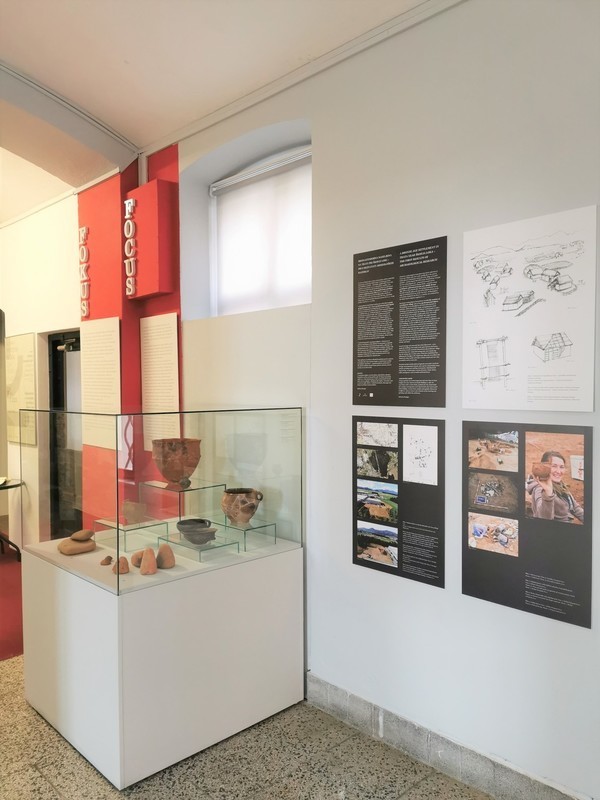
Systematic archaeological research has revealed the remains of a prehistoric village with at least 35 documented objects. The buildings can be identified on the basis of the location of postholes, which show mostly simple rectangular floor plans consisting of two parallel lines of holes for vertical posts or with a central line of postholes inside the building, most likely to support the roof. Between the upright wooden posts, there were walls made of wattle and daub. The buildings' size ranges between 5 and 7 × 3 m, some buildings, however, are larger and more complex than this, and are sized up to 30 × 10 m. In addition to the basic buildings, number of different pits and postholes have been documented that could not be connected into meaningful units, it is, however, assumed that they were part of various fences, extensions, jutting roofs and other useful everyday structures. The settlement picture shows a settlement of the scattered type, most likely without any defensive structures. The settlements' boundaries have yet to be discovered; given the current state of the research it can be assumed that the settlement extended further west, east and south, while towards the north the population density was lower.
Several storage and waste pits have been discovered – a few inside the buildings, but mostly in the space between the houses. Most of the ceramic materials discovered in this prehistoric village are from these pits. Large food-storage pots were mostly dug into the storage pits. In many cases, it has been established that, following the damage to the original pot, these pits were filled with shards of a large number of broken ceramic vessels and were thus secondarily used as waste pits.
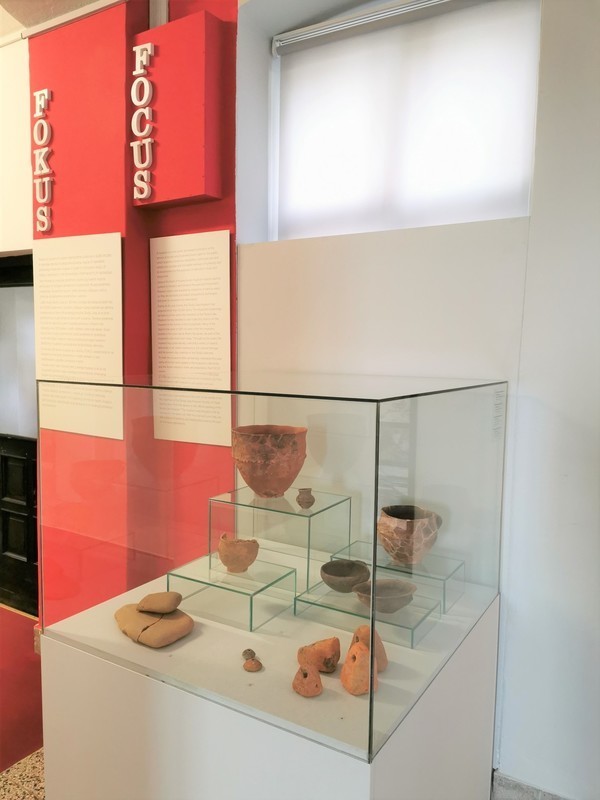
The finds include mainly pottery fragments of ceramic vessels for storage and preparation of food, stone querns and grinding stones used for grinding and crushing cereal grains. Paleobotanical research has revealed plant remains of emmer wheat, barley, millet and legumes, such as lentils and broad beans.
A WEAVING LOOM
A large quantity of ceramic fragments and more than 20 loom weights have been discovered inside Building 11. After the excavation of the ceramic finds, postholes for the construction of a wooden weaving loom were discovered in the western part of the building. Ceramic loom weights and spindles discovered in different contexts attest to the existence of the weaving and spinning craft within the settlement.
Barbara Brezigar