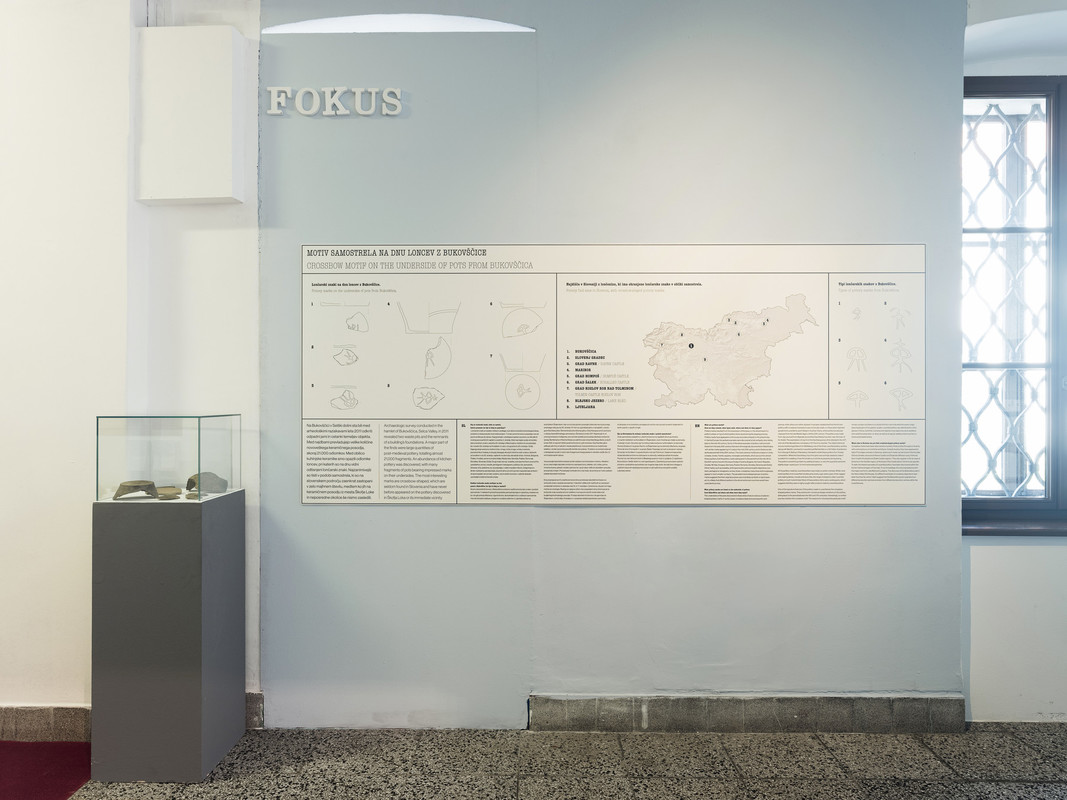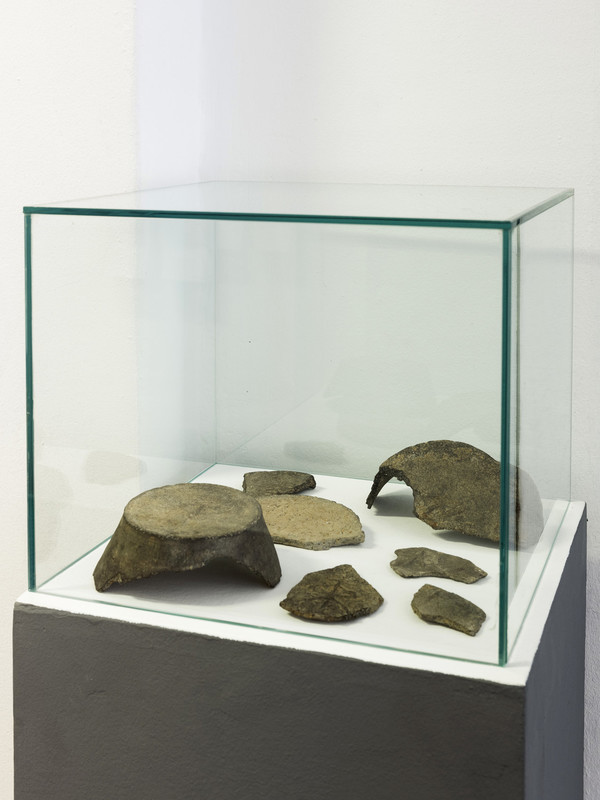
Crossbow Motif on the Underside of Pots from Bukovščica
Archaeologic survey conducted in the hamlet of Bukovščica, Selca Valley, in 2011 revealed two waste pits and the remnants of a building’s foundations. A major part of the finds were large quantities of post-medieval pottery, totalling almost 21,000 fragments. An abundance of kitchen pottery was discovered, with many fragments of pots bearing impressed marks on their undersides. The most interesting marks are crossbow-shaped, which are seldom found in Slovenia and have never before appeared on the pottery discovered in Škofja Loka or its immediate vicinity.
What are pottery marks? How are they created, what types exist, where and when do they appear?
Pottery marks resulted from the impression of the base, i.e. the wheel head of a potter’s wheel, on top of which pottery items stood during the shaping process. Pottery marks have appeared continuously since late antiquity to the present day. In Central Europe, the earliest examples were discovered at late antiquity sites dating back to the mid-4th century. Some of the latest examples of pottery marks include those from the early 20th century that were ethnologically documented in Bela Krajina, with similar marks appearing in Croatia in the mid-20th century and in Serbia as late as the second half of the 20th century. The most common motifs are crosses-in-circle, crosses, circles, rhombi, squares, rectangles and wheels, which account for almost three quarters of all the pottery marks dating back to the period from the mid-4th to the 20th century found in the area of today’s Austria, Bulgaria, the Czech Republic, Croatia, NE Italy, Hungary, Germany, Poland, Romania, Slovakia, Slovenia and Serbia. Other marks, such as swastika, anthropomorphic and zoomorphic depictions, sun, stars, pentagrams, hexagrams, arrows, bows, crossbows, trees, lines and hourglasses, appear in much smaller numbers. The persistent and widespread use of pottery marks suggests that their original purpose was most likely symbolic or apotropaic, as it is unlikely that different potters in the aforementioned countries would have used identical ones.
What pottery marks are found on the underside of pottery from Bukovščica and where and when were they made?
The undersides of the pots discovered in Bukovščica feature various crossbow-shaped pottery marks. In some cases, crossbow depictions are beautiful and precise, while others are rather stylised. It has been established that the kitchen pottery with crossbow impressions was not locally made, i.e. these were imported goods from Lavanttal (Lavant Valley) in Austrian Styria, where potters produced clayware from the late Middle Ages until the 20th century. The pottery was made from clay sourced from deposits around the Daschberg mountain near the town of St. Andrä. The exploitation of clay from the Dachberg area is first attested in the 1371 rent roll of the Benedictine monastery in St. Paul im Lavanttal. The oldest historical source mentioning potters from Wolfsberg, one of the three Lavanttal pottery centres (along with Bad St. Leonhard im Lavanttal and Reichenfels), is a 1521 letter of protection from George III, Bishop of Bamberg, intended to shield these potters from foreign competition. While the Daschberg clay’s fine grain size and high plasticity make it excellent for modelling, it has the tendency to shrink excessively during drying. The potters solved this problem by adding tempers, i.e. very fine quartzite sand and slightly larger-sized (up to 1.5 mm) carbonate particles.
All the pottery made by Lavanttal potters was made on potter’s wheels. While more recent pottery from Lavanttal includes pots, bowls, jugs, ewers, pans, three-legged pots, baking dishes, moulds and stove tiles, the range of shapes in older Lavanttal pottery is much more limited. Most of these pottery items were cooking pots, which suggests that they were a highly sought-after product made by Lavanttal potters.
One of the signature features of the pottery made in Lavanttal are the crossbow-shaped pottery marks. They are found in numerous design variations on the pottery dating back to the period between the 15th and 17th centuries. Interestingly, no written sources mention the crossbow motif. The reasons for choosing this particular motif remain unclear, but there is no doubt that this mark indicated the ware’s origin, assuring buyers of its superior quality. Lavanttal pottery was distributed to other places in Styria, Carinthia, Carniola and neighbouring regions by pack peddlers, who sold the wares door-to-door, as well as at regular weekly and annual fairs in towns and market towns.
Where else in Slovenia can you find crossbow-shaped pottery marks?
Crossbow marks have been discovered on pottery finds at sites throughout Austria, with a strong focus on Carinthia and Styria. Outside Austria, they have appeared in Italy’s Friuli region and also in Slovenia, where such marks can be found in the Koroška (Slovenj Gradec area and at Ravne Castle) and Štajerska (Maribor area, Pohorski Dvor Castle (Hompoš) and Šalek Castle) regions. They also appear in the far west of Slovenia in the Goriška region, at the Kozlov Rob Castle above Tolmin to be specific. To date, the fewest examples of Lavanttal pottery have been discovered within the former historical region of Carniola. To our knowledge, the only examples found in this region are from Lake Bled and Ljubljana. The discovery at the Bukovščica site in the Selca Valley fills this gap. Six different examples of crossbow depictions have been found so far, which might suggest that the Bukovščica pots originate from different production periods and also from different production centres within the Lavanttal area.