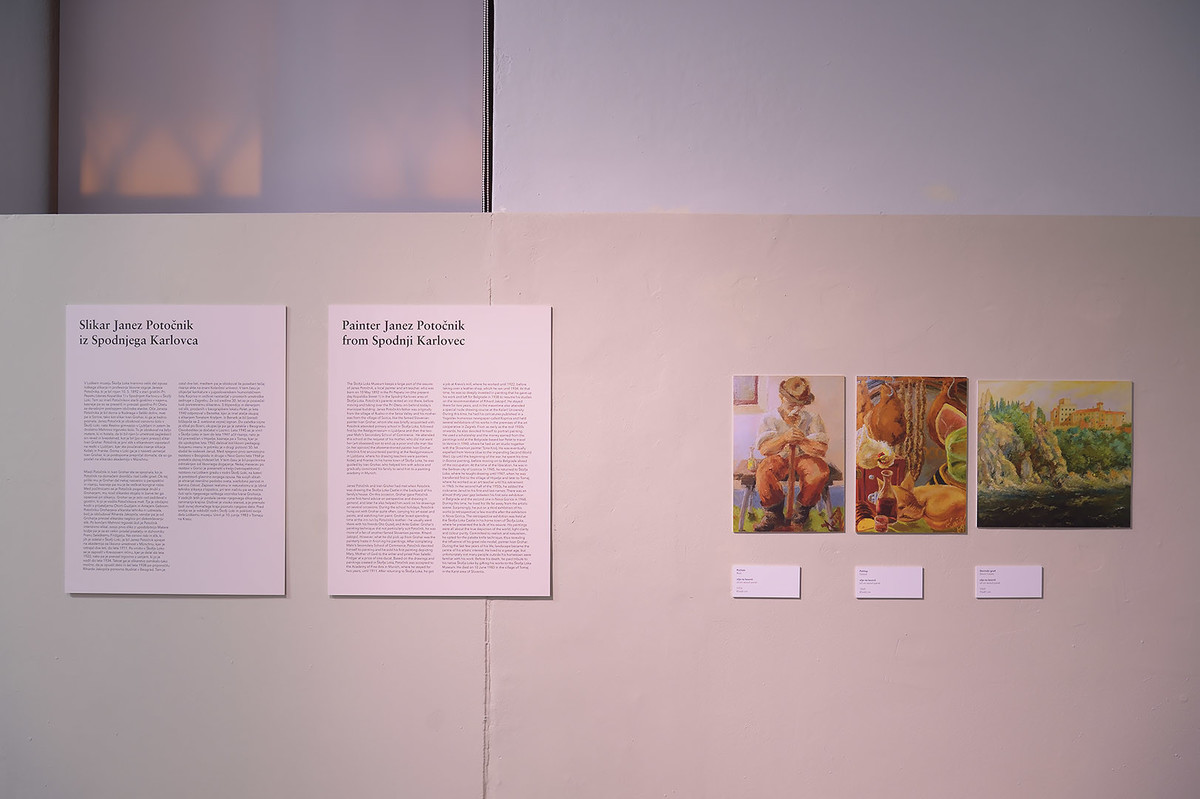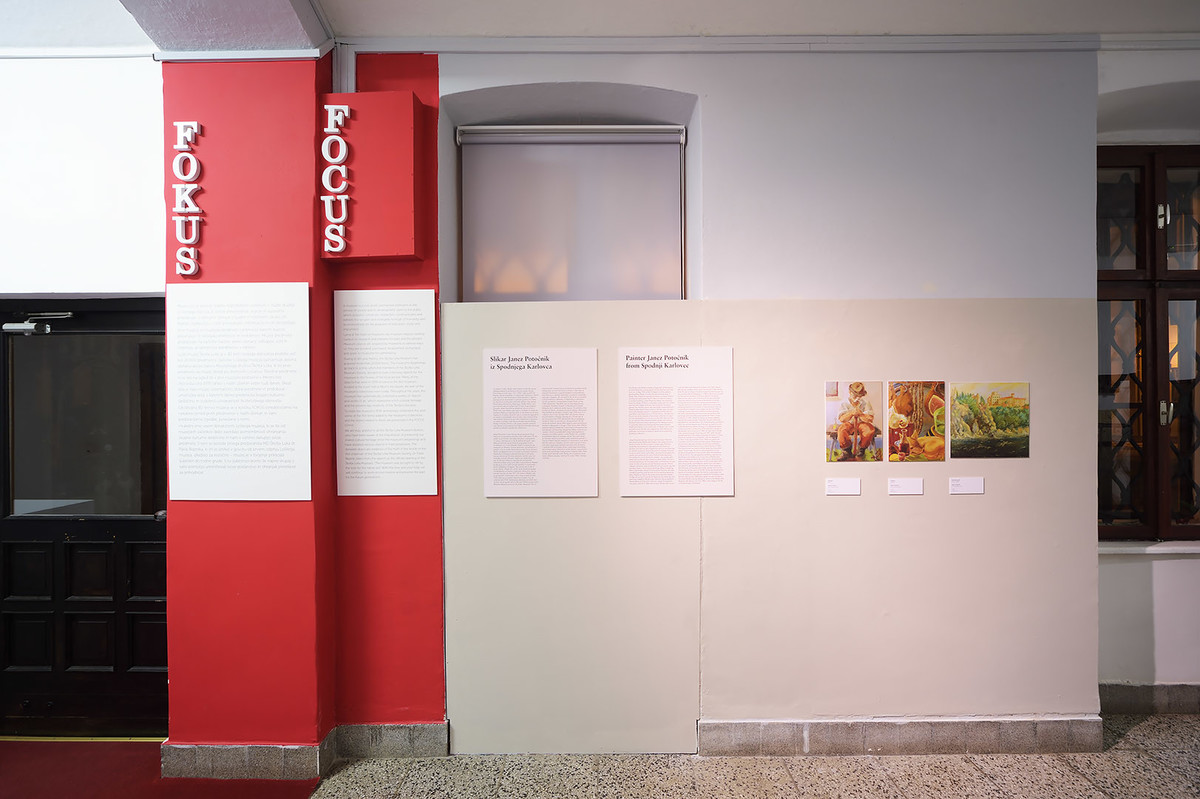
Painter Janez Potočnik from Spodnji Karlovec
The Škofja Loka Museum keeps a large part of the oeuvre of Janez Potočnik, a local painter and art teacher, who was born on 10 May 1892 in the Pri Pepetu inn (the present-day Kopališka street 1) in the Spodnji Karlovec area of Škofja Loka. Potočnik’s parents rented an inn there, before moving and taking over the Pri Otetu inn behind today’s municipal building. Janez Potočnik’s father was originally from the village of Rudno in the Selca Valley and his mother was from the village of Sorica, like the famed Slovenian painter Ivan Grohar, whom she was briefly acquainted with. Potočnik attended primary school in Škofja Loka, followed first by the Realgymnasium in Ljubljana and then the two-year Mahr’s Secondary School of Commerce. He attended this school at the request of his mother, who did not want her (art-obsessed) son to end up a poor and idle man like (in her opinion) the aforementioned painter Ivan Grohar. Potočnik first encountered painting at the Realgymnasium in Ljubljana, where his drawing teachers were painters Koželj and Franke. In his hometown of Škofja Loka, he was guided by Ivan Grohar, who helped him with advice and gradually convinced his family to send him to a painting academy in Munich.
Janez Potočnik and Ivan Grohar had met when Potočnik was drawing the Škofja Loka Castle in the backyard of his family’s house. On this occasion, Grohar gave Potočnik some first-hand advice on perspective and drawing in general, and later he also helped him work on his drawings on several occasions. During the school holidays, Potočnik hung out with Grohar quite often, carrying his art easel and paints, and watching him paint. Grohar loved spending time at the inn run by Potočnik’s mother – he usually went there with his friends Oto Guzelj and Ante Gaber. Grohar’s painting technique did not particularly suit Potočnik, he was more of a fan of another Slovenian painter, Rihard Jakopič. However, what he did pick up from Grohar was the painterly haste in finishing his paintings. After completing Mahr’s Secondary School of Commerce, Potočnik devoted himself to painting and he sold his first painting depicting Mary, Mother of God to the writer and priest Fran Saleški Finžgar at the price of one ducat. Based in the drawings and paintings created in Škofja Loka, Potočnik was accepted to the Academy of Fine Arts in Munich, where he stayed for two years, until 1911. After returning to Škofja Loka, he got a job at Krev’s mill, where he worked until 1922, before taking over a leather shop, which he ran until 1934. At that time, he was deeply invested in painting that he gave up his work and left for Belgrade in 1938 to resume his studies on recommendation of Rihard Jakopič. He stayed there for two years, and in the meantime also attended a special nude drawing course at the Kolarč University. During this time, he had his caricatures published in a Yugoslav humorous newspaper called Kopriva and held several exhibitions of his works in the premises of the art cooperative in Zagreb. From as early as the mid-1930s onwards, he also devoted himself to portrait painting. He used scholarship and the money earned from the paintings sold at the Belgrade-based bar Polet to travel to Venice in 1940, where he had an art studio together with the Slovenian painter Tone Kralj. He was eventually expelled from Venice (due to the impending Second World War=. Up until the beginning of the war, he spent his time in Bosnia painting, before moving on to Belgrade ahead of the occupation. At the time of the liberation, ha was in the Serbian city of Loznica. In 1945, he returned to Škofja Loka, where he taught drawing until 1947, when he was transferred first to the village of Hrpelje and later to Tomaj, where he worked as an art teacher until his retirement in 1965. In the second half of the 1950s, he added the nickname Januš to his first and last names. There was an almost thirty-year gap between his first solo exhibition in Belgrade and the second one in Nova Gorica in 1968. During this time, he lived his life far away from the artistic scene. Surprisingly, he put on a third exhibition of his works (a retrospective) a few months after the exhibition in Nova Gorica. The retrospective exhibition was held at the Škofja Loka Castle in his hometown of Škofja Loka, where he presented the bulk of his oeuvre. His paintings were all about the true depiction of the world, light clarity and colour purity. Committed to realism and naturalism, he opted for the palette knife technique, thus revealing the influence of his great role model, painter Ivan Grohar. During the last few years of his life, landscape became the centre of his artistic interest. He lived to a great age, but unfortunately not many people outside his hometown were familiar with his work. Before his death, he paid tribute to his native Škofja Loka by gifting his works to the Škofja Loka museum. He died on 10 June 1983 in the village of Tomaj in the Karst area of Slovenia.