The Tower on Krancelj Hill – The Site of the Earliest Archaeological Investigation of the Medieval Period in the Škofja Loka Area
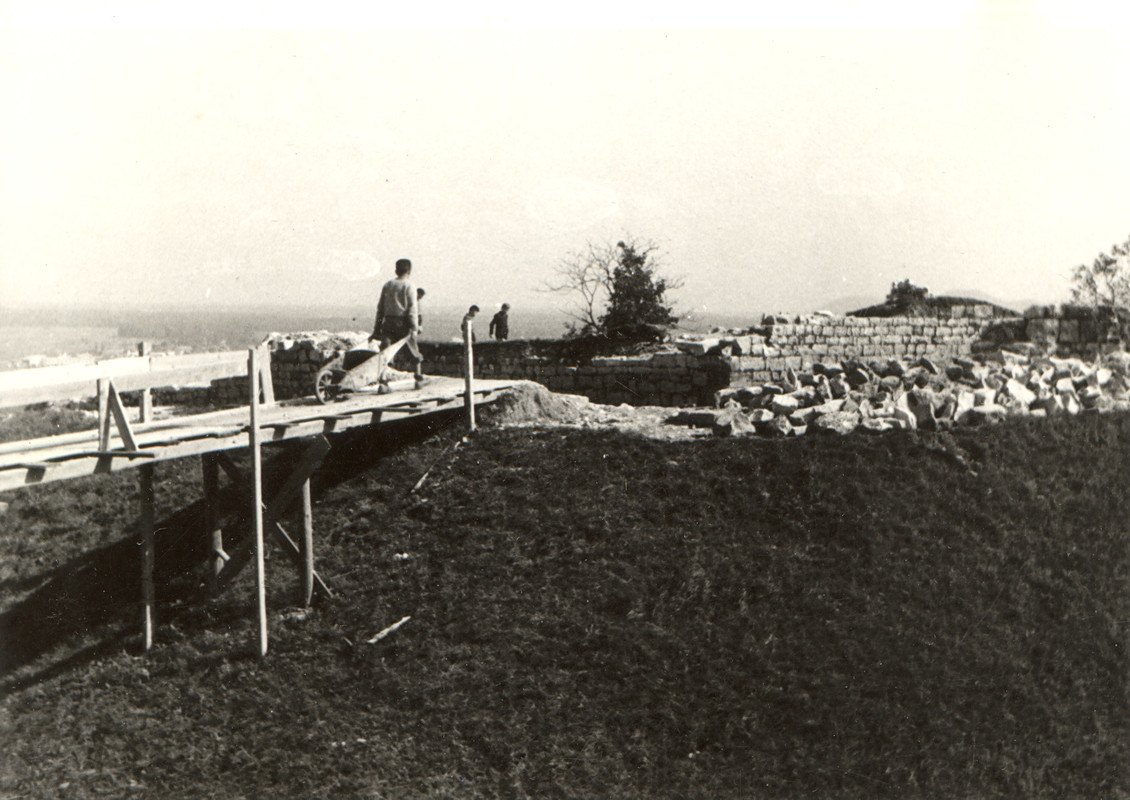
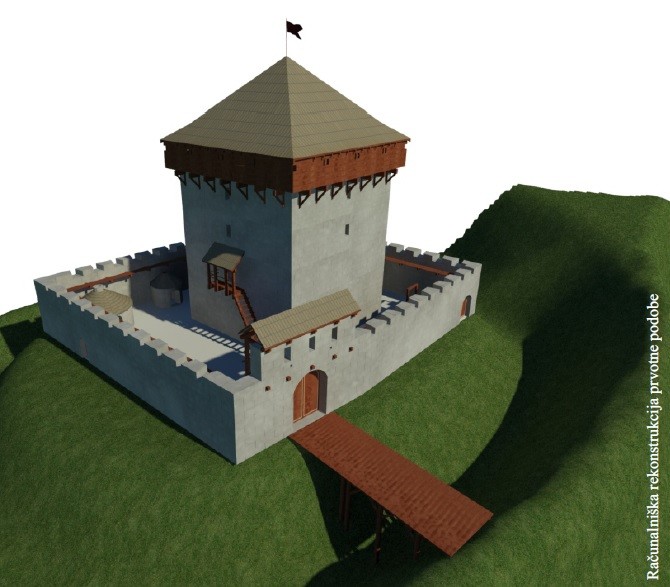
A simple square tower on the Krancelj Hill, which became the first castle in the area of Škofja Loka, was built by the Bishops of Freising probably in as early as the 11th century. Over time, several elements were added to the tower and, by the mid-15th century, it was already fortified with defensive walls and had a 5-metre-deep moat and a drawbridge. The castle remained in use until the devastating earthquake of 1511, when it was abandoned. The tower remains were gradually overgrown with vegetation and over the centuries the tower faded into oblivion, remaining completely forgotten until the mid-20th century, when archaeological research started in the 1954–1955 period. The first two archaeologists to undertake excavation work were Stane Gabrovec and Rudolf Berce of the Ljubljana-based National Museum of Slovenia. Initially, prehistoric finds were expected to be found at this site, as the overgrown remains of a medieval castle gave it the appearance of a large barrow on top of a hill. The expected evidence of earlier settlement was not found since a trial excavation showed that the finds date back to the Middle Ages, more specifically to the Romanesque period. However, at that time, this period was no longer in the domain of archaeology, but rather in the domain of art history or history, and after the trail excavations, the National Museum thus ceased all work on the Krancelj Hill. Further research was conducted under the expert management of Cene Avguštin, an art historian at the Municipal Museum of Kranj. Technical research management was entrusted to Karel Plestenjak, the director of the Škofja Loka Museum, while the digging was carried out by the students of local schools. A remarkable achievement for the time in question was a restoration of the excavated walls and a presentation of architectural remains with a partial addition built onto it according to the plans by architect Tone Bitenc. Today, the Tower on the Krancelj Hill is part of the Three Castles’ Educational Trail, and its remains are a point of interest attracting both local and foreign visitors.
A SERVANT-SHAPED CANDLESTICK - A REMARKABLE ARCHAEOLOGICAL FIND OF EUROPEAN REPUTATION
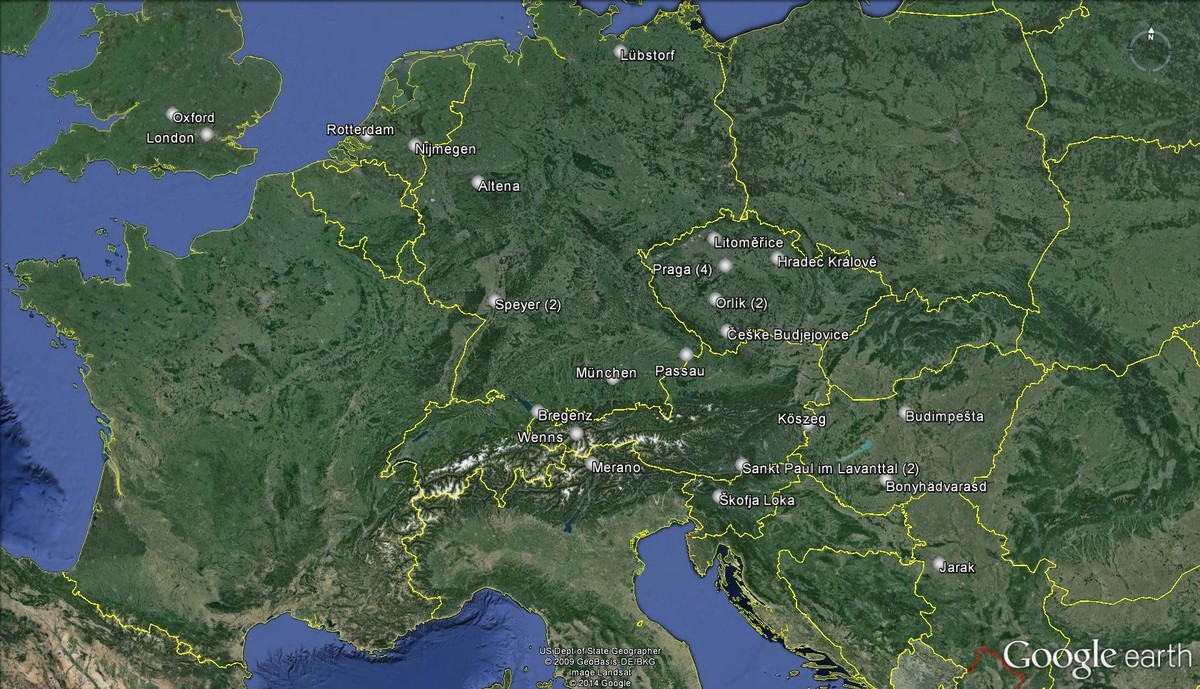
In addition to the architectural remains, numerous small ceramic and metal items have been excavated at the Tower on the Krancelj Hill, the most noteworthy of which is a bronze statuette that used to be part of an anthropomorphic candlestick. The statuette represents a medieval servant clad in close-fitting trousers and a girded skin-tight tunic with loose elbow-length sleeves. In his right hand, the servant is holding a round tray with a perforated border concealing the contact between the tray and the servant’s palm. In the tray’s middle, there used to be a candlestick cup. The left hand with a tray and a candlestick cup is not preserved and the tripod pedestal is also missing. Candlesticks of this kind are serial products that differ from one another only in some minor details, which can be explained through the use of different moulds. All the candlesticks are classified as the so-called dinanderie – objects cast in brass or bronze, which were made in the town of Dinant and other towns in Belgium, the Netherlands and Germany in the area between the rivers Meuse and Moselle. During the Late Middle Ages and the Renaissance (14th–15th centuries), such products were very popular and were thus for sale all over Europe. The map showing the locations reveals that at present there are 34 known servant-shaped candlesticks originating from Slovenia (1), Italy (1), Austria (4), Hungary (3), Serbia (1), Czechia (11), Germany (8), the Netherlands (2), United Kingdom (2), and an unknown location (1).