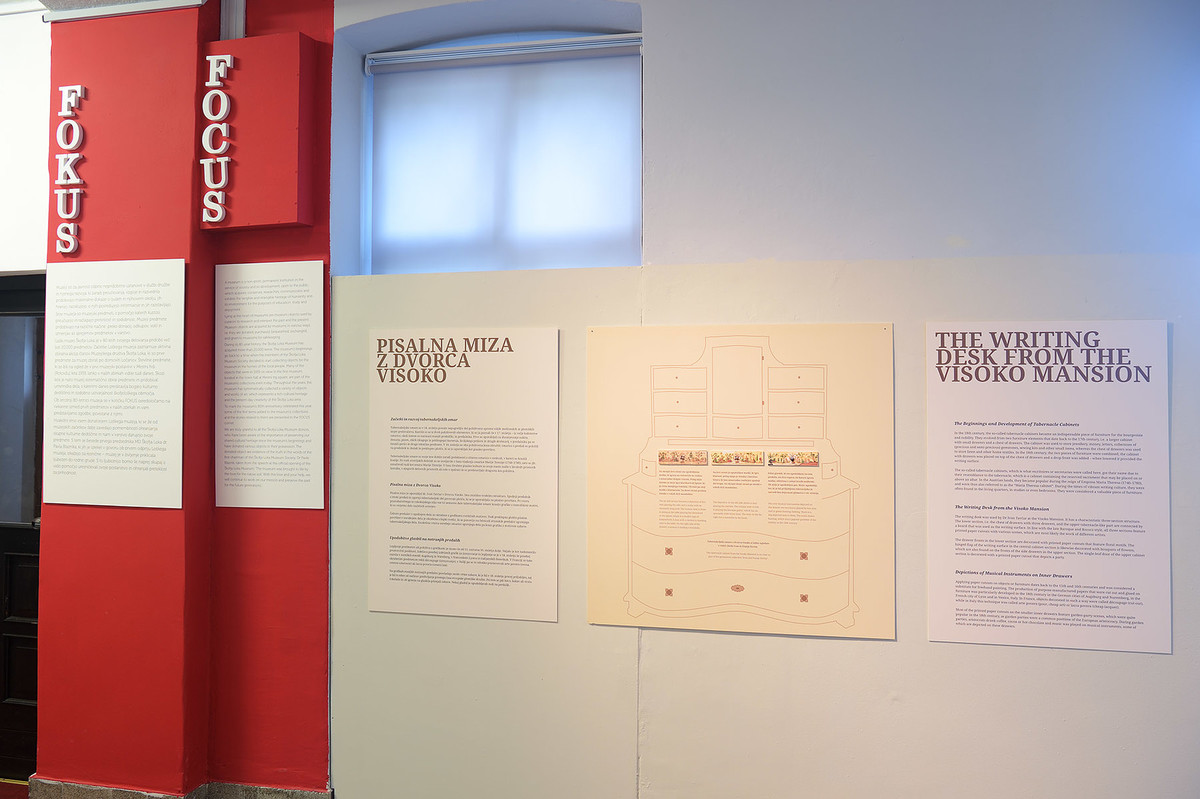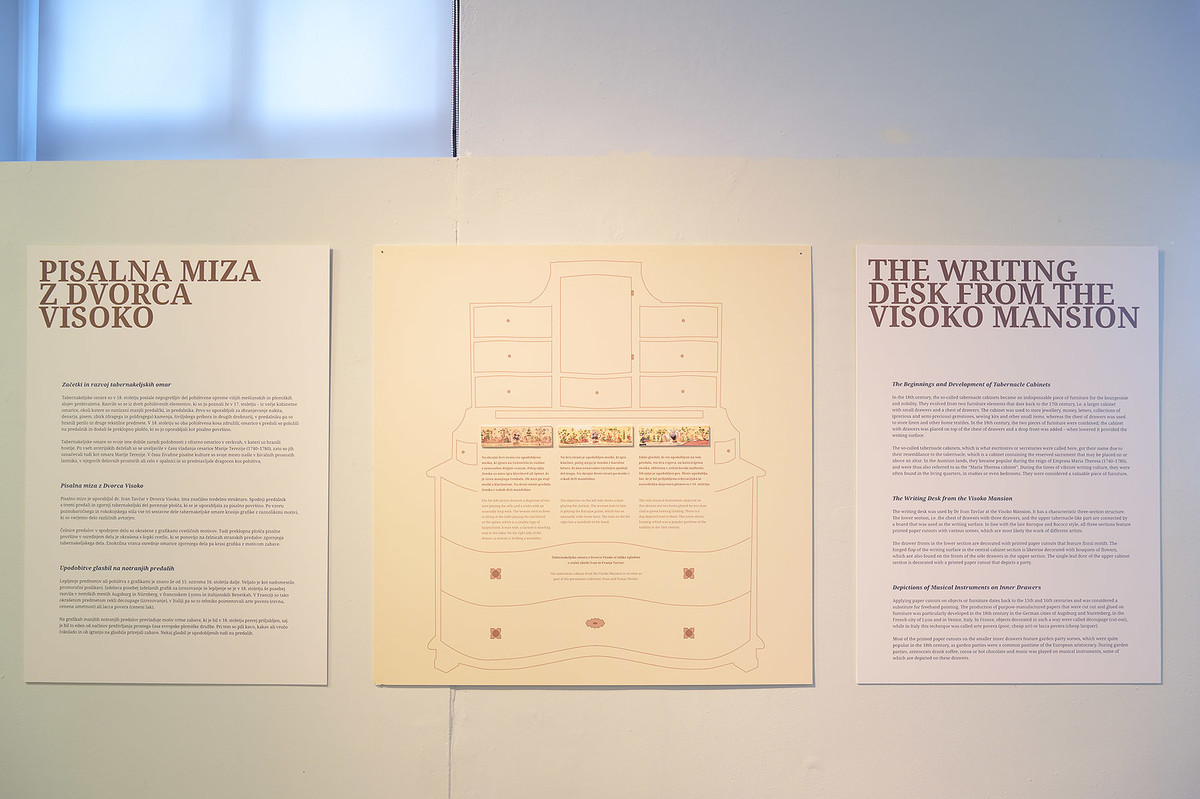
The writing desk from the Visoko Mansion
The Beginnings and Development of Tabernacle Cabinets
In the 18th century, the so-called tabernacle cabinets became an indispensable piece of furniture for the bourgeoisie and nobility. They evolved from two furniture elements that that date back to the 17th century, i.e. a larger cabinet with small drawers and a chest of drawers. The cabinet was used to store jewellery, money, letters, collections of (precious and semi-precious) gemstones, sewing kits and other small items, whereas the chest of drawers was used to store linen and other home textiles. In the 18th century, the two pieces of furniture were combined; the cabinet with drawers was placed on top of the chest of drawers and a drop front was added – when lowered it provided the writing surface.
The so-called tabernacle cabinets, which is what escritoires or secretaries were called here, got their name due to their resemblance to the tabernacle, which is a cabinet containing the reserved sacrament that may be placed on or above an altar. In the Austrian lands, they became popular during the reign of Empress Maria Theresa (1740–1780), and were thus also referred to as the “Maria Theresa cabinet”. During the times of vibrant writing culture, they were often found in the living quarters, in studies or even bedrooms. They were considered a valuable piece of furniture.
The Writing Desk from the Visoko Mansion
The writing desk was used by Dr Ivan Tavčar at the Visoko Mansion. It has a characteristic three-section structure. The lower section, i.e. the chest of drawers with three drawers, and the upper tabernacle-like part are connected by a board that was used as the writing surface. In line with the late Baroque and Rococo style, all three sections feature printed paper cutouts with various scenes, which are most likely the work of different artists.
The drawer fronts in the lower section are decorated with printed paper cutouts that feature floral motifs. The hinged flap of the writing surface in the central cabinet section is likewise decorated with bouquets of flowers, which are also found on the fronts of the side drawers in the upper section. The single-leaf door of the upper cabinet section is decorated with a printed paper cutout that depicts a party.
Depictions of Musical Instruments on Inner Drawers
Applying paper cutouts on objects or furniture dates back to the 15th and 16th centuries and was considered a substitute for freehand painting. The production of purpose-manufactured papers that were cut out and glued on furniture was particularly developed in the 18th century in the German cities of Augsburg and Nuremberg, in the French city of Lyon and in Venice, Italy. In France, objects decorated in such a way were called découpage (cut-out), while in Italy this technique was called arte povera (poor, cheap art) or lacca povera (cheap lacquer).
Most of the printed paper cutouts on the smaller inner drawers feature garden-party scenes, which were quite popular in the 18th century, as garden parties were a common pasttime of the European aristocracy. During garden parties, aristocrats drank coffee, cocoa or hot chocolate and music was played on musical instruments, some of which are depicted on these drawers.
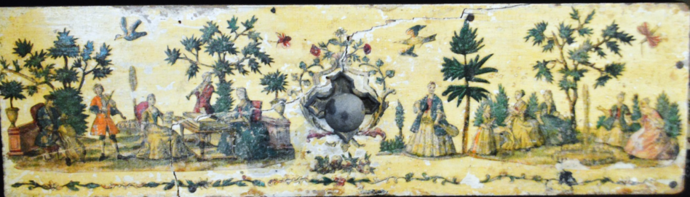
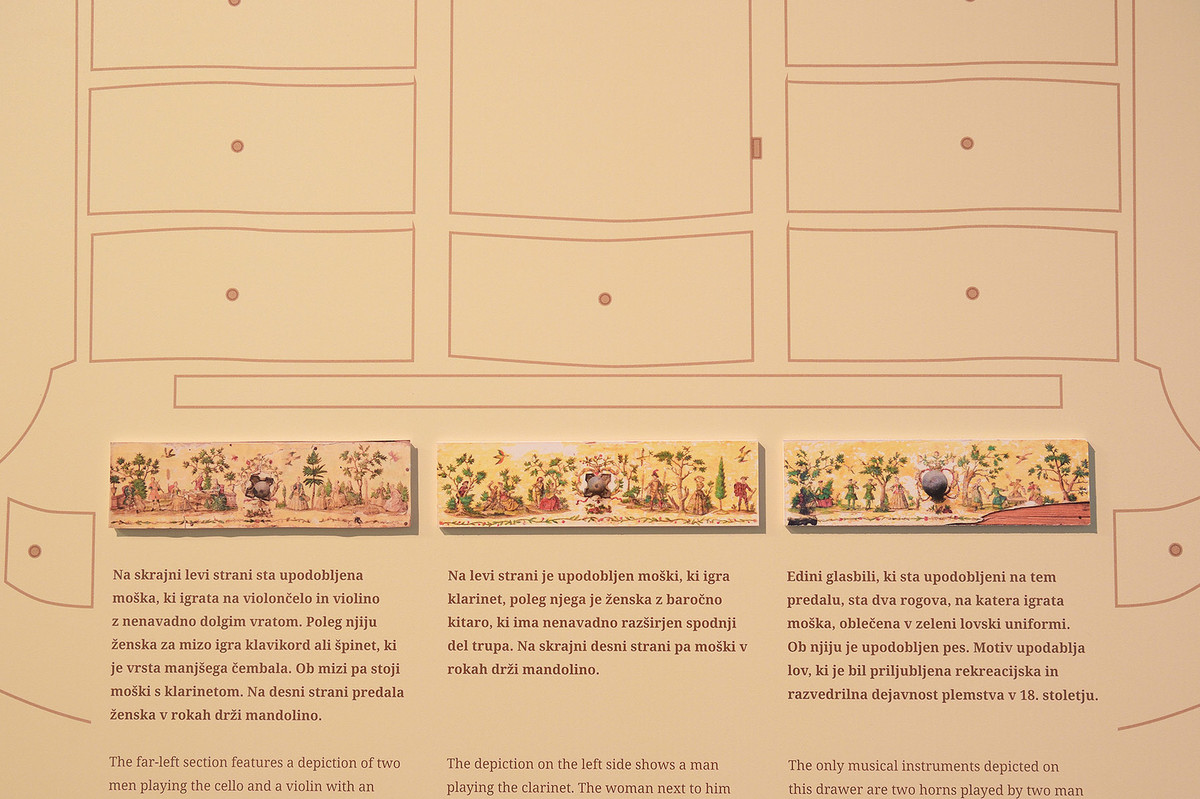
The far-left section features a depiction of two men playing the cello and a violin with an unusually long neck. The woman next to them is sitting at the table playing the clavichord or the spinet, which is a smaller type of harpsichord. A man with a clarinet is standing next to the table. On the right side of the drawer, a woman is holding a mandolin.
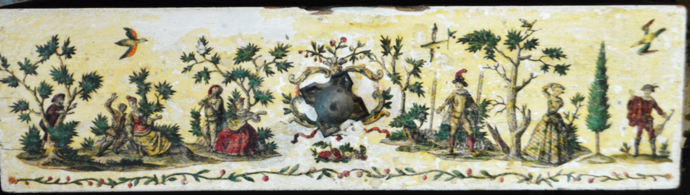
The depiction on the left side shows a man playing the clarinet. The woman next to him is playing the Baroque guitar, which has an unusually wide lower bout. The man on the far right has a mandolin in his hand.
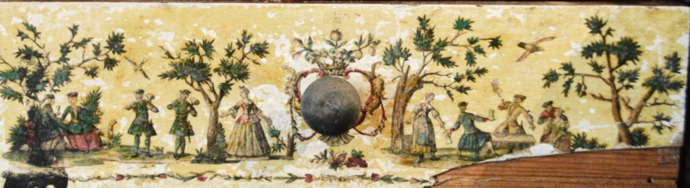
The only musical instruments depicted on this drawer are two horns played by two man clad in green hunting clothing. There is dog depicted next to them. The scene shows hunting, which was a popular pasttime of the nobility in the 18th century.