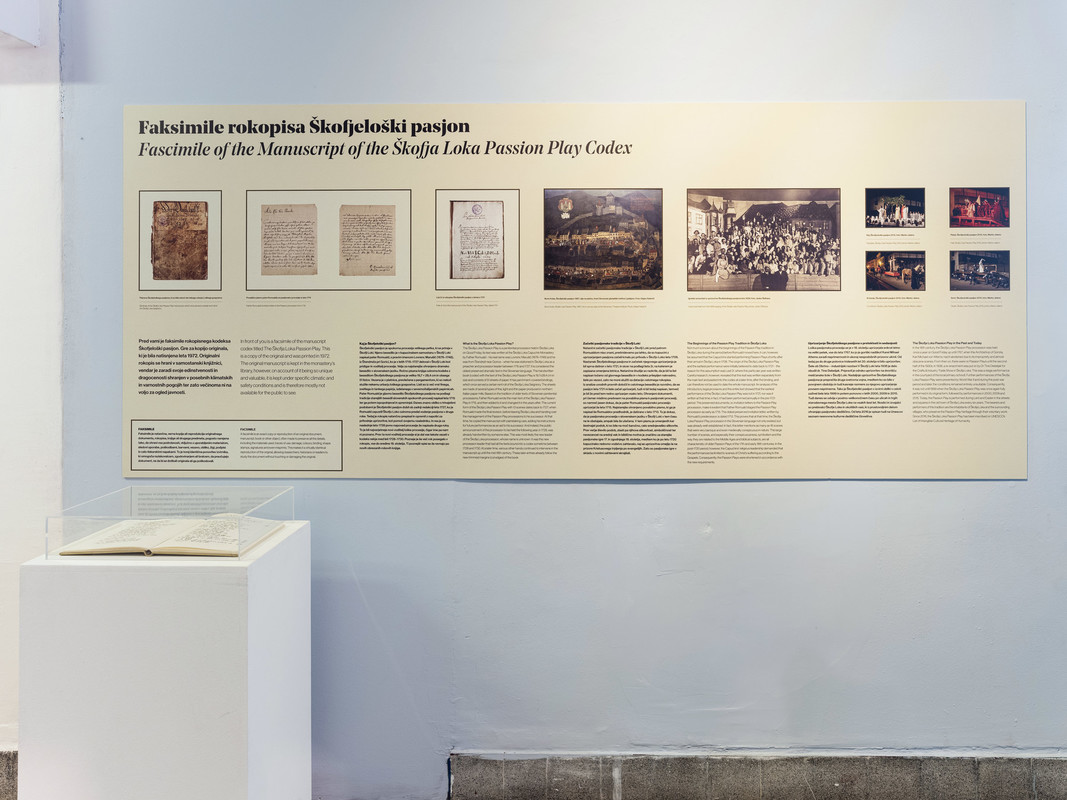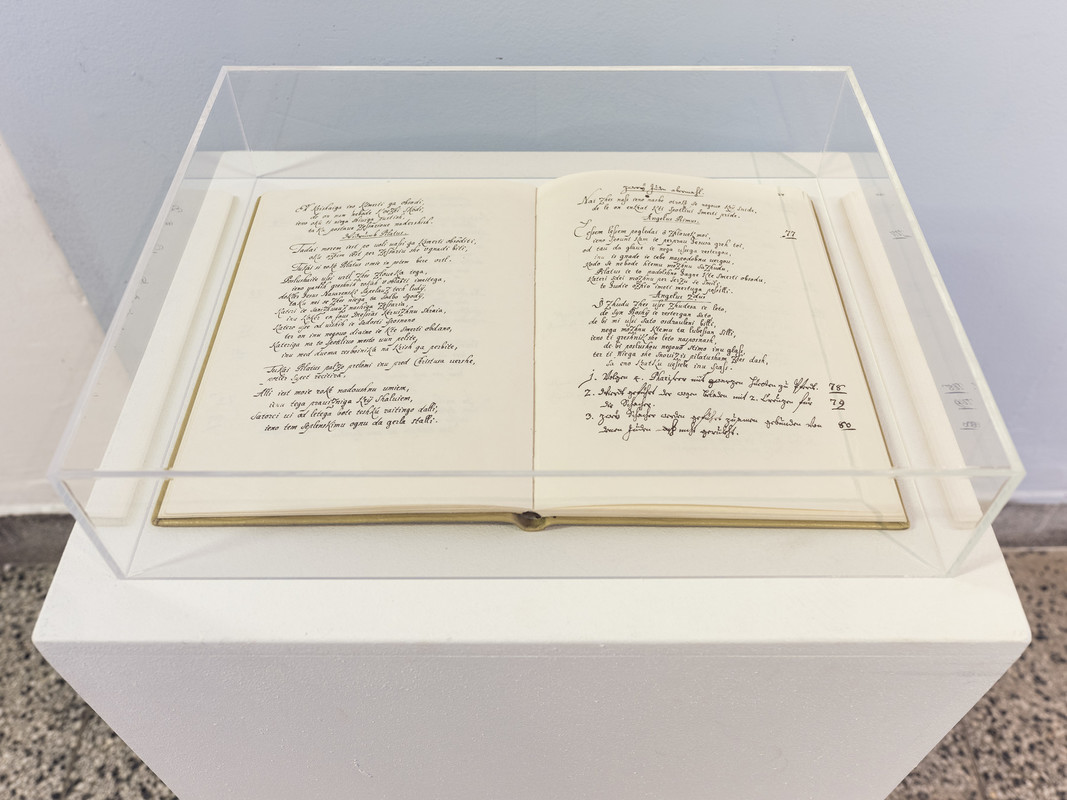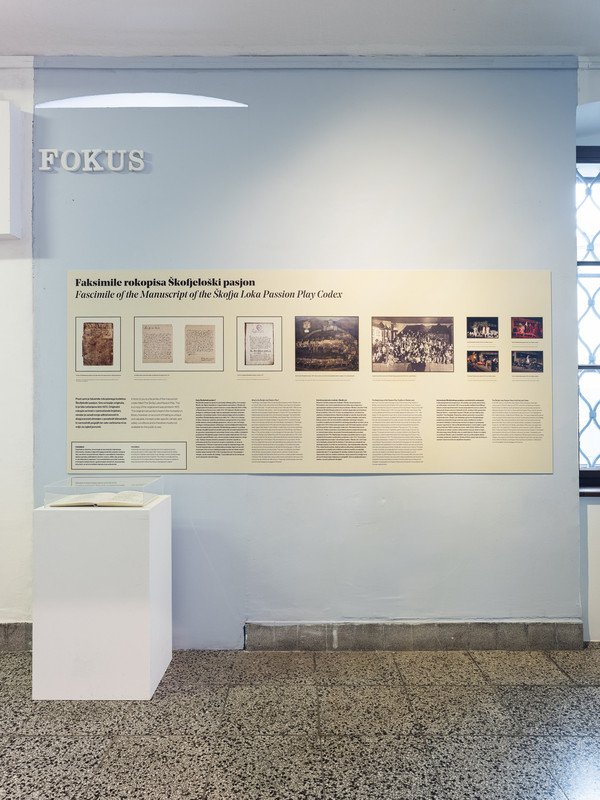
Facsimile of the Manuscript of the Škofja Loka Passion Play Codex
is a copy of the original and was printed in 1972. The original manuscript is kept in the monastery’s library, however, on account of it being so unique and valuable, it is kept under specific climatic and safety conditions and is therefore mostly not available for the public to see.
What Is the Škofja Loka Passion Play?
The Škofja Loka Passion Play is a penitential procession held in Škofja Loka on Good Friday. Its text was written at the Škofja Loka Capuchin Monastery by Father Romuald – his real name was Lovrenc Marušič (1676–1748) and he was from Štandrež near Gorica – when he was stationed in Škofja Loka as a preacher and procession leader between 1715 and 1727. It is considered the oldest preserved dramatic text in the Slovenian language. This handwritten book (codex) with the text of the Škofja Loka Passion Play is 19.7x28.4 cm in size and consists of 51 sheets of paper. It has parchment-covered bindings, which once served a certain rent roll of the Škofja Loka Seigniory. The sheets are made of several types of fine, light and thin paper produced in northern Italian paper mills. Based on the tradition of older texts of Slovenian penitential processions, Father Romuald wrote the main text of the Škofja Loka Passion Play in 1715, and then added to it and changed it in the years after. The current form of the Škofja Loka Passion Play with 13 scenes dates back to 1727, when Romuald made the final revision, before leaving Škofja Loka and handing over the management of the Passion Play processions to his successor. At that time, he copied the manuscript with painstaking care, adding his instructions for future performances as an aid to his successor. And indeed, the public announcement of the procession to be held the following year, in 1728, was already handwritten by someone else. This was most likely the new leader of the Škofja Loka procession, whose name is unknown. It was this new procession leader that had all the texts bound into a codex sometime between 1728 and 1730. At a later time, various other hands continued to intervene in the manuscript up until the mid-18th century. These later entries already follow the new trimmed margins (cut edges) of the book.
The Beginnings of the Passion Play Tradition in Škofja Loka
Not much is known about the beginnings of the Passion Play tradition in Škofja Loka during the period before Romuald moved here, it can, however, be assumed that the Capuchins started performing Passion Plays shortly after their arrival in Škofja Loka in 1706. The origin of the Škofja Loka Passion Play and the earliest performance were initially believed to date back to 1721 – the reason for this assumption was Leaf 2r, where this particular year was written. Careful research, however, revealed that this leaf was written separately from the main text and pasted into the codex at a later time, after the binding, and can therefore not be used to date the whole manuscript. An analysis of the introductory legal provisions and the entire text showed that the earliest performance of the Škofja Loka Passion Play was not in 1721, nor was it written at that time; in fact, it had been performed annually in the pre-1721 period. The preserved documents, i.e. invitation letters to the Passion Play procession, make it evident that Father Romuald staged the Passion Play procession as early as 1715. The oldest preserved invitation letter, written by Romuald’s predecessor, is dated 1713. This proves that at that time, the Škofja Loka Passion Play procession in the Slovenian language not only existed, but was already well-established. In fact, this letter mentions as many as 16 scenes that were very baroque and even medievally conspicuous in nature. This large number of scenes, and especially their conspicuousness, symbolism and the way they are related to the Middle Ages and biblical subjects, are all characteristic of older Passion Plays of the 17th and early 18th centuries. In the post-1720 period, however, the Capuchins’ religious leadership demanded that the performances be limited to scenes of Christ’s suffering according to the Gospels. Consequently, the Passion Plays were shortened in accordance with the new requirements.
The Škofja Loka Passion Play in the Past and Today
In the 18th century, the Škofja Loka Passion Play procession was held once a year on Good Friday up until 1767, when the Archbishop of Gorizia, Karl Michael von Attems, had it abolished due to its impropriety and almost obscene scenes. From then on, there were no Passion Plays until the second half of the 1930s. In 1936, a re-enactment was put on by Dr Tine Debeljak for the Crafts & Industry Trade Show in Škofja Loka. This was a stage performance in the courtyard of the local primary school). Further performances of the Škofja Loka Passion Play were prevented by World War II and during the post-war period and later, the conditions remained entirely unsuitable. Consequently, it was not until 1999 when the Škofja Loka Passion Play was once again fully performed in its original form, followed by performances in 2000, 2009 and 2015. Today, the Passion Play is performed during Lent and Easter in the streets and squares in the old town of Škofja Loka every six years. The bearers and performers of this tradition are the inhabitants of Škofja Loka and the surrounding villages, who preserve the Passion Play heritage through their voluntary work. Since 2016, the Škofja Loka Passion Play has been inscribed on UNESCO’s List of Intangible Cultural Heritage of Humanity.