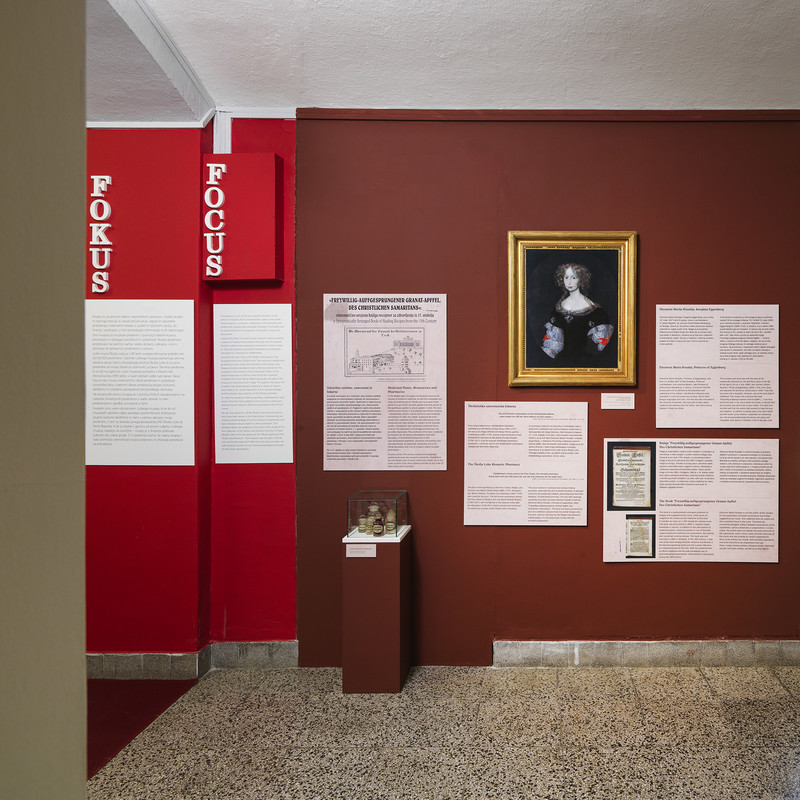
“Freywillig-auffgesprungener Granat-Apffel, Des Christlichen Samaritans”
A Systematically Arranged Book of Healing Recipes from the 17th Century
Medicinal Plants, Monasteries and Pharmacies
In the Middle Ages, European monasteries became the centres of traditional medicine, as well the knowledge and study of medicinal plants. Monks and nuns grew these plants in a part of the monastic garden that was known as the apothecary garden or physic garden. In fact, the main medical care practice in monasteries was herbal medicine – phytotherapy. At first, monks and nuns used medicinal concoctions for their own needs. Supplying the local people with medicines from monastic pharmacies is not mentioned until later periods. In addition to the monastic garden, monasteries also comprised a sickroom and a room for the preparation and storage of medicines, the so-called dispensary. The existence of the latter is attested by the plans for the famous Benedictine Saint Gall Monastery in Switzerland dating back to 820. Like monasteries elsewhere, Slovenian monasteries also had pharmacies; an especially noteworthy one is the Olimje Monastery with one of Europe’s oldest monastic pharmacies.
As early as the 17th century, trained and recognised apothecaries were also present in convents. One of them was the Škofja Loka Convent, which was initially run by the Order of Saint Clare (Poor Clares) and later by the Order of Saint Ursula (the Ursulines).
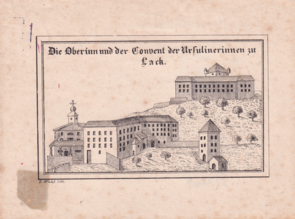
The Ursuline Convent (bottom) and the Škofja Loka Castle (top) prior to 1891
The Škofja Loka Monastic Pharmacy
“Established in times past by the Poor Clares, the monastic pharmacy, dating back well over 300 years old, was the only pharmacy for the wider area.”
(AUŠL, Chronik des Ursulinenkonventes in Bischoflack, 1891–1930, t. e. 2: 110)
The first known apothecary at the Poor Clares’ Škofja Loka Convent was Marija Cecilija Rasp (1660–1737). Alongside her, Maria Felizitas, Countess of Lichtenberg (1685–1749), also cared for the poor. The last known apothecary among the Poor Clares of Škofja Loka was Marija Rozalija Rauber (1756–1817), who transferred to the Ursuline order after the dissolution of the Poor Clares’ convent and continued her pharmacy practice under Škofja Loka’s Ursulines.
The nuns’ interest in medicine and various healing practices, especially the use of medicinal plants, is attested mainly by the preserved medical, pharmaceutical and other literature. Printed books from the 17th and 18th centuries owned by Carniolan monastic libraries include a work by Eleonora Maria Rosalia, Princess of Eggenberg, titled “Freywillig-auffgesprungener Granat-Apffel, Des christlichen Samaritans”. The book has been preserved as part of a collection of books from the former Škofja Loka Convent, which is now kept by the Škofja Loka Museum. Unfortunately, it is not known how it came into the convent’s possession.
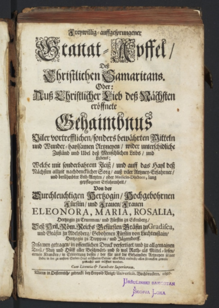
The Book “Freywillig-auffgesprungener Granat-Apffel [...]”
The book is a systematically arranged collection of recipes and suggestions for cures, which gives an insight into the traditional folk medicine of that time. It includes as many as 1,750 recipes for various cures. The book was first printed in 1695 in Leopold Voigt’s bookstore in Vienna. In addition to the descriptions of medicinal plants, medical practices in use at the time, magical treatment methods and superstition, the reprints also contained cooking recipes. The book was last reprinted in 1863 in Stuttgart. In the 18th century, it was one of the most widespread folk medicine handbooks in the German-speaking world and had a great influence on medical practice at the time. With the establishment of official medicine and the ever-increasing use of pharmaceutical preparations, it diminished in importance during the 19th century.
Eleonora Maria Rosalia is not the author of the recipes for the preparation of herbal concoctions and written suggestions for cures. She collected them for years and then published them in the book. The texts are somewhat abridged, without detailed explanations of the ingredients, active substances or preparations. In most cases, the author does not specify the exact amounts of the ingredients, and in many cases not even the parts of the plants that are suitable for certain preparations. Most of the entries are simple, with provided ingredients and brief instructions for preparation and use. Rarer, longer entries contain colloquial words, regionally specific and Latin names, as well as archaic terms.
Eleonora Maria Rosalia, Princess of Eggenberg
Eleonora Maria Rosalia, Princess of Eggenberg, was born on 18 May 1647 to Karl Eusebius, Prince of Liechtenstein, and Johanna Beatrix, née Princess of Dietrichstein-Nikolsburg, in Vienna. It is known that the prince paid a lot of attention to the education and upbringing of his children. His first-born Eleonora was educated in much the same way as boys, had to learn foreign languages and Latin, and she was also educated in the classical humanities. She was able to learn about medicine and alchemy from her father, who had a strong interest in these two fields.
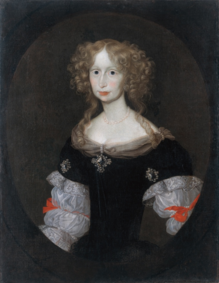
A portrait of Eleonora Maria Rosalia, Princess of Eggenberg. Photo by Bojan Salaj. Kept by the National Gallery of Slovenia, Ljubljana.
The princess had close ties with the area of the present-day Slovenia for the last thirty years of her life. At the age of 19 (on 4 July 1666), she married Johann Seyfried, Prince of Eggenberg (1669–1716), from Graz, who became the Governor of Carniola in 1692. They had two sons and a daughter, however, one of the sons died in childhood. The reason she authored the book “Freywillig-auffgesprungener Granat-Apffel [...]” can thus be found partly in her son’s death and partly in the fact that the princess was said to be in poor health. It is clear from the title itself that the author also wanted to help the poor and helpless. In addition to taking care of her own health and the health of her children, especially her remaining son, the princess was known for being very pious and charitable. She died on 3 October 1703 at the age of 56.
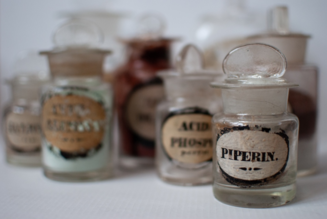
Apothecary powder jars from the Škofja Loka monastic pharmacy