A Majolica Jug from Bukovščica
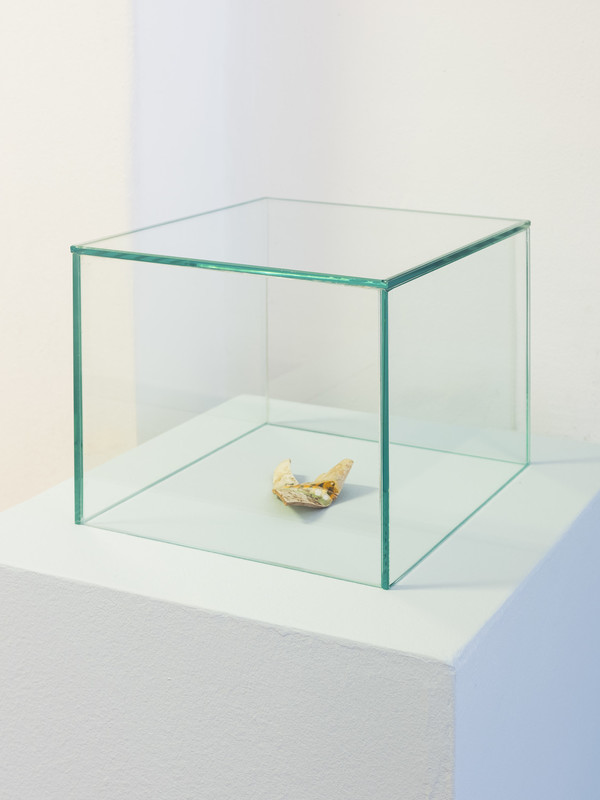
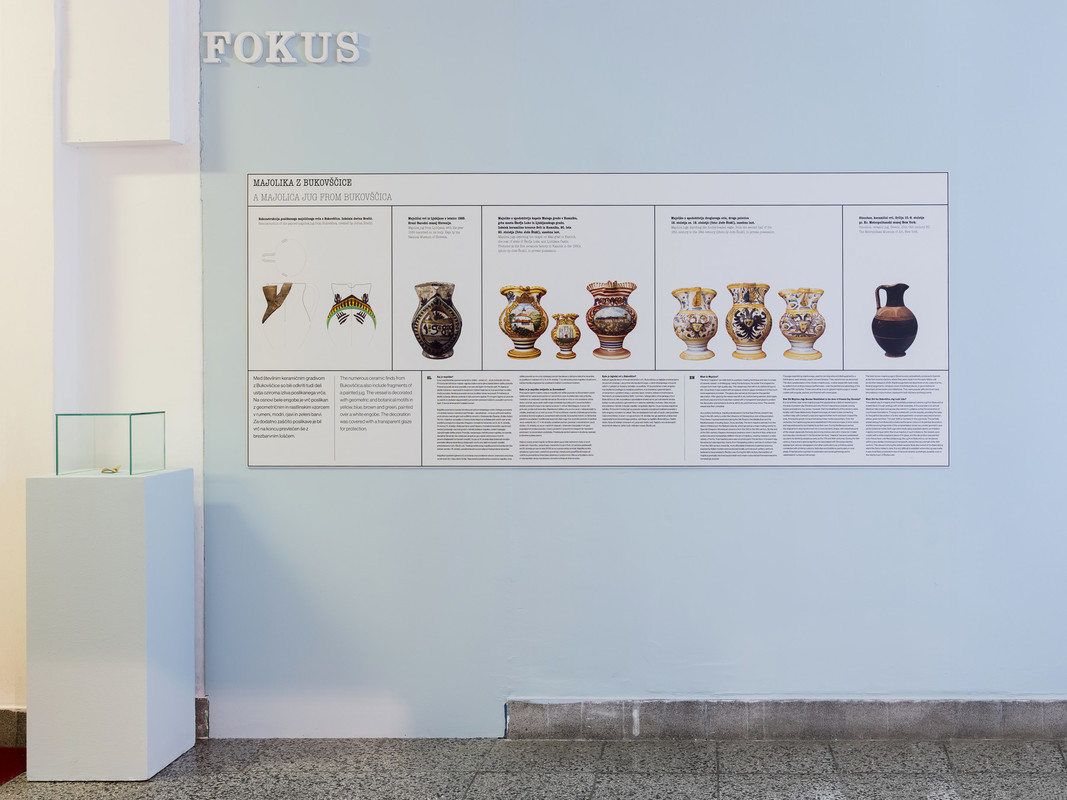
The numerous ceramic finds from Bukovščica include fragments of a painted jug. The vessel is decorated with geometric and botanical motifs in yellow, blue, brown and green, painted over a white engobe. The decoration was covered with a transparent glaze for protection.
What Is Majolica?
The term “majolica” can refer both to a pottery-making technique and also to a type of ceramic vessel—a drinking jug. Using this technique, the potter first shaped the chosen form from high-quality clay. The vessel was then left to dry before firing in a kiln. Once fired, it was coated with an opaque white tin glaze reminiscent of the much more expensive porcelain. The glaze also served as the base for the painted decoration. After glazing, the vessel was left to dry before being painted, dried again, and fired a second time. It was then coated with a transparent lead glaze to protect the decoration and enhance its shine, left to dry, and fired once more. The ceramic vessel was then complete.
As a pottery technique, majolica developed in Central Asia (Persia, present-day Iraq) in the 9th century under the influence of Chinese blue-and-white porcelain. From there, it spread westward along the Silk Road to the Middle East and the Mediterranean, including Spain, Sicily, and Italy. The term majolica derives from the island of Mallorca in the Balearic Islands, which served as a major trading centre for Spanish (Hispano-Moresque) ceramics from the 13th to the 15th century. By the end of the 15th century, Hispano-Moresque ceramics were in decline in Italy, while local potters became increasingly skilled in the art of majolica, creating vessels in a wide variety of forms. True majolica ware was not produced in the territory of present-day Slovenia but was imported, mainly from the leading pottery centres of northern Italy. From the 16th century onwards, more affordable imitations of painted ceramics inspired by Italian models were produced locally, and one such pottery centre is believed to have existed in Škofja Loka. During the 18th century, the tradition of majolica gradually declined as porcelain and cream-coloured earthenware became increasingly popular.
Clay jugs resembling majolica jugs, used for serving wine and distinguished by a trefoil spout, were already used in ancient Greece. They were known as oinochoai. The direct predecessor of the modern majolica jug—a wine vessel still made today by potters from ordinary bisque earthenware—was the painted and glazed jug of the 14th and 15th centuries. These were either true tin-glazed majolica jugs or vessels coated with engobe, painted, and finished with a lead glaze.
How Did Majolica Jugs Become Established in the Area of Present-Day Slovenia?
It is not entirely clear when majolica jugs first appeared as a distinct vessel type in the area of present-day Slovenia and why this form became so popular among buyers and patrons. It is certain, however, that the inhabitants of this territory were familiar with these distinctively shaped wine jugs, as trade routes connecting northern Italy with Central Europe and regions further north and east crossed the area. Among the goods transported along these routes was pottery. Over the centuries, the majolica jug became established in this area as a type of wine vessel and was embraced by its inhabitants as their own. During the Baroque period, the original form was transformed into a more dynamic shape, with individual parts of the vessel, especially the body, becoming more sculptural in character. A taller foot was also introduced. In the Slovenian territory, “majolica” became established as a term for drinking vessels as early as the 17th and 18th centuries. During the 19th century, it acquired a special significance associated with Slovenian identity, appearing in various newspapers and other publications as a drinking vessel connected with drinking customs, festivities and traditions, particularly in rural areas. It has become a symbol of celebration and social gatherings and is celebrated in numerous folk songs.
The best-known majolica jugs in Slovenia were undoubtedly produced in Kamnik, at the Svit ceramics factory, where they were made from the early 1950s until production ceased in 2008. Majolica jugs featured depictions of city coats of arms, floral arrangements, miniature views of individual places, or good wishes for important anniversaries and milestones. They were popular gifts and must-have decorations in many homes, displayed in both kitchens and living rooms.
What Did the Bukovščica Jug Look Like?
The easiest way to imagine what the partially preserved ceramic jug from Bukovščica looked like is through analogy with similar examples. A fine example of an almost identical, fully preserved jug was discovered in Ljubljana during the excavation of courthouse foundations. This jug is coated with a white engobe, providing the base for the painted decoration: a Gothic-style geometric ornament executed in brown, yellow, green and blue. The year 1585 is inscribed on the jug’s body. The partially preserved jug from Bukovščica features the same colours in its painted decoration, and the surviving fragments of the ornamentation reveal very similar geometric and partly botanical motifs. Both jugs were made using engobiato dipinto, an imitation majolica technique rather than true majolica. In such imitations, the vessels were coated with a white engobe in place of tin glaze, and the decoration was painted onto this surface. Like the Ljubljana jug, the jug from Bukovščica can be placed within a very similar chronological framework, namely the second half of the 16th century. This places it among the oldest ceramic finds discovered at the Bukovščica site in the Selca Valley to date. It is very difficult to establish where the jug was made. It was most likely produced in one of the local ceramic workshops, possibly even in the nearby town of Škofja Loka.