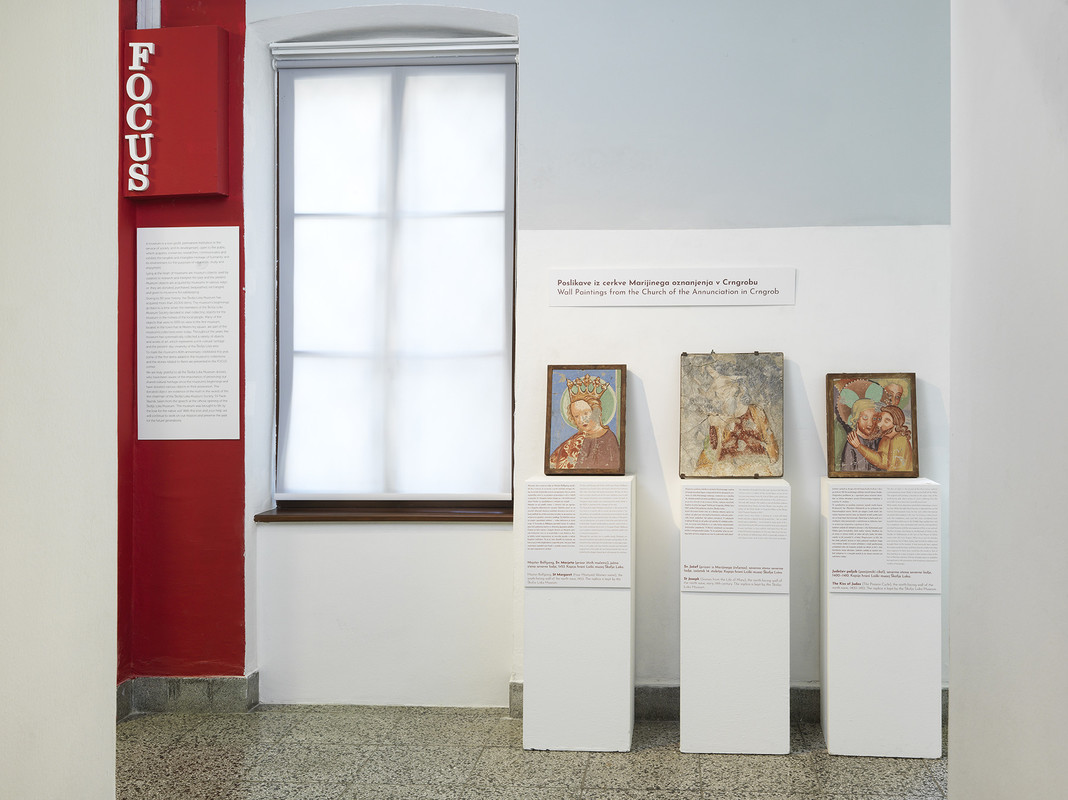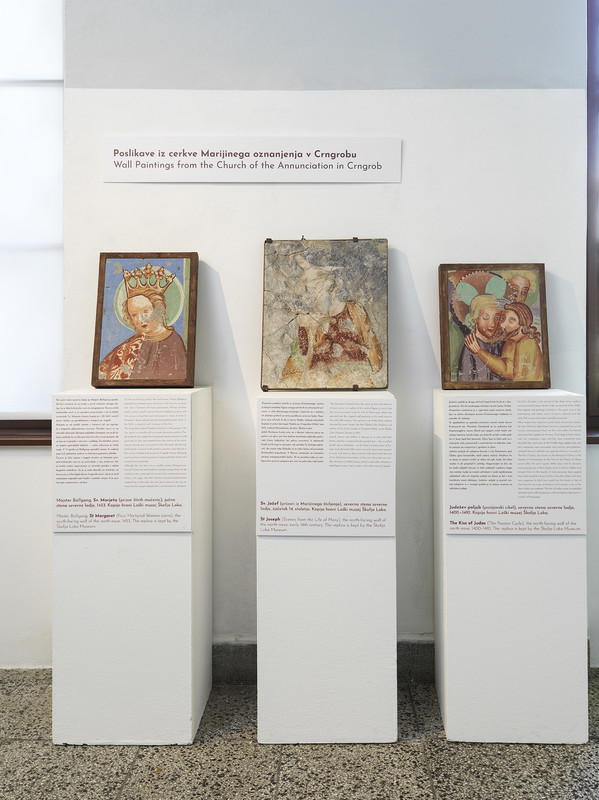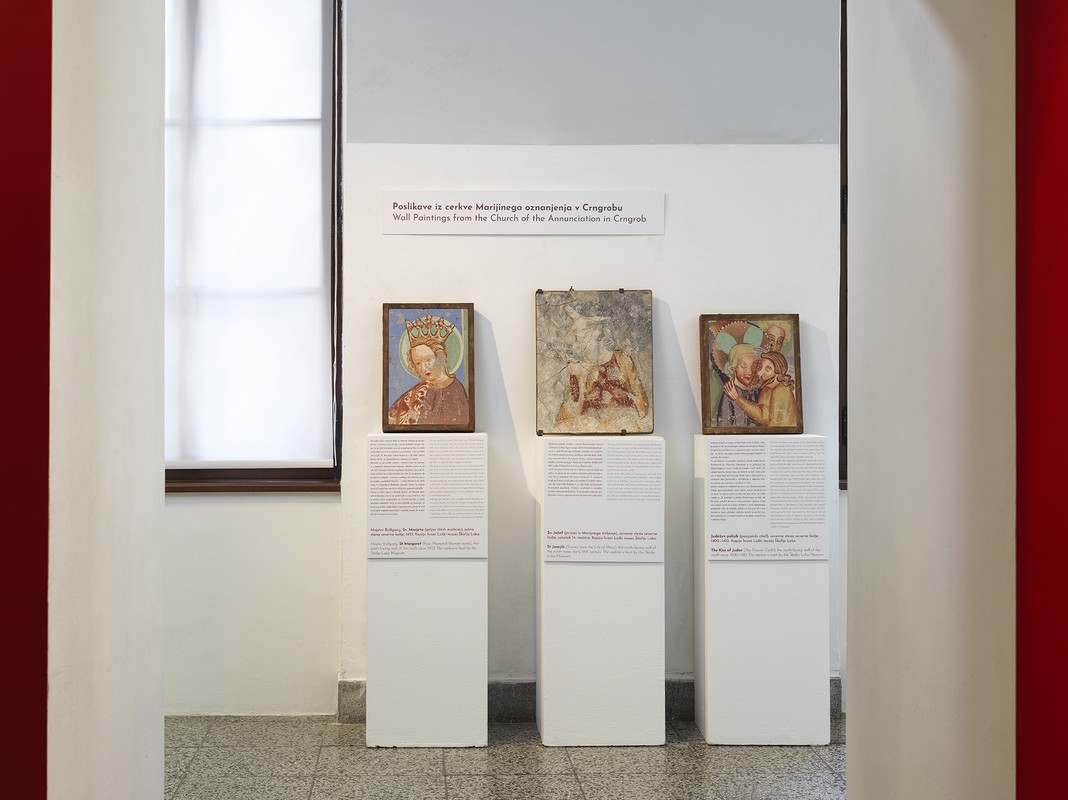
Wall Paintings from the Church of the Annunciation in Crngrob
St Joseph (Scenes from the Life of Mary), the north-facing wall of the north nave, early 14th century
The depiction of Joseph from the waist up from the Nativity of Jesus scene is a replica of the central figure of one four surviving scenes from the Life of Mary cycle, which was painted over the original wall painting in the north nave in the early 14th century. The replica is one of the three replicas donated by Janez Veider, the then Škofja Loka chaplain and author of the (first) Guide to Crngrob (1936), to the Škofja Loka Museum Society in 1937.
Joseph, Jesus's stepfather, is leaning on a stick with both hands and has a typical Jewish pointed hat – the so-called Jewish cap or Judenhut – on his head. In some parts of Europe, from the early 13th century onwards, Jews were required to wear such hats, so they could be told apart from the rest of the (Christian) population. In fine arts, these hats are usually attributes of biblical Jews, which is especially common in multi-figure scenes. Such a hat is also often worn by Joseph.
The Kiss of Judas (The Passion Cycle), the north-facing wall of the north nave, 1400-1410
The Kiss of Judas is the second of the three fresco replicas commissioned by Janez Veider in the second half of the 1930s. the original wall painting is located in the upper strip of the north-facing wall, where scenes of Jesus's suffering grom the early 15th century have been partially preserved.
What makes these depictions particularly interesting is Jesus's fair hair. While the light-faired Saviour is depicted here as Sol Invictus (Unconquered Sun), his fair curls reflect the beauty standards that applied at the time. According to these standards, fair complexion, eyes, and hair were considered more beautiful than dark ones. In the Middle Ages, golden hair and fair complexion were associated with sanctity and goodness, and dark features with the very opposite of this, i.e. sin and evil. The kiss of Judas, also known as he Betrayal of Christ, in the Grden of Gethsemane at the foot of the Mount of Olives comes after the Last Supper. While Jesus and his disciples were praying, one of them, Judas, went to look for soldiers and brought them to the teacher. It has previously been agreed that Judas would kiss Jesus and thus show the soldiers who they were supposed to bind. Jews would often kiss the hands or feet of their teacher as a sign of respect; in this context, a kiss on the face is thus less common. The kiss of Judas came to symbolise betrayal and is still synonymous with treacherous betrayal in a number of languages.
Master Bolfgang, St Margaret (Four Martyred Women scene), the south-facing wall of the north nave, 1453
On the south-facing wall of the north nave, Master Bolfgnag depicted four female saints who lived in the first few centuries AD, when Christians still faced persecution. All four of them died a martyr’s death and are the saints believers pray to their prayers of petition and intercession in the times of need. St Margaret, whose replica was commissioned by Janez Veider in the 1930s is depicted with a dragon at her feet.
The thing that makes Margaret stand out in the group of the four saints is a mantle with an ornate decorative pattern. Textile patterns are usually the most poorly preserved part of wall paintings, as they were painted when the surface of the painting was already dry, as a result of which the paint did not stick to the binder. To paint textile patterns, painters used stencils, in fact, each workshop had its own. In Crngrob, Master Bolfgang used a pattern containing pairs of wings, palmette motifs, and a stylised pomegranate.
Although she was born into a wealthy family, Margaret embraced Christianity and made her living by raising sheep. As she wanted to stay unmarried, she turned down a marriage proposal by a rich judge, who then had her tortured and beheaded. Legend has it that while she was being tortured, she was attacked by the dragon-shaped devil, who became her attribute.